In the sophisticated and high-stakes world of wholesale gold and jewelry distribution, inventory management is not merely about tracking stock; it is about managing an entire enterprise’s capital. For B2B jewelry distributors and manufacturing facilities, gold acts as both a primary raw material and a high-value financial asset. With the global gold market characterized by rapid price fluctuations, the B2B supply chain demands a level of precision, security, and velocity that legacy systems and manual spreadsheets simply cannot provide.
Effectively tracking large shipments and managing intricate distributor accounts requires a specialized Gold wholesale ERP capable of handling fractional weights, varying purities, and complex commission structures. In this comprehensive guide, we will explore why modernizing your supply chain infrastructure is the definitive step toward operational resilience, cost reduction, and sustained market dominance in the precious metals industry.
1. The Challenges of Managing B2B Gold Distribution
The wholesale jewelry market operates on principles far removed from standard retail. When dealing with bulk quantities, such as Ingots or massive shipments of finished jewelry, the operational risks are magnified. For a wholesaler, a minor oversight in inventory management isn’t just an administrative annoyance—it represents a direct erosion of working capital.
Operational Complexities in Wholesale
Managing a gold wholesale business involves navigating several high-pressure variables:
- Asset Sensitivity: Every Ounce of gold in a wholesale warehouse must be accounted for. Discrepancies in high-volume shipments can arise from scale inaccuracies, weighing errors, or administrative oversight, each resulting in immediate financial loss.
- Purity and Valuation: B2B transactions often involve materials of differing quality. Whether dealing in 18k, 22k, or 24k gold, the system must perform instantaneous, error-free Karat conversions. Manual calculations, even if done by experienced personnel, introduce the risk of significant valuation errors.
- Supplier and Distributor Trust: Wholesale success is built on long-term partnerships. When your Suppliers and distributor accounts rely on your system to verify weight, purity, and price, any error undermines the professional trust upon which your business model is founded.
- Supply Chain Velocity: Large-scale shipments must move through the supply chain rapidly. A wholesaler who cannot provide real-time updates on shipment status or provide accurate Gold accounting for these movements will quickly lose their competitive advantage.
To understand how modern enterprises are solving these issues through digitalization, review these digital transformation case studies.
2. The Power of Automated Gold Wholesale ERP
A dedicated Gold wholesale ERP is the central nervous system of a successful B2B jewelry operation. It moves the business from a reactive state—where stock is counted only after shortages are noticed—to a proactive, automated state where assets are managed with surgical precision.
Precision in Gold Accounting
At the heart of the system is a specialized Gold accounting engine. Unlike standard accounting packages, a gold-specific ERP understands that your inventory value changes based on the market price per gram. It allows you to maintain dual-tracking: keeping the count of pieces or batches while simultaneously tracking the exact weight in grams or ounces.
Seamless Distributor Account Management
Distributors are the lifeblood of a wholesale operation. An effective ERP system categorizes and tracks every distributor account with absolute clarity. It allows you to:
- Manage Credit Limits: Automatically restrict orders for distributors who have exceeded their agreed credit terms.
- Customized Pricing Tiers: Automatically apply negotiated price lists based on the volume, karat, or relationship tier of the distributor.
- Commission Structures: Automate the calculation of commissions for your sales representatives based on the weight or the labor (workmanship) component of the wholesale orders.
For businesses looking to integrate these wholesale operations with their general financial workflows, exploring comprehensive ERP solutions is the essential starting point for modernizing the enterprise.
Manual Ledger vs. Gold Wholesale ERP
| Operational Aspect | Manual Ledger / Spreadsheets | Gold Wholesale ERP System |
| Purity/Karat Tracking | Requires constant manual conversions and re-calculations. | Automated, instantaneous conversion and valuation for every Karat. |
| Distributor Balances | High risk of manual entry error in credit balances. | Real-time, automated tracking of distributor payments and credit limits. |
| Supply Chain Visibility | Fragmented; lacks real-time insight into shipment status. | End-to-end transparency from supplier receipt to distributor delivery. |
| Financial Reporting | Prone to human errors; difficult to consolidate. | Automated generation of financial reports, VAT logs, and profit analysis. |
3. Managing Large Shipments and Logistics with Confidence
In the wholesale trade, receiving or dispatching a large shipment is a high-pressure event. A shipment of Ingots or finished sets requires verified weighing at the point of origin and the point of receipt. A specialized ERP bridges this gap, creating an audit trail that is essentially bulletproof.
Procurement and Supplier Tracking
The ability to manage Suppliers is fundamental. Your ERP should allow you to register every supplier with their specific metal delivery history, quality testing reports, and average fulfillment time. When you receive a large shipment, the software should instantly update your inventory based on the exact weight recorded on the digital scale, ensuring that your books are always aligned with your physical vault.
Tracking Logistics and Transit
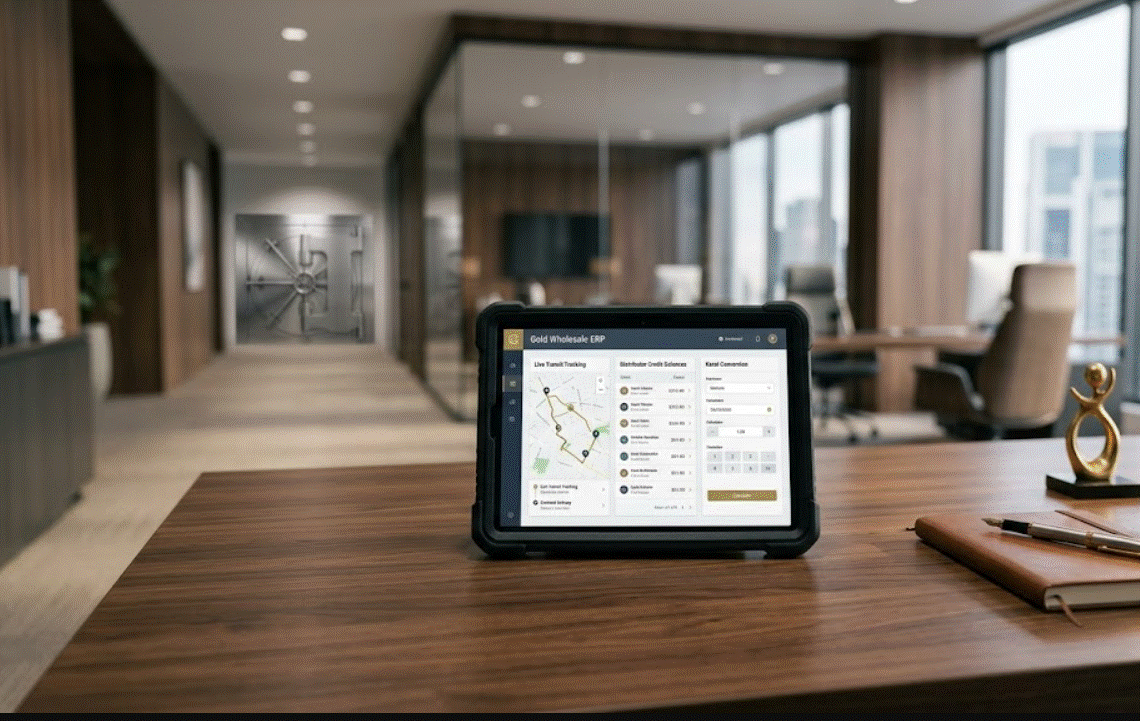
Large shipments often spend significant time in transit, whether through armored courier services or internal logistics routes. A smart ERP allows you to move stock into a “Transit” status. In this state, the gold is technically out of your current showroom inventory but still legally within your asset books. This prevents shortages and ensures that you always know exactly which batch is in transit, which is in the vault, and which is currently out with a distributor.
For more information on the technological foundations of such systems, refer to our comprehensive guide to gold management software.
4. The Value of Specialization in Wholesale Operations
When choosing your technological stack, specialization is the most critical constraint. Generic software is designed for standardized retail where items are singular and costs are stable. Wholesale gold distribution is a different beast entirely. It involves managing fractional weights, variable labor costs, and the absolute necessity of maintaining high-integrity financial records for tax purposes.
The Role of Automated Gold Workmanship Calculation
One of the most complex B2B wholesale tasks is the Gold workmanship calculation. In a professional wholesale trade, the price is not just weight × market price. It is weight × market price + workmanship fees. Managing this calculation manually for hundreds of different jewelry styles across thousands of items is impossible. Your ERP must be configured to automatically apply the appropriate workmanship cost per piece or per gram, ensuring that your distributors are billed correctly and that your margins are protected.
The Operational Workflow of Wholesale Gold Management
| Workflow Stage | Automation Process | Value for the Enterprise |
| Material Intake | Scanning and digital weighing from Suppliers. | Instant, accurate update of raw material inventory assets. |
| Manufacturing/Production | Automated recording of gold loss and labor (workmanship) added. | Exact determination of the true cost of finished inventory. |
| Distributor Dispatch | Digital batch assignment and transit tracking. | Eliminates losses during internal and external logistics. |
| Financial Settlement | Automated Gold accounting and invoicing. | Speeds up the cash conversion cycle and enhances business transparency. |
5. Security and Compliance in B2B Gold Wholesale
Security in a B2B gold wholesale environment is twofold: physical and digital. Digital security involves ensuring that only authorized personnel can access sensitive pricing, supplier contracts, or inventory valuation data. An ERP system enforces this through rigorous role-based access control (RBAC).
Compliance, on the other hand, involves reporting every transaction accurately to the tax and regulatory authorities. Because gold is a sensitive commodity, most jurisdictions require detailed logs of who you bought from, who you sold to, and the exact weight and purity involved. An integrated ERP automates this compliance, generating the necessary documents and tax logs that demonstrate you are following all legal requirements regarding gold trade oversight.
To keep your HR and administrative processes as efficient as your inventory management, you can learn more about managing staff attendance to ensure your warehouse and office operations are perfectly synchronized. Managing your workforce efficiently starts with adopting modern solutions like Best Self Service Applications For Attendance Management In Saudi Arabia.
6. Driving Wholesale Growth with the Right Technology
Ultimately, the goal of a Gold wholesale ERP is to provide the operational efficiency required to scale your business. When your warehouse staff, procurement officers, and account managers work from a single source of truth, you eliminate the friction that holds many growing enterprises back.
A centralized system allows you to:
- Optimize Working Capital: By understanding exactly how much gold is tied up in each distributor’s account, you can optimize your stock levels and reduce unnecessary holding costs.
- Improve Distributor Relationships: Providing your distributors with fast, accurate invoices and reliable inventory status reports builds loyalty that translates into repeat, high-volume orders.
- Future-Proof the Business: As the gold industry becomes more digitized, the wholesalers who have integrated their operations into a unified system will be the ones who define the future of the market. Wholesale gold traders managing multiple warehouses need an erp gold system that updates every price list simultaneously, not one location at a time. Contact Daysum to see multi-location pricing sync on your own product catalog.
Frequently Asked Questions (FAQs)
An professional gold ERP is integrated with live market data feeds. When a wholesale order is initiated, the system pulls the real-time Gram price from global exchanges. This ensures that the quote provided to your distributor is accurate at the exact moment of transaction, protecting your profit margins from market volatility that occurs between the time a quote is requested and the time the order is finalized.
Yes. A specialized ERP is designed to track inventory by individual item or by batch, with a specific Karat value assigned to every entry. When you ship a mixed load—say, a shipment containing both 18k and 21k jewelry—the system maintains separate sub-ledgers for each. It correctly calculates the total raw gold value for each purity level, applies the appropriate workmanship charges, and aggregates the shipment totals accurately, ensuring your accounting remains impeccable.
While a POS is designed for retail checkout, it lacks the depth required for wholesale management. A Gold wholesale ERP manages the entire lifecycle: supplier procurement, production costs, inventory transit, credit management for distributor accounts, and comprehensive financial reporting. A POS is simply a tool for selling to a consumer; an ERP is a system for managing a corporation.
During the wholesale manufacturing phase, a certain amount of "gold loss" is inevitable. An advanced ERP system includes a production tracking module where the input weight of the raw material and the output weight of the finished pieces are compared. The system automatically calculates the weight difference and records it as manufacturing overhead or operational loss, which is essential for accurate Gold accounting and tax reconciliation.