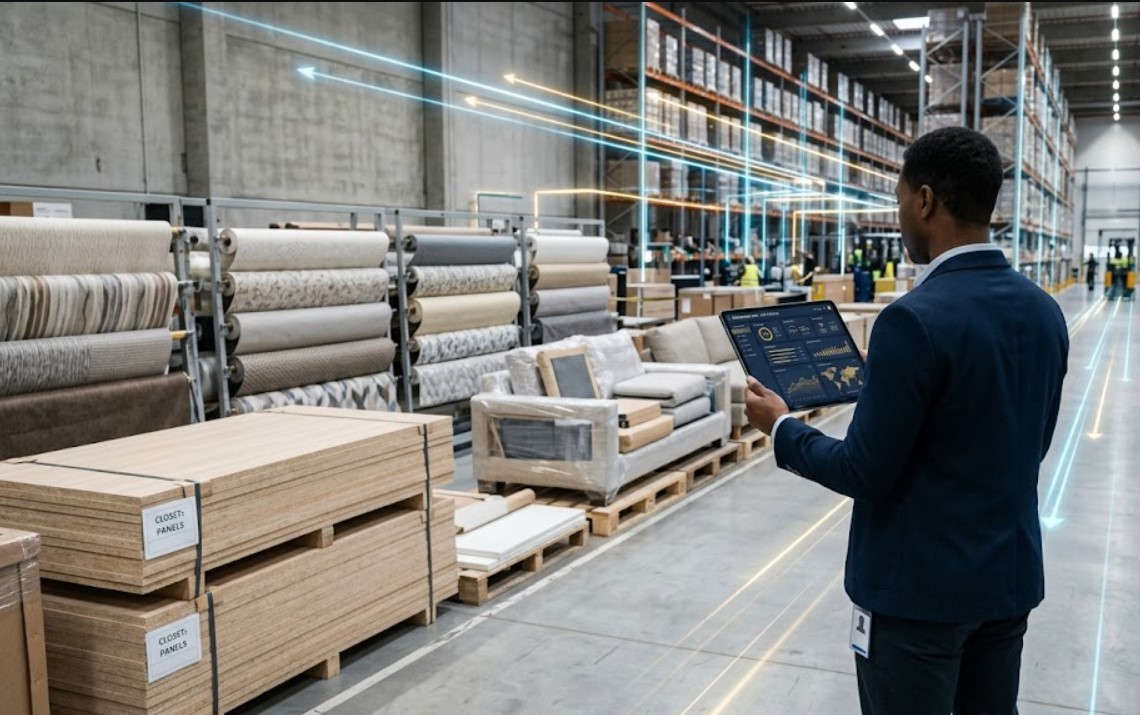
The furniture manufacturing sector in the Kingdom of Saudi Arabia is experiencing an unprecedented boom, driven by massive urban development, mega-projects, and a growing residential real estate market. To stay competitive in this fast-paced environment, furniture factories must operate with absolute precision. However, managing the production of highly customized items like sofas, curtains, and custom closets introduces a unique set of operational hurdles. The primary challenge lies not in the design or the sales process, but on the factory floor: maintaining absolute control over every piece of fabric, block of foam, and sheet of wood.
Efficient material tracking is the cornerstone of a profitable manufacturing operation. When materials are poorly managed, factories suffer from unexplained stock discrepancies, excessive scrap, delayed production timelines, and ultimately, shrinking profit margins. This comprehensive guide explores advanced strategies and methodologies for tracking furniture materials accurately, from the moment they arrive at the receiving dock to their final assembly, ensuring maximum yield and complete operational transparency.
The Complexities of Managing Diverse Furniture Materials
Unlike standard assembly lines that produce identical widgets, a furniture factory deals with a highly variable and complex inventory. Each product category demands a completely different approach to measurement, storage, and handling.
- Sofas and Upholstery: Manufacturing a single sofa requires managing dimensional lumber for the frame, various densities of polyurethane foam, springs, webbing, and specialized upholstery fabrics. These materials are measured in different units—meters, kilograms, and individual pieces.
- Curtains and Drapery: Curtain production is heavily reliant on textiles. Raw materials such as sheer fabrics, blackout linings, eyelets, hooks, and motorized tracks must be tracked meticulously. A slight miscalculation in fabric shrinkage or pattern repetition can ruin an entire batch.
- Custom Closets and Wardrobes: Closet manufacturing involves rigid materials like MDF (Medium-Density Fiberboard), plywood, melamine panels, edge banding, and hundreds of small hardware components such as concealed hinges, drawer slides, and handles.
Tracking these diverse items requires moving away from manual spreadsheets and adopting a unified digital approach. Implementing a specialized furniture ERP system allows production managers to create a single source of truth, standardizing how every component is coded, measured, and issued to the production floor.
Pillar 1: Precision Fabric Tracking for Sofas and Curtains
Textiles are among the most difficult materials to track in any manufacturing environment. Unlike a solid piece of hardware, fabric is dynamic. It is subject to stretching, variable widths, and most importantly, dye lot variations.
Fabric tracking must begin the moment a roll enters the warehouse. Each roll should be assigned a unique barcode that records its specific dye lot number, exact width, initial length, and supplier details. If a customer orders a large sectional sofa or curtains for multiple rooms, the factory must ensure that all fabric is pulled from the exact same dye lot to prevent mismatched shading.
Furthermore, tracking linear meters is not enough; the system must account for pattern matching. When cutting patterned fabrics for a sofa, more material is required to ensure the patterns align perfectly across the seams. An advanced tracking system calculates this specific material usage, ensuring that the exact required yardage is deducted from the inventory ledger.
Material Tracking Metrics by Furniture Category
| Product Category | Primary Raw Materials | Key Tracking Metrics | Common Tracking Challenges |
| Sofas & Seating | Foam, hardwood frames, upholstery fabric, springs, staples. | Linear meters (fabric), board feet (wood), weight/density (foam). | Managing dye lots for fabric; tracking irregular foam offcuts. |
| Curtains & Blinds | Textiles, sheer fabrics, blackout lining, grommets, rails. | Linear meters, piece counts (hardware). | Accounting for pattern repeats and fabric shrinkage margins. |
| Closets & Cabinets | MDF/Plywood panels, edge banding, hinges, drawer runners. | Square meters (panels), linear meters (banding), piece counts. | Managing panel offcuts and preventing small hardware shrinkage. |
Pillar 2: Perfecting the Stock Issue Workflow
One of the most critical points of failure in factory inventory control occurs during the transfer of materials from the warehouse to the production floor. If workers grab materials without proper documentation, the inventory system instantly becomes inaccurate, leading to stockouts and halted production.
To maintain perfect accuracy, factories must implement a strict stock issue protocol driven by digital Bills of Materials (BOM). When a production order is generated for a custom closet, the system should automatically generate a precise picking list.
Here is how an optimized stock issue workflow operates:
- Work Order Generation: The production manager approves a manufacturing order.
- BOM Explosion: The system breaks the order down into exact required components (e.g., 4 sheets of white melamine, 20 meters of PVC edge banding, 12 soft-close hinges).
- Digital Requisition: The warehouse team receives a digital picking ticket on their mobile scanners.
- Barcode Verification: Warehouse staff scan the barcodes of the selected materials. The system validates that the correct items and quantities are being picked.
- Inventory Deduction: Once confirmed, the items are officially transferred from “Available Warehouse Stock” to “Work in Progress (WIP)”, maintaining absolute traceability.
By digitizing this workflow through robust odoo supply chain management modules, factories eliminate human error, prevent unauthorized material usage, and ensure that every gram of material is financially accounted for against a specific customer order.
Pillar 3: Wood and Hardware Tracking for Custom Closets
Producing custom closets and modular storage requires a highly structured approach to material handling. The core of this process is panel processing. When standard 8×4 MDF sheets are cut to create wardrobe doors and shelves, the tracking system must seamlessly communicate with the factory’s CNC (Computer Numerical Control) machines.
Nesting software is typically used to optimize how individual closet components are mapped onto a raw sheet of wood to minimize waste. However, from an inventory perspective, the ERP must track the transformation of that raw sheet into individual, serialized components. As soon as the sheet is cut, the “parent” raw material is consumed, and “child” WIP components are generated, each needing its own barcode label for tracking through the edge-banding and drilling stations.
Hardware tracking is equally vital. Hinges, screws, and handles are notorious for “disappearing” on the factory floor due to their small size. These items should be managed through strict bin locations and automated reorder points. Utilizing comprehensive furniture factory management software allows floor supervisors to monitor real-time hardware consumption rates, immediately flagging anomalies if a specific workstation is using more screws or glue than the BOM specifies.
Pillar 4: Waste Control and Yield Optimization
In furniture manufacturing, profitability is often determined by what you throw away. Waste control is an essential metric that must be tracked daily. Waste occurs in several forms: fabric remnants after cutting sofa patterns, sawdust and offcuts from panel processing, and foam scrap.
A sophisticated material tracking system doesn’t just record what goes into the final product; it records what is left behind. By tracking expected scrap versus actual scrap, management can identify inefficiencies.
- Usable Offcuts: If a large panel is cut and a significant piece remains, a smart tracking system will automatically log that offcut back into inventory as a new, dimensionally specific piece of raw material, complete with a new barcode. This ensures it can be utilized for a future, smaller order, such as a bedside table drawer, rather than being discarded.
- Scrap Analysis: If a specific fabric consistently yields 15% waste when the industry standard is 10%, management can investigate whether the issue lies with the fabric supplier (flawed rolls), the nesting algorithm, or the cutting machine operator.
Key Performance Indicators (KPIs) for Waste Control
| KPI Name | Description | Target Benchmark | Corrective Action for Underperformance |
| Material Yield Variance | The difference between planned material usage (BOM) and actual usage. | < 2% Variance | Recalibrate cutting machines; retrain operators on nesting optimization. |
| Scrap Rate | The percentage of total raw material that ends up in the waste bin. | 5% – 8% (Material dependent) | Review supplier quality (e.g., fabric flaws requiring recuts); optimize BOMs. |
| Offcut Recovery Rate | The percentage of offcuts successfully returned to inventory and reused. | > 75% | Implement stricter barcode tagging for offcuts; mandate offcut usage in ERP before pulling new sheets. |
| Inventory Shrinkage | Unexplained loss of inventory due to theft, damage, or misplacement. | < 1% | Enforce stricter stock issue protocols; conduct frequent cycle counts. |
Pillar 5: Bridging the Gap Between Factory and Showroom
The ultimate goal of tracking furniture materials is to deliver a flawless final product to the consumer while maintaining healthy profit margins. The tracking process does not end when the sofa is wrapped in plastic or the closet is flat-packed. The finished goods must seamlessly transition from factory inventory to retail stock.
When a product is completed, the system finalizes the manufacturing order, consuming all WIP materials and generating a new finished good SKU. This immediate synchronization is crucial for retail operations. If a customer is waiting for a bespoke curtain order, the retail sales team must have real-time visibility into the factory’s progress.
By integrating factory operations with furniture store management solutions, the entire lifecycle of the material—from a raw fabric roll arriving at the dock, to its cutting, stitching, and final delivery to a home in Riyadh or Jeddah—is fully transparent. This end-to-end traceability ensures accurate financial valuations, streamlined logistics, and a significantly elevated customer experience.
The Future of Furniture Manufacturing
As the Saudi market continues to expand, furniture factories can no longer rely on guesswork and manual estimations to manage their operations. The complexities of handling diverse items like plush sofa fabrics, delicate curtain textiles, and rigid closet panels demand a highly automated, data-driven approach.
By prioritizing precise material tracking, enforcing strict stock issuance protocols, and leveraging technology to control waste, manufacturers can drastically reduce their overhead costs. Ultimately, gaining absolute control over your raw materials is the most direct path to scaling your production capacity, ensuring product quality, and securing long-term profitability in a highly competitive industry.
Frequently Asked Questions (FAQs)
Material tracking directly impacts profitability by preventing inventory shrinkage, optimizing the usage of expensive raw materials, and drastically reducing waste. When a factory tracks exact usage against the Bill of Materials (BOM), it eliminates blind spots, prevents over-ordering, and ensures that the final product's pricing accurately reflects the true cost of materials consumed.
Textiles and upholstery fabrics are traditionally the most challenging due to variable roll lengths, pattern repeats, and dye lot discrepancies. The best way to manage them is through advanced barcode tracking that records specific dye lots upon receiving, coupled with nesting software that calculates exact linear meter requirements based on pattern alignments, ensuring accurate inventory deduction during the stock issue phase.
Usable offcuts should never be treated as immediate waste. A modern ERP system allows workers to scan and log large offcuts back into the warehouse inventory as new, dimensionally specific items. When a future work order requires a small piece of that material, the system will direct the worker to pick the offcut before authorizing the cutting of a brand-new raw sheet, maximizing overall yield.
Custom closet manufacturing relies on highly complex, individualized Bills of Materials containing hundreds of micro-components (panels, edge bands, cams, dowels, hinges). Spreadsheets cannot update in real-time, cannot integrate directly with CNC machine nesting data, and cannot prevent unauthorized stock issuance. An automated ERP ensures real-time synchronization between the design software, the cutting machines, and the financial inventory ledger.