Navigating the corporate landscape in the Kingdom of Saudi Arabia requires far more than just a solid business model; it demands absolute regulatory precision. As the Kingdom accelerates toward the ambitious milestones of Vision 2030, the Ministry of Human Resources and Social Development (MHRSD) has fundamentally transformed the way businesses operate. Digital transformation is no longer a luxury—it is a mandatory framework designed to protect employee rights, enforce nationalization quotas, and ensure economic transparency.
For companies operating in Riyadh, Jeddah, Dammam, and beyond, remaining compliant with the Saudi Labor Law is a high-stakes endeavor. Relying on outdated manual processes, scattered spreadsheets, and fragmented communication channels exposes organizations to severe operational and financial risks. The modern solution lies in deploying sophisticated Human Resources Management Systems (HRMS) that integrate directly with government portals. This comprehensive guide explores the core requirements of Saudi labor laws, dissects the hidden costs of manual management, evaluates the top HRMS providers in the market, and outlines a strategic roadmap for leveraging platforms like Daysum to achieve flawless, automated compliance.
1. Core Saudi Labor Law Requirements Every Business Must Master
To understand the value of an automated HR system, one must first grasp the depth and complexity of the regulations it is designed to manage. The Saudi Labor Law is a comprehensive legal framework that dictates every phase of the employment lifecycle, from the initial contract signing to the final end-of-service settlement.
Fundamental Employee Rights: Wages and Working Hours
The foundation of the Saudi Labor Law rests on fair compensation and structured working conditions. The standard working hours are strictly capped at 8 hours per day or 48 hours per week. During the holy month of Ramadan, these hours are legally reduced for Muslim employees to a maximum of 6 hours a day or 36 hours a week.
Any time worked beyond these parameters must be classified as overtime. Employers are legally obligated to compensate overtime at 150% of the employee’s basic hourly wage. Failing to track these hours accurately or denying employees their rightful overtime pay is a direct violation of the law, frequently resulting in labor disputes and heavy fines.
Leaves, Vacations, and the End-of-Service Gratuity (EOSG)
The law provides a highly specific safety net for employees regarding time off.
- Annual Leave: Workers are entitled to a minimum of 21 days of paid annual leave, which legally increases to 30 days after the employee completes five consecutive years of service with the same employer.
- Sick and Maternity Leave: The law outlines a cascading pay scale for sick leave (full pay for the first 30 days, 75% for the next 60 days, and unpaid for the subsequent 30 days within a single year). Female employees are granted ten weeks of fully paid maternity leave.
- End-of-Service Gratuity (EOSG): Perhaps the most mathematically complex requirement is the EOSG. This mandatory severance package is calculated based on the employee’s final salary, their total years of service, and the specific reason for contract termination (resignation versus employer-initiated termination). Calculating this manually is a massive liability.
Documented Contracts and the Nitaqat (Saudization) Quotas
In the digital age, verbal agreements hold zero legal weight. All employment contracts must be formally documented and authenticated through the government’s Qiwa platform. Furthermore, companies must rigorously adhere to the Nitaqat program, a localization initiative that categorizes businesses into color-coded tiers (Platinum, Green, Yellow, Red) based on their ratio of Saudi national employees to expatriates. Maintaining a compliant Nitaqat tier is essential for business continuity, as falling into the Red tier immediately freezes the company’s ability to renew work permits or apply for new visas.
The Severe Risks of Non-Compliance
The MHRSD operates with a zero-tolerance policy for systemic labor violations. Non-compliance is met with immediate, punitive action. Fines often start at SAR 10,000 for a single violation (such as failing to upload a wage protection file correctly) and multiply per affected employee. Beyond financial penalties, chronic violations lead to the suspension of the company’s GOSI (General Organization for Social Insurance) account and MHRSD portal access, effectively halting all business operations and causing irreversible reputational damage.
2. The Hidden Costs: Manual Compliance Challenges
Despite the strict regulatory environment, some organizations still attempt to manage their human capital using legacy software and manual data entry. This approach is fraught with operational bottlenecks and legal landmines.
|
Compliance Challenge |
Root Cause in Manual Systems |
Main Business Impact |
|
Tracking Labor Law Updates |
Relying on HR staff to manually research and apply MHRSD decrees. |
Unintentional, systemic violations leading to unexpected government fines. |
|
Documentation Management |
Storing physical contracts, passport copies, and medical leaves in filing cabinets. |
Time-intensive retrieval, high risk of lost data, and severe human errors during audits. |
|
Payroll and Saudization |
Calculating deductions, overtime, and Nitaqat ratios via Excel spreadsheets. |
Failed Wage Protection System (WPS) files, GOSI audit failures, and localization penalties. |
|
Operational Disruption |
Disconnected departments (HR, Finance, Operations) working in silos. |
Catastrophic business interruptions, delayed project deliveries, and suspended government services. |
The Domino Effect of Human Error
When an HR administrator manually inputs attendance data into a payroll spreadsheet, the margin for error is astronomical. A single mistyped digit can result in an incorrect GOSI deduction. When that flawed data is submitted to the Mudad platform for WPS verification, the file is rejected. This rejection triggers an automatic flag within the MHRSD system, exposing the company to an immediate compliance audit. This is why transitioning to a reliable cloud attendance system is the first critical step in eliminating the domino effect of manual mistakes.
3. How HRMS Enables Complete and Automated Compliance
Human Resources Management Systems are no longer optional administrative tools; they are essential legal safeguards. A modern HRMS acts as a digital bridge between a company’s internal operations and the Saudi government’s regulatory portals, ensuring that compliance is proactive rather than reactive.
Automatic Law Updates and Digital Contract Management
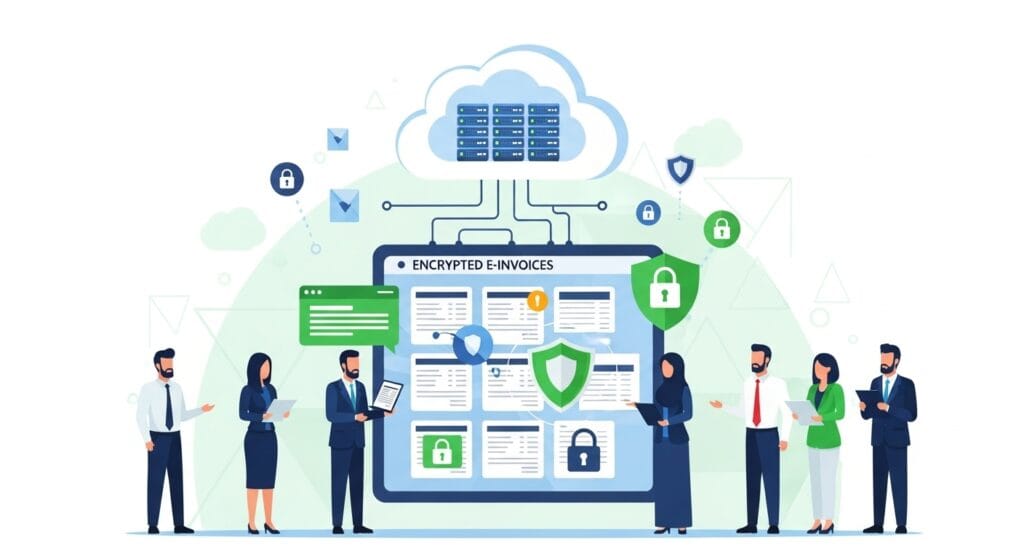
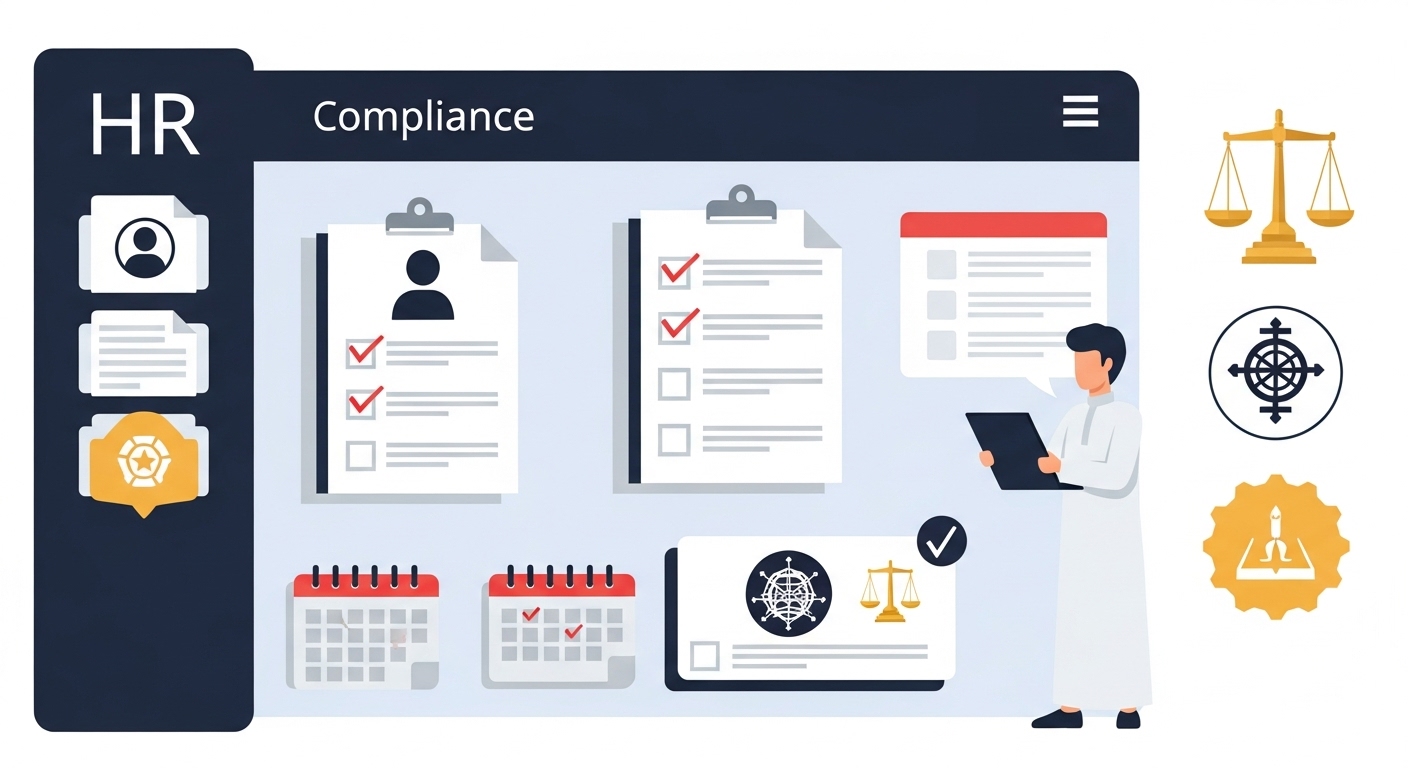
Top-tier HR platforms are continuously updated by their developers to reflect the latest MHRSD regulations. If the government changes the EOSG calculation rules or amends the minimum wage requirements for Saudization, the system’s underlying algorithms are updated instantly. Furthermore, an HRMS centralizes all documentation in a secure, encrypted cloud vault. Contracts, visa expirations, and warning letters are digitally managed, with automated alerts notifying HR weeks before any critical document expires.
Real-Time Saudization Tracking and WPS/GOSI Compliance
Managing the Nitaqat program requires constant vigilance. An advanced HRMS features dynamic Saudization dashboards that calculate the company’s exact localization ratio in real-time. If an HR manager attempts to initiate the termination of a Saudi employee, the system will actively simulate how that departure will impact the company’s Nitaqat tier, allowing leadership to make informed, data-driven decisions.
Simultaneously, the system completely automates the payroll pipeline. It processes attendance data, calculates overtime, factors in exact GOSI deductions, and generates a flawless Wage Protection System (WPS) file that is ready for immediate upload to the corporate bank and Mudad platform.
Ready Audit Reports and Multi-Branch Support
When MHRSD inspectors conduct an audit, they demand immediate, organized proof of compliance. An integrated HRMS generates comprehensive, timestamped audit reports with a single click. For enterprises operating across multiple cities, cloud-based systems ensure that attendance and payroll policies are enforced uniformly across all branches, eliminating discrepancies between headquarters and regional offices. This level of synchronization is easily achievable when utilizing comprehensive hrms cloud solutions designed specifically for the Saudi market.
4. Leading Competitors in the Saudi HRMS Market
The demand for localized compliance technology has fostered a highly competitive software market. By the rankings of 2026, several platforms stand out for their robust government integrations and unwavering focus on Saudi labor laws.
|
System Provider |
Key Compliance Features & Strengths |
Critical Government Integrations |
|
ZenHR |
Guaranteed 100% compliance with Saudi labor laws. Features an exceptionally accurate, auto-updating EOSG calculator and flawless automated WPS file formatting. |
Deep, native integrations with GOSI, the Muqeem portal, and the Qiwa platform. |
|
Bayzat |
Champions user experience and mobile accessibility. Offers automated gross-to-net payroll processing and highly visual, real-time Saudization tracking dashboards. |
Direct API links with major Saudi banks and automated pipelines for WPS compliance. |
|
Jisr |
An enterprise-grade solution offering end-to-end management from hiring to retirement. Generates legally binding digital proofs of work and complex structural reports. |
Seamless data synchronization with Qiwa, GOSI, and MHRSD databases. |
|
IdaraTech |
Focuses on creating a unified corporate platform. Highly effective at linking employee attendance records directly to financial and operational outputs. |
Robust, direct links to GOSI, Muqeem, and advanced identity verification on Qiwa. |
While standalone HR applications provide tremendous value, organizations looking to scale aggressively often require a broader technological ecosystem. By pursuing a customized odoo implementation saudi arabia, companies can unify their HRMS with their accounting, inventory, and sales modules, ensuring that employee compliance directly translates into transparent financial reporting.
5. Strategic Implementation Steps for Total Compliance
Purchasing an HRMS is only the beginning of the journey. To truly fortify your business against labor disputes and fines, the deployment must be executed methodically.
Step 1: Assess Internal Needs Versus Competitor Benchmarks
Begin by conducting a rigorous internal audit. Where are your current compliance blind spots? Are you struggling with accurate overtime pay, or is your Nitaqat tier constantly fluctuating? Compare your specific pain points against the benchmarks set by industry leaders like ZenHR and Daysum. Understanding your precise needs ensures you do not overpay for unnecessary features while securing the exact tools required to protect your business.
Step 2: Select a Nitaqat-Compliant HRMS
Do not compromise on localization. Ensure the platform you select is natively built for the Saudi market. It must handle the Hijri calendar, support flawless Arabic interfaces, and feature algorithms explicitly programmed according to the MHRSD rulebook. A generic, international HR tool will not protect you during a GOSI audit.
Step 3: Train the HR Team and Customize Workflows
A software system is only as effective as the people operating it. Invest in comprehensive training for your HR department. Customize the system’s workflows to match your company’s internal policies—setting exact grace periods for lateness, defining specific shift allowances, and programming automated approval hierarchies for leaves and financial disbursements. Ensure that the HRMS connects seamlessly with your financial software so that payroll generation automatically supports your electronic invoice ksa and general ledger requirements.
Step 4: Monitor Proactively via Automated Reports
Once the system is live, transition your HR team from data entry clerks to strategic analysts. Set up automated weekly reports that flag compliance risks before they materialize. Monitor warnings for employees approaching their maximum legal overtime limits, review automated Nitaqat forecasts, and track expiring Iqamas to ensure your company remains perpetually in the green.
6. Market-Proven Benefits of Digital HR Transformation
The transition to an automated, compliance-focused HRMS yields returns that fundamentally alter the trajectory of a business.
- Massive Time Savings and Error Eradication: Market data consistently shows that companies adopting automated HR systems experience an 80% reduction in time spent processing payroll. Furthermore, the elimination of manual data entry results in a 99% reduction in payroll and compliance errors, guaranteeing that employees receive exactly what they have earned.
- Absolute Fine Avoidance: By preventing WPS file rejections, unauthorized overtime, and missed visa renewals, the software acts as an impenetrable shield against MHRSD penalties. The cost of the software is frequently offset entirely by avoiding a single SAR 10,000 regulatory fine.
- Empowering Vision 2030 Growth: As the Saudi economy expands, agility and transparency are the ultimate competitive advantages. A digitally compliant business is inherently scalable. Whether you are opening a new branch in Neom or hiring hundreds of new engineers in Riyadh, a robust HRMS handles the growing regulatory burden effortlessly, allowing your leadership to focus purely on innovation, expansion, and contributing to the Kingdom’s visionary future.
Frequently Asked Questions (FAQs)
If the salaries transferred to employees' bank accounts do not exactly match the contractual wages and attendance data reported in the WPS file, the Mudad platform will flag the submission as non-compliant. The MHRSD will issue a formal warning, requiring immediate justification. Failure to resolve the discrepancy quickly results in heavy financial fines and the temporary suspension of MHRSD services, preventing the issuance or renewal of work permits.
While an HRMS cannot force you to hire Saudi nationals, it guarantees 100% visibility and accuracy regarding your compliance. Advanced systems calculate your exact Saudization ratio in real-time and provide predictive alerts. If an upcoming termination or new expatriate hire threatens to drop your company into the Yellow or Red tier, the system will alert management immediately, allowing you to take corrective action before the government officially downgrades your status.
Yes. In fact, digital records are heavily preferred by labor courts over easily manipulated paper documents. Provided the HRMS utilizes secure, timestamped audit trails (and tracks attendance via verifiable methods like biometrics or GPS), the digital logs of leaves, warnings, and working hours serve as irrefutable legal evidence, protecting the employer against false claims of wrongful termination or unpaid wages.
When an HRMS operates in isolation, the finance team must manually import payroll data to update the general ledger—a process highly susceptible to error. Integrating HR with a comprehensive ERP system (like Odoo) ensures that every approved leave, overtime hour, and EOSG accrual is automatically and instantly reflected in the company’s financial statements. This guarantees absolute financial transparency, speeds up month-end closing procedures, and ensures perfect alignment during external financial audits.