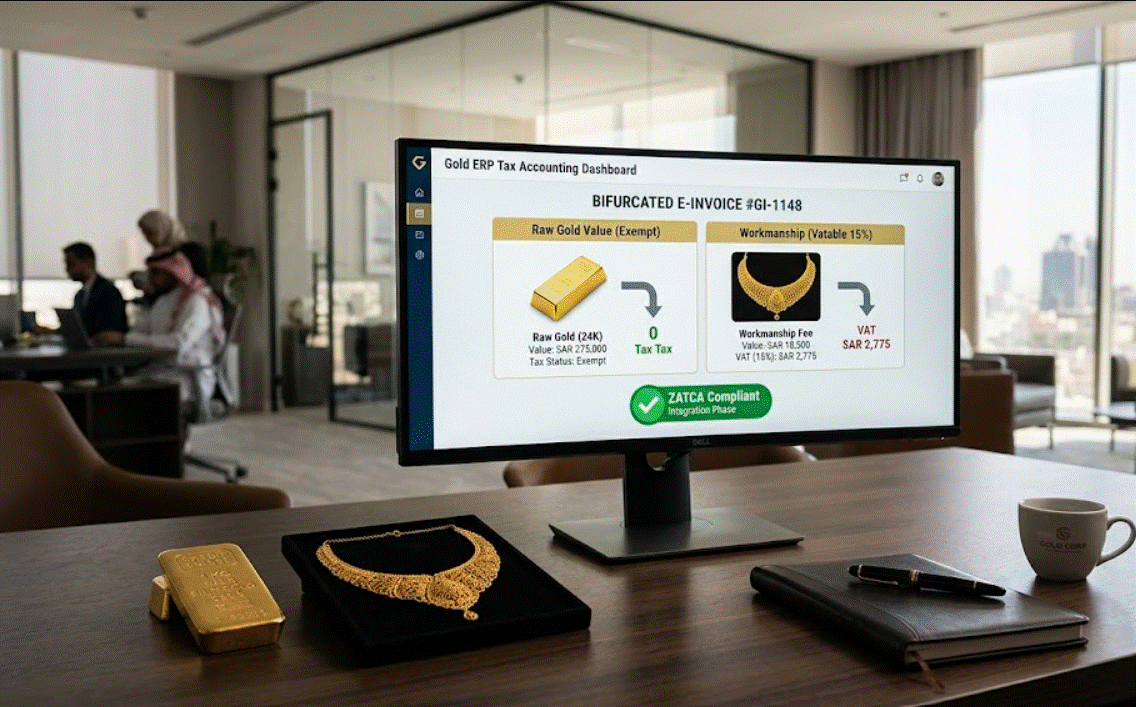
In the high-stakes, regulated environment of the B2B wholesale gold and jewelry sector, financial precision is not merely a best practice; it is a fundamental requirement for corporate survival. For Chief Financial Officers (CFOs) and financial controllers, the accounting mechanics of gold distribution are notoriously complex. The industry operates under a unique tax logic where the raw material—gold bullion or scraps—is treated as a financial asset or commodity, often exempt from or zero-rated for Value Added Tax (VAT), while the service component—the workmanship or “making charges”—is a taxable service.
Managing this distinction manually across thousands of transactions is a recipe for catastrophic financial errors. A single miscalculation can trigger severe penalties during a governmental Tax audit, leading to reputational damage and erosion of profit margins. The definitive solution for professional accounting in this sector is the implementation of a specialized ERP that utilizes advanced “Localization” layers to automate tax logic. By integrating a sophisticated Gold management software that handles the separation of tax-exempt assets from taxable services, enterprises can ensure absolute E-invoicing compliance and streamlined financial operations. This article explores how modern accounting systems achieve this precision and why it is the gold standard for financial integrity in the B2B jewelry trade.
The Accounting Identity: Defining the Tax Base for Gold
In professional Jewelry accounting, the most critical accounting identity is the clear bifurcation between the asset and the service. If your accounting system treats a gold purchase invoice as a monolithic sum, you are inevitably overpaying or underpaying your VAT obligations, both of which are equally dangerous.
The Anatomy of a Compliant Gold Invoice
To be compliant with modern tax authorities—such as the Zakat, Tax and Customs Authority (ZATCA) in Saudi Arabia or relevant bodies in the broader Middle East—a B2B gold transaction must be decomposed into its constituent parts:
- The Raw Material Value: This represents the weight of the gold in Gram multiplied by the live market price at the moment of the transaction. In many B2B wholesale contexts, this portion of the invoice is legally distinct from the manufacturing service.
- The Workmanship (Making Charges): This is the value-added service provided by the manufacturer or wholesaler. It represents the labor, design, and manufacturing overhead.
The accounting engine must be configured to recognize the raw gold component as a non-taxable (or zero-rated) entity and the workmanship as a taxable service. Doing this manually for every batch of inventory is prone to error. An automated system uses the “Accounting Identity” of each product to automatically split the transaction. This ensures that when the final invoice is generated, the VAT is applied strictly to the workmanship subtotal, while the raw gold value remains untouched.
For those overseeing digital transitions, it is imperative to align these accounting practices with digital transformation strategies to ensure that your financial data remains clean and audit-ready.
Technical Precision: How the System Auto-Calculates Taxes
The power of an enterprise-grade ERP lies in its ability to enforce complex accounting rules without human intervention. When a B2B transaction occurs, the system does not just “calculate”; it follows a rigorous sequence of logic that ensures compliance at every step.
Automated Logic Flow:
- Item Identification: The product is scanned via Barcode. The system identifies the gold purity (karat) and the associated workmanship fee.
- Bifurcation: The system automatically extracts the raw gold value (based on the current Gram price feed) from the total sales price.
- Tax Base Determination: The system identifies the tax-exempt status of the raw material and isolates the workmanship component as the taxable base.
- VAT Application: The integrated tax engine applies the standard VAT rate (e.g., 15%) only to the workmanship subtotal.
- Digital Declaration: The system generates an E-invoicing compliant document, ensuring that the XML file transmitted to the Tax authority contains the itemized breakdown required for instant clearance. A properly configured erp gold module calculates VAT per gram automatically at the point of transaction, so your accountant never has to reconcile it manually at month-end. Request a walkthrough of the VAT engine with our team.
This process eliminates the need for manual spreadsheets or “off-the-cuff” calculations. It provides an unalterable audit trail that satisfies even the most rigorous inspection. For a detailed exploration of how these systems integrate with broader organizational needs, learn more about our ERP solutions.
Financial Logic: Manual vs. Automated Tax Bifurcation
| Feature | Manual/Legacy Accounting | Automated ERP Logic (Daysum Odoo) |
| Tax Base Separation | Manual split per invoice; prone to miscalculation. | Instant, automated separation of raw gold vs. workmanship. |
| VAT Calculation | Applied to the grand total; high risk of non-compliance. | Applied strictly to the taxable service (workmanship) component. |
| Audit Readiness | Difficult to prove tax logic; manual documentation. | Immediate generation of itemized E-invoicing records. |
| Human Resource Effort | High; requires specialized tax accountants. | Low; automated rules handle the compliance workload. |
Why CFOs Prioritize Automated Localization
For a CFO, the “Accounting Identity” of the business is about more than just the current balance sheet; it is about risk mitigation and future-proofing. Financial leaders prioritize systems that offer deep Localization because tax laws in the gold sector are subject to sudden shifts.
When a B2B gold company operates in multiple jurisdictions, the accounting logic must change to match the specific Declaration requirements of each country. A system that is not localized will fail when the business expands across borders. By utilizing an ERP that supports distinct localization layers, the CFO ensures that the system handles the unique tax nuances of Saudi Arabia, the UAE, or Egypt without requiring an entire software overhaul.
The Role of Localization in Financial Integrity
Localization involves more than just tax rates; it involves:
- Currency Handling: Managing the gold price in one currency while managing local labor costs and overheads in another.
- Chart of Accounts Compliance: Ensuring that the ledger structure meets the national standards (like IFRS or local GAAP).
- Reporting Frequency: Automatically mapping data to the specific reporting cycles required by the local Tax authority.
This structural flexibility is a hallmark of Odoo and its capability to serve as a global financial platform for B2B distributors.
Perpetual Inventory and Financial Accuracy
A professional accounting system is only as good as the perpetual inventory valuation that feeds it. If your stock valuation is inaccurate, your COGS is wrong, and if your COGS is wrong, your tax declaration is compromised.
In a gold-focused ERP, the system maintains a “perpetual” view. When gold bullion is moved from the warehouse to the manufacturing floor (the “workmanship phase”), the system automatically records this transfer in the general ledger. It tracks the raw material cost and the labor cost added during the process. This provides the CFO with absolute visibility into the inventory’s current worth. Optimizing your precious metals inventory becomes seamless when you leverage Bespoke Jewelry Workshop Software.
If a company reports an incorrect inventory value to the Tax authority, they face the risk of being accused of manipulating their assets to hide profit. Perpetual inventory, integrated with automated tax calculation, provides a robust, real-time defense against such accusations.
The CFO’s Checklist for Financial Integrity
Accurate VAT is one layer of financial control — pair it with centralized stock visibility to close the loopholes that usually cause shrinkage.
| Pillar of Integrity | ERP Accounting Capability | Result for the Business |
| Operational Accuracy | Automated separation of raw gold vs. workmanship. | Correct VAT payment, avoiding both underpayment and overpayment. |
| Regulatory Alignment | Native compliance with local E-invoicing mandates. | Instant approval of invoices by the tax authority and audit-proof records. |
| Data Integrity | Perpetual inventory logs every movement in the ledger. | Complete protection against asset shrinkage and valuation errors. |
| Strategic Insight | Real-time reporting on margin contribution per karat. | Ability to focus sales on high-margin workmanship pieces rather than raw gold. |
Implementation Strategy: Ensuring a Smooth Transition
Transitioning from a traditional or semi-manual accounting method to a fully automated, tax-compliant system is a significant event for a B2B gold business. It requires more than just installing software; it requires a deep-dive analysis of your current accounting practices.
Step 1: Mapping the Accounting Logic
Work with technical partners to define exactly how your workmanship fees are classified. The system needs to understand whether your “making charges” are flat fees, percentage-based, or weight-based, as this dictates how the tax engine bifurcates the total invoice value.
Step 2: Integrating the Localizations
Ensure the ERP is configured with the specific legal “localization” modules for your operating jurisdiction. This involves setting up the correct tax codes, mandatory reporting templates, and the API integrations required for local e-invoicing platforms.
Step 3: Training and Validation
The financial team must be trained on how to review the automated journal entries. While the system is highly reliable, the CFO should maintain final oversight to ensure that inventory adjustments and tax mappings are consistently applied.
By focusing on a structured approach, you ensure the digital transformation delivers measurable improvements in financial accuracy rather than temporary disruption.
Conclusion
For the B2B gold wholesale sector, VAT is no longer a peripheral concern; it is central to how the business is valued, audited, and taxed. The sophistication of an accounting system that can auto-calculate taxes on workmanship while excluding the raw gold asset is a non-negotiable requirement for professional financial management. By implementing an ERP that prioritizes local tax compliance, perpetual inventory valuation, and seamless e-invoicing, CFOs and financial managers can safeguard their corporations against the catastrophic risk of audit penalties.
This level of accounting professionalism does not just keep the tax authorities satisfied; it provides the executive team with the clarity needed to make high-stakes business decisions. When your data is pristine, when your tax liabilities are correctly segregated, and when your system provides a real-time, audit-ready declaration of your financial health, your business is positioned not just to survive in a regulated market, but to lead it.
Frequently Asked Questions (FAQs)
The ERP system uses a product classification structure. Each item is tagged with a "Product Type" and a "Tax Category." The raw gold commodity is configured as an "Exempt" or "Zero-rated" tax item, while the labor component (workmanship) is classified as a "Taxable Service." When the invoice is generated, the system's tax engine automatically splits the total, applying the VAT rate only to the workmanship portion, ensuring perfect compliance with local tax laws.
Yes. In fact, tax authorities in the GCC and across the MENA region explicitly require clear itemization on invoices, especially for commodities where the tax treatment of the material differs from the service. By clearly identifying the workmanship fee separately from the gold price on the electronic invoice, you are fulfilling the primary transparency requirement mandated by these authorities.
The system maintains a ledger of "Inventory Costs" rather than just relying on the current spot price for accounting purposes. When you move raw gold into production, the ERP records the cost of that raw gold at the time of procurement. The workmanship fee is then added to this cost base. The automated calculator uses these stored values to generate the invoice, ensuring that your profit margins remain protected regardless of short-term market price shifts.
During a Tax audit, an inspector looks for consistency and traceability. An automated ERP provides an instant, itemized report that maps every invoice to its underlying ledger entry. Because the tax engine is rule-based and consistent, you can provide the auditor with a clean, electronic report that demonstrates, transaction by transaction, exactly how the tax was calculated, which items were exempt, and why. This level of clarity significantly reduces the audit's scope and duration.