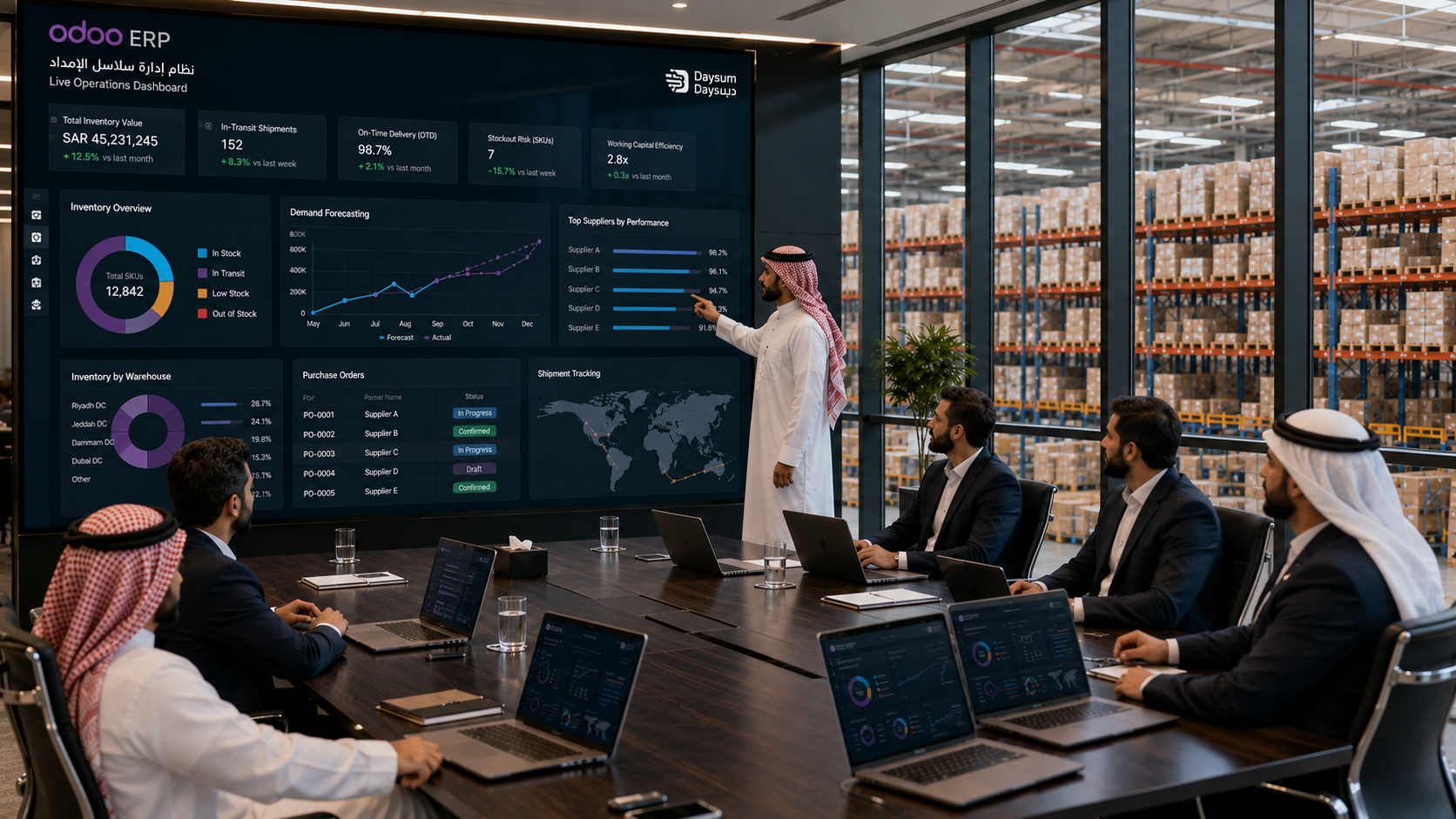
In the highly competitive and volatile world of Business-to-Business (B2B) commerce, the efficiency of your supply chain is not just a metric of operational success; it is the absolute determinant of your company’s financial survival. For operations directors, warehouse managers, and supply chain executives, the ultimate nightmare is the dreaded stockout. A sudden lack of critical raw materials or finished goods does not merely result in a delayed shipment; it halts entire manufacturing production lines, breaches stringent Service Level Agreements (SLAs) with corporate clients, and severely damages brand reputation.
Conversely, overcompensating for the fear of stockouts by hoarding excess inventory traps millions of dollars in stagnant working capital, suffocating the company’s cash flow and limiting strategic growth. The key to mastering this delicate balancing act is absolute, real-time visibility. By deploying a centralized, automated Odoo supply chain management ecosystem, enterprises can synchronize their procurement, warehousing, and delivery channels seamlessly. In this comprehensive guide, we will explore how leveraging the highly flexible Odoo Community framework through Daysum transforms warehouse management, optimizes the working capital cycle, and permanently eradicates the operational paralysis caused by inventory shortages.
1. The Catastrophic Cost of a Shortage in B2B Operations
To truly appreciate the value of an automated supply chain, operations managers must first quantify the true cost of a Shortage. In a B2B manufacturing or wholesale distribution environment, inventory is not just merchandise sitting on a shelf; it is the lifeblood of the operational cycle.
When a crucial component is missing from the warehouse, the ripple effects are devastating and immediate:
- Production Stoppages: In manufacturing, missing a single raw material means the assembly line grinds to a halt. The company continues to pay for idle labor and machine overhead while producing zero output.
- Eroded Client Trust: Corporate buyers rely on strict delivery schedules to run their own operations. Consistently failing to deliver on time forces these lucrative clients to seek more reliable competitors.
- Expedited Shipping Penalties: To compensate for a stockout and save a client relationship, managers are often forced to use emergency air freight or expedited Logistics services, completely wiping out the profit margin for that specific order.
The traditional approach to preventing these disasters was maintaining massive “safety stocks.” However, in modern corporate finance, tying up cash in excess inventory is considered a severe mismanagement of the working capital cycle. Capital locked in stagnant warehouse bins cannot be used for R&D, marketing, or geographic expansion. To break free from this archaic model, forward-thinking enterprises are transitioning to digital platforms to achieve all-in-one business control with Odoo ERP software, ensuring that capital is preserved and inventory flows smoothly.
2. Odoo Inventory: The Command Center for Real-Time Visibility
The foundation of a resilient, stockout-free enterprise is a flawless warehouse management system. Odoo inventory represents a paradigm shift from reactive record-keeping to proactive, intelligent asset management. Built on a smart, double-entry inventory framework, it treats stock movements like accounting journal entries, meaning nothing is ever lost, and every movement has a traceable origin and destination.
Dynamic Warehouse Routing
For large-scale B2B operations managing multiple physical locations—such as a central distribution hub in Riyadh and secondary warehouses in Jeddah and Dammam—Odoo provides unparalleled control. The system allows operations managers to configure complex, automated routing rules. These rules dictate exactly how products move through the supply chain: from receiving docks to quality control, then to specific storage zones, and finally to the packing and shipping areas.
Automated Reordering Rules
The most direct mechanism to prevent a stockout is the system’s ability to trigger automated replenishments. Warehouse managers can set specific “Minimum Stock Rules” for every single SKU in the database. The moment the live inventory level drops below this predefined critical threshold—due to a massive B2B sales order or a manufacturing consumption—Odoo inventory instantly generates a draft Purchase Order (PO) or a Manufacturing Order (MO). This ensures that the replenishment cycle begins before the actual shortage physically occurs on the warehouse floor.
Understanding how to use data to enhance inventory management empowers warehouse teams to set these thresholds accurately, ensuring optimal stock levels without unnecessary capital expenditure.
Traditional Inventory Management vs. Real-Time Odoo Supply Chain
| Operational Challenge | Traditional/Manual Warehouse Management | Automated Odoo Supply Chain Integration | Impact on B2B Working Capital |
|---|---|---|---|
| Inventory Tracking | Relies on periodic manual cycle counts; high risk of human error. | Real-time tracking via barcode scanners and automated stock valuation. | Protects the balance sheet by providing an exact, live valuation of corporate assets. |
| Replenishment Strategy | Reactive; orders are placed only after a physical Shortage is discovered. | Proactive; automated reordering rules trigger before the stock reaches zero. | Ensures continuous production and sales, keeping the cash-to-cash cycle flowing rapidly. |
| Multi-Warehouse Routing | Requires complex, error-prone manual spreadsheets to coordinate transfers. | Automated push/pull routing rules manage inter-warehouse transit seamlessly. | Reduces internal Logistics costs and optimizes stock distribution across regions. |
| Lead Time Management | Hard to track accurately, leading to panic buying and rushed freight. | System calculates exact vendor lead times and factors them into reorder triggers. | Eliminates expensive expedited shipping fees, significantly improving gross margins. |
3. Intelligent Procurement and Bulletproof Supplier Tracking
An optimized warehouse is useless if the purchasing department cannot secure raw materials efficiently. In the Odoo supply chain ecosystem, the warehouse and the purchasing departments operate as a single, unified organism.
The Procurement process in B2B environments often involves dealing with fluctuating global prices, varying minimum order quantities (MOQs), and unpredictable delivery schedules. Odoo automates this complexity through intelligent vendor management algorithms. When an automated reordering rule triggers a purchase request, the system automatically selects the primary vendor based on predefined criteria such as the lowest price, the fastest delivery time, or the highest historical reliability.
Masterful Supplier Tracking
To protect the supply chain, companies must rigorously monitor the performance of their partners. Supplier tracking in Odoo goes far beyond simply storing a vendor’s contact information. The system meticulously logs every interaction, tracking the exact delivery times against the promised lead times, monitoring the defect rate of received goods, and analyzing pricing trends over time.
By evaluating Vendors based on hard, empirical data rather than subjective relationships, procurement managers can negotiate better B2B contracts, consolidate their purchasing power, and seamlessly switch to backup suppliers if a primary vendor begins to show signs of logistical instability. This rigorous oversight ensures that your inbound supply chain remains an impenetrable fortress against external disruptions.
4. Demand Forecasting: Predicting the Future to Protect Capital
While automated reordering rules are excellent for managing current stock, true supply chain mastery requires looking into the future. Demand forecasting is the strategic capability that separates industry leaders from companies that constantly struggle with dead stock and sudden stockouts.
In a B2B context, demand is rarely linear. It is affected by seasonality, macroeconomic shifts, and the specific procurement cycles of your corporate clients. The Odoo platform aggregates massive volumes of historical sales data, procurement lead times, and manufacturing cycles to generate highly accurate predictive analytics.
By utilizing advanced Demand forecasting, operations managers can:
- Anticipate massive spikes in demand before major industrial seasons and adjust minimum stock rules proactively.
- Identify slow-moving inventory before it becomes obsolete, allowing the sales team to liquidate it and free up trapped working capital.
- Align procurement schedules perfectly with future manufacturing requirements, ensuring that cash is only spent on materials exactly when they are needed.
To successfully leverage these advanced predictive modules without disrupting your current operations, partnering with an expert integrator for a smooth Odoo ERP implementation is an absolute necessity for large-scale enterprises.
5. Orchestrating Logistics and Vendor Relationships
The final mile of the supply chain involves moving the finished product from your warehouse dock to the B2B client’s facility. Flawless Logistics orchestration is the ultimate test of your supply chain’s efficiency.
Within the Odoo framework, the logistics and shipping modules are intrinsically linked to the inventory and sales applications. When a bulk order is ready for dispatch, the system automatically generates the picking lists, calculates the volumetric weight for freight forwarding, and prints the necessary delivery slips and tracking labels.
Moreover, integrating third-party logistics (3PL) providers directly into your ERP ensures that you can provide your corporate clients with real-time tracking portals. This level of transparency dramatically elevates customer satisfaction and reduces the administrative burden on your customer service teams. Managing your Vendors and freight forwarders through a unified digital dashboard guarantees that every link in the supply chain is accountable, transparent, and optimized for speed and cost-efficiency.
The ROI of an Automated Odoo Supply Chain in B2B Operations
| Strategic Capability | Technological Execution in Odoo | Financial & Operational Return on Investment (ROI) |
|---|---|---|
| Working Capital Optimization | Accurate Demand forecasting and Just-in-Time (JIT) automated reordering. | Frees up millions of dollars previously trapped in excess, obsolete inventory. |
| Eradication of Stockouts | Live synchronization between POS, B2B sales portals, and physical warehouse bins. | Guarantees uninterrupted manufacturing and maximizes revenue capture from clients. |
| Vendor Accountability | Granular Supplier tracking documenting lead times, quality rates, and price variances. | Empowers the Procurement team to negotiate superior contracts and penalize underperformance. |
| Logistical Efficiency | Automated barcode scanning, optimized picking routes, and integrated shipping APIs. | Drastically reduces warehouse labor costs and accelerates the final fulfillment cycle. |
6. The Power of Odoo Community Tailored by Daysum
While the core features of an ERP are powerful, the diverse and highly specific operational realities of B2B manufacturing and distribution in regions like Saudi Arabia and the UAE demand absolute software flexibility. Proprietary, closed-source ERP systems force companies into rigid workflows that stifle operational agility and impose exorbitant licensing fees.
This is where the strategic brilliance of the Odoo Community edition comes to the forefront. As an open-source framework, it provides an infinitely customizable canvas. However, transforming this framework into an enterprise-grade powerhouse requires deep technical and operational expertise. Daysum, as a verified and highly experienced integrator, specializes in bridging this gap.
By leveraging expert Odoo ERP customization services through Daysum, your enterprise gains a system that perfectly mirrors your unique supply chain topography. Daysum customizes the Odoo inventory modules to handle your specific unit-of-measure conversions, tailors the Procurement workflows to match your internal approval hierarchies, and localizes the financial backend to ensure absolute compliance with regional tax authorities like ZATCA. This bespoke approach guarantees that your investment in digital transformation yields maximum operational control and uncompromised scalability. For modern jewelers looking to increase profitability, we highly recommend reading about Cloud ERP Cybersecurity For Diamond And Jewelry Stores. Within an odoo gold supply chain setup, purchase orders for raw bullion automatically trigger karat-based costing the moment goods are received, cutting out a manual costing step entirely. Request a supply-chain demo tailored to gold.
Conclusion: Real-Time Supply Chain
The modern B2B supply chain is an intricate, fast-moving ecosystem where the margin between high profitability and crippling operational failure is razor-thin. For operations and warehouse managers, relying on outdated spreadsheets and manual counts is a guaranteed path to devastating stockouts and trapped working capital. By embracing the fully automated, real-time Odoo supply chain architecture, enterprises can completely revolutionize their operations. Through intelligent Odoo inventory tracking, rigorous Supplier tracking, and data-driven Demand forecasting, businesses ensure that raw materials and finished goods flow seamlessly across the network. Partnering with a specialized integrator like Daysum to deploy a highly customized Odoo Community framework provides the ultimate digital command center—protecting your capital cycle, empowering your Logistics teams, and ensuring that your enterprise is always fully stocked and ready to dominate the market.
Frequently Asked Questions (FAQs)
The system prevents shortages through proactive "Automated Reordering Rules." Warehouse managers configure minimum and maximum stock thresholds for every item. The moment the live inventory level drops to the minimum threshold, the system automatically drafts a Purchase Order (PO) or a Manufacturing Order (MO). Because the system factors in the specific lead time of the vendor, the replenishment order is placed exactly with enough time for the new stock to arrive before the current stock is completely depleted.
Yes, the system is highly sophisticated in managing supplier redundancies. You can link multiple Vendors to a single product, each with their own specific price lists, minimum order quantities (MOQs), and delivery lead times. When an automated reordering rule is triggered, the system can be configured to automatically select the vendor that offers the best price or the fastest delivery, ensuring optimal procurement agility.
If a supplier consistently delivers late, the warehouse manager is forced to artificially inflate the "safety stock" levels to compensate for the unreliability, which traps vital working capital. Supplier tracking in Odoo provides hard data on vendor performance (on-time delivery rates, defect rates). Armed with this data, operations managers can either force the supplier to improve or switch to a more reliable vendor, allowing the company to safely lower safety stock levels and free up cash flow.
Absolutely. One of the strongest features of the localized Odoo Community edition is its robust multi-warehouse and multi-company architecture. It supports complex Logistics workflows, including cross-docking, dropshipping, and automated inter-warehouse transfers. This means if a B2B order is placed in Riyadh but the stock is in Jeddah, the system will automatically orchestrate the internal transfer and update the accounting ledgers in real-time, completely without manual intervention.