The corporate landscape in the Kingdom of Saudi Arabia is undergoing a massive, structural transformation. Driven by the ambitious goals of Vision 2030, the entire nation is moving rapidly away from paper-based, manual administration toward a fully digitized, highly efficient economy. This nationwide push for digital transformation is not just a high-level government initiative; it directly impacts how every single private company operates on a daily basis.
At the center of this corporate shift is the way businesses manage their human capital. The old days of crowded administrative offices, endless paper forms for vacation requests, and manual payroll calculations are completely incompatible with the speed at which the Saudi market is evolving. To keep up, companies are actively migrating toward decentralized digital frameworks. They are realizing that forcing highly skilled professionals to wait in line for a simple salary certificate or to update their residential address is a massive drain on overall productivity.
The core philosophy driving this change is the complete decentralization of routine tasks. By implementing robust digital portals, businesses are transferring the power of data management directly to the workforce. To truly grasp the mechanics of this shift, it is essential to understand what are employee self-service (ESS) systems and how they function as the bridge between the individual and the company’s central database. These systems act as secure, private gateways where individuals can independently view their financial documents, submit requests, and update their personal files without ever needing to draft an email or knock on a manager’s door.
What Are the Core Drivers Forcing Companies to Upgrade Their Infrastructure?
The transition toward autonomous workforce management in the Kingdom is not just a trend; it is a fundamental business necessity driven by a unique combination of regulatory pressure, demographic shifts, and the simple need for operational survival. Companies that fail to adapt are finding themselves paralyzed by administrative bottlenecks and severe regulatory penalties.
We can break down the primary catalysts for this massive adoption into four distinct areas:
- Uncompromising Government Compliance Mandates: The Saudi government has digitized its own operations brilliantly, and it expects the private sector to match that standard. Initiatives like the Wage Protection System (WPS) and the Mudad platform are no longer optional; they are heavily enforced mandates. Companies must prove that salaries are paid on time and accurately. Relying on manual spreadsheets to track attendance, calculate overtime, and generate payroll is a guaranteed path to calculation errors. A single mistake in reporting to the General Organization for Social Insurance (GOSI) or the Muqeem portal can result in hefty fines or the suspension of governmental services. Understanding how to ensure your HR system complies with Saudi labor laws is the single biggest driver for upgrading to automated, error-free platforms.
- The Demands of a Mobile-First Generation:
Saudi Arabia boasts one of the highest smartphone penetration rates in the world, coupled with an incredibly young, tech-savvy workforce. This demographic manages their banking, shopping, and travel entirely through sophisticated mobile apps. When they enter the workplace, they expect the exact same level of digital convenience. If a company forces them to use outdated, clunky interfaces or paper forms, it immediately creates a negative perception of the employer. They expect to request time off, view their payslips, and check their schedules from their phones, 24/7. - Massive Gains in Operational Efficiency:
Every hour an administrative specialist spends answering a question about a vacation balance is an hour stolen from strategic planning. By automating these routine inquiries, companies instantly reclaim thousands of working hours annually. This liberation allows the administrative teams to pivot away from acting as internal helpdesks. Instead, they can focus their energy on critical initiatives like talent acquisition, designing competitive compensation packages, and building a stronger internal culture. - Strategic Clarity Through Real-Time Data Insights:
In a manual setup, management only sees problems after they occur. They realize turnover is high only when people start resigning. They notice a spike in absenteeism only when a project falls behind schedule. Autonomous digital systems capture data constantly. When individuals log their own hours, update their goals, and request leave through a central portal, leadership gains a live dashboard of organizational health. They can track absence trends, monitor overtime costs, and optimize workforce planning based on hard, real-time analytics rather than guesswork.
How Do Regulatory Integrations Protect Businesses from Severe Penalties?
To understand the gravity of the compliance landscape in Saudi Arabia, one must look closely at how the different governmental platforms interact. The Kingdom has created a highly interconnected digital ecosystem to protect workers’ rights and ensure corporate transparency. Operating outside of this ecosystem is virtually impossible for any growing business.
When a company manually manages its workforce, it faces the terrifying task of updating multiple distinct portals every time a change occurs. If an individual receives a salary increase, that information must be perfectly synchronized across the internal payroll, the bank, the Mudad platform, and GOSI. A delay or a typo in any of these steps triggers an alert within the Ministry of Human Resources and Social Development (MHRSD).
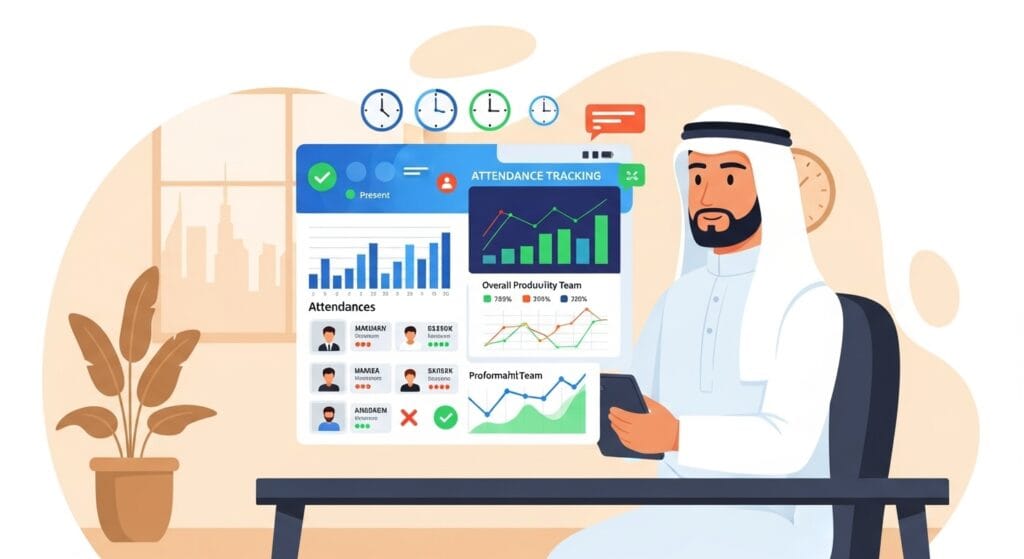
This is why having a reliable time attendance system saudi arabia is entirely non-negotiable. These advanced platforms do not just record when someone walks through the door; they automatically calculate the exact payable hours, factor in any approved overtime, deduct any unpaid leave, and package this data perfectly for the payroll run.
The table below highlights the massive operational difference between handling these requirements manually versus utilizing an integrated digital framework:
|
Regulatory Requirement |
The Risk of Manual Processing |
The Security of Automated Synchronization |
|
Wage Protection System (WPS) & Mudad |
Finance teams manually build WPS files. High risk of format errors, leading to file rejection and immediate compliance violations. |
The system automatically generates the exact WPS-compliant file format, completely eliminating human formatting errors. |
|
GOSI Updates |
When salaries change or individuals join/leave, data must be manually typed into the GOSI portal, risking calculation mismatches. |
Internal salary changes automatically flag the required updates, ensuring the company’s internal ledgers perfectly match the government records. |
|
Muqeem (Expatriate Management) |
Tracking Iqama (residency) expiration dates via spreadsheets often leads to missed deadlines and massive renewal penalties. |
The portal sends automated, escalating alerts to both the individual and management months before an Iqama expires. |
|
Nitaqat (Saudization) Tracking |
Manually calculating the ratio of Saudi nationals to expatriates across different job tiers is incredibly complex and prone to miscalculation. |
Live dashboards track Saudization percentages in real-time, warning management if a new hire or resignation will drop the company into a lower Nitaqat tier. |
What Does the Future Look Like for Workforce Management Beyond 2026?
As we look toward the horizon, the capabilities of these digital portals are expanding at a breathtaking pace. The tools that seem cutting-edge today will become the baseline standard tomorrow. The roadmap for workforce administration in Saudi Arabia points directly toward hyper-automation, artificial intelligence, and absolute geographical flexibility.
We can anticipate several major technological leaps that will redefine the daily corporate experience:
Artificial Intelligence Driving Proactive Compliance
Currently, systems are excellent at recording data and flagging obvious errors. The next generation of software will move from reactive reporting to proactive decision-making. AI algorithms will continuously monitor the company’s Saudization (Nitaqat) status against the constantly evolving labor laws. If the AI detects that an upcoming expatriate hire will jeopardize the company’s “Platinum” or “Green” status, it will automatically block the hiring workflow and suggest alternative staffing strategies. Furthermore, AI will handle complex, multi-variable payroll calculations instantly, factoring in localized tax rules, changing benefit structures, and variable commission rates without requiring any human intervention. For companies looking to prepare for this shift, exploring the best tools for attendance and payroll integration in Saudi Arabia is the necessary first step toward full automation.
Unprecedented Mobile Dominance and Biometric Security
The concept of accessing work portals via a desktop computer is rapidly fading. The future belongs entirely to mobile applications. However, with this convenience comes the absolute necessity for airtight security. Passwords are no longer sufficient. We will see a universal shift toward biometric authentication—fingerprint scanning and facial recognition built directly into the mobile apps. This ensures that the person accessing the payslip or requesting the contract update is undeniably the authorized user. This level of security is crucial as these apps will house highly sensitive financial and personal identification data.
Hybrid and Remote Work Supported by Advanced Geofencing
The definition of the workplace has changed forever. Many Saudi companies are embracing hybrid models, where individuals split their time between the corporate office, remote client sites, and their homes. Managing attendance in this fluid environment is impossible with physical punch clocks.
The immediate future relies heavily on GPS and geofencing technologies. Companies will set invisible digital perimeters around approved work locations (whether that is a specific construction site in Riyadh or the company headquarters in Jeddah). When an individual crosses that digital boundary, their mobile app allows them to log their hours. If they are outside the approved zone, the system prevents them from checking in. This provides management with absolute certainty regarding field operations without having to physically micromanage their teams. Understanding the mechanics of these advancements gives businesses a clear view of the future of attendance apps what can we expect in the coming years.
The Era of Zero-Friction Government Connectivity
While current systems generate the files needed for government portals, the future involves seamless, two-way API (Application Programming Interface) connectivity. The internal company software will speak directly to the MHRSD, GOSI, and Muqeem servers in real-time. When a new contract is digitally signed by an individual on their phone, the system will automatically register that contract with the government, update the social insurance records, and adjust the Nitaqat tier instantly. This total integration will completely eradicate the concept of “data entry” from the administrative vocabulary.
How Does Daysum Empower Companies to Master This Digital Transition?
Navigating this complex matrix of government compliance, employee expectations, and rapid technological advancement requires a partner that understands the specific nuances of the Saudi Arabian market. Generic, off-the-shelf software built for Western markets often fails spectacularly when forced to handle the unique requirements of Nitaqat calculations or WPS file structuring.
This is precisely why Daysum was engineered. We recognize that businesses in the Kingdom do not just need a digital filing cabinet; they need a comprehensive operational engine. Daysum provides a deeply integrated architecture designed specifically to manage the complete lifecycle of your workforce while guaranteeing absolute alignment with local regulatory bodies.
By utilizing comprehensive hrms cloud solutions from Daysum, companies completely eliminate the friction between their people and their processes. The Daysum interface is intentionally designed to be as intuitive as the social media apps your team uses every day, ensuring instant adoption across all age groups and technical skill levels. Whether it is a field technician logging their location via GPS, or a department head reviewing a real-time analytics dashboard of their team’s performance, the experience is flawless.
Daysum removes the anxiety from compliance. Our systems are built to automatically handle the heavy lifting of accurate payroll generation and government reporting, ensuring that your organization is always a step ahead of regulatory audits. Choosing Daysum means choosing to stop fighting with administrative bottlenecks and starting to focus your energy on what actually matters: scaling your business, capturing market share, and leading your industry in the era of Vision 2030.
Frequently Asked Questions
Absolutely not. Reputable platforms are built with strict privacy boundaries. GPS tracking is only active during the precise moment a person clicks "check-in" or "check-out," and only verifies if they are within the approved geographical zone. The system does not track or record their physical movements throughout the day or outside of working hours, ensuring complete respect for personal privacy while maintaining operational accountability.
The calculation of end-of-service benefits is notoriously complex, depending on the type of contract, the reason for departure, and the total years of service. Premium digital systems have the entirety of the Saudi Labor Law hardcoded into their financial engines. When a resignation or termination is processed, the software instantly calculates the exact, legally mandated EOSB payout, factoring in unpaid leave and prorated allowances, eliminating human error entirely.
Cloud architecture actually protects you from local internet outages. Because the data is not stored on a physical server in your office closet, your team can access the portal from anywhere using their mobile data (4G/5G) or from their home internet connections. The business operations continue uninterrupted, which is a massive advantage over legacy desktop software that dies the moment the local network drops.
No, they are arguably more critical for small and medium-sized enterprises (SMEs). Large corporations have entire departments dedicated to monitoring compliance. An SME usually relies on one or two people who are constantly overwhelmed. An automated system acts as a digital compliance officer for the SME, protecting them from devastating fines and allowing a small team to manage the workforce with the efficiency of a massive corporation.
Yes, this is a standard feature of high-tier platforms. The interface language is tied to the individual's personal profile, not the entire company database. An Arabic-speaking manager can review a request in Arabic, while the English-speaking expatriate who submitted the request views their portal entirely in English. This dual-language capability completely removes communication barriers and ensures everyone understands the company policies clearly.