The global economic landscape is undergoing a monumental shift, characterized by rapid digitalization and an uncompromising demand for transparency. In the Kingdom of Saudi Arabia, this transformation is not merely a corporate trend; it is a foundational pillar of Saudi Vision 2030. At the heart of this financial renaissance is the implementation of the electronic invoice ksa system, mandated by the Zakat, Tax and Customs Authority (ZATCA).
The shift from traditional, paper-based accounting to a sophisticated, real-time digital grid has fundamentally altered how businesses operate. Recent data indicates that the implementation of ZATCA e-invoicing has successfully slashed tax evasion by an astounding 80%. This is largely attributed to the real-time monitoring capabilities of the FATOORA portal. Forward-thinking companies and early adopters—supported by advanced platforms like Daysum, ClearTax, and major telecommunications entities like STC—are reporting a 40% acceleration in invoice processing times and a 95% reduction in manual accounting errors.
In this comprehensive guide, we will explore the profound role that electronic invoicing plays in enhancing financial transparency and credibility. We will delve into the technical mechanisms that make this possible, quantify the business benefits, review real-world Saudi success stories, and analyze how advanced ERP providers are leading the market in compliance and efficiency.
Defining Financial Transparency and Credibility in the Modern Era
To truly understand the impact of e-invoicing, we must first define what transparency and credibility mean in a modern financial context. These are no longer abstract buzzwords; they are measurable, operational realities.
What is Financial Transparency?
Financial transparency means maintaining accurate, accessible, and highly verifiable financial records. In the context of the Saudi market, it translates to the generation of structured XML and PDF/A-3 invoices that are instantly checkable through the ZATCA portal.
When a business issues an e-invoice, it is no longer handing over a piece of paper that can be easily lost, altered, or forged. Instead, it is generating a dynamic data packet. Stakeholders—whether they are consumers, B2B clients, or government auditors—can instantly scan a QR code to verify the legitimacy of the transaction. This immediate verifiability removes the veil of obscurity from corporate finances, building deep, enduring trust across the entire supply chain.
What is Financial Credibility?
While transparency is about visibility, credibility is about trust and immutability. Financial credibility grows when stakeholders are confident that the data they are viewing cannot be manipulated. ZATCA’s mandate enforces this through tamper-proof Universally Unique Identifiers (UUIDs) and advanced cryptographic digital signatures.
Once an invoice is issued and stamped, it is permanently sealed. Any attempt to alter the invoice post-issuance will break the digital signature, immediately flagging the document as fraudulent. With these protocols becoming mandatory for 99% of VAT-registered firms by the year 2026, the entire Saudi economy is moving toward a standard of absolute financial credibility.
How E-Invoicing Drives Transparency: The Technical Mechanisms
The leap from traditional invoicing to e-invoicing is powered by specific, highly sophisticated technological features. Each feature plays a distinct role in ensuring that every halala is accounted for.
Below is a detailed breakdown of how these features drive transparency, mapped against ZATCA’s integration phases.
|
Technical Feature |
Transparency & Credibility Impact |
ZATCA Mechanism / Phase |
|
Auto UUID & Dynamic QR Code |
Enables instant verification of the invoice’s authenticity by buyers and auditors via mobile scanning. |
Phase 1 (Generation) – Mandatory requirement for all tax invoices. |
|
FATOORA API Integration |
Facilitates government real-time review. B2B invoices are cleared before being shared with the buyer. |
Phase 2 (Integration) – Rolling out in targeted waves. |
|
Cryptographic Digital Signature |
Ensures post-issue immutability. Locks the document so no prices, dates, or VAT amounts can be altered. |
Handled via certified Cryptographic Service Providers (CSP). |
Decoding the Technology
- The Power of the UUID: The Universally Unique Identifier is a 128-bit number used to identify information in computer systems. In e-invoicing, it ensures that no two invoices can ever have the same identification code, completely eliminating the risk of duplicate invoicing or “double-booking” revenues.
- The FATOORA API: Application Programming Interface (API) connectivity means that a company’s accounting software speaks directly to the government’s servers. There is no middleman and no delay, ensuring that the government has a real-time pulse on the economy.
ZATCA Compliance Benefits: Beyond Avoiding Penalties
When business leaders discuss ZATCA compliance, the conversation often revolves around fear—specifically, the fear of heavy financial penalties. While it is true that failing to comply with e-invoicing regulations can result in severe fines of up to SAR 50,000 per violation, the benefits of leveraging robust e invoicing zatca software extend far beyond merely avoiding punishment.
Automated VAT Reporting and Simplified Rules
Advanced e-invoicing platforms automatically categorize transactions. They apply simplified invoice rules for B2C (Business to Consumer) transactions and standard tax invoice rules for B2B (Business to Business) transactions without requiring manual input from the cashier or accountant. At the end of the month or quarter, the system generates an automated, error-free VAT report. This automation saves hundreds of administrative hours and guarantees that the tax filed matches the tax collected flawlessly.
Smart Validations Prevent Rejection
One of the most critical features of a high-tier e-invoicing system is its ability to perform pre-submission checks. Platforms like Daysum perform over 150 smart validations in the background before an invoice is ever sent to the FATOORA portal. These checks verify everything from the exact 15-digit format of the buyer’s VAT registration number to the logical calculation of the 15% VAT on line items. By catching these errors pre-submission, companies avoid the administrative nightmare of dealing with rejected invoices and issuing complex debit/credit notes.
Building Financial Credibility with Accurate Transaction Documentation
At the core of a credible business is its ability to maintain pristine, unquestionable records. Electronic invoicing introduces a level of forensic accuracy to transaction documentation that paper ledgers could never achieve.
The ISO 8601 Timestamp Standard
Every ZATCA-compliant e-invoice must include a timestamp formatted to the ISO 8601 standard. This is not just a date on a page; it is a meticulously coded string of data that records the exact year, month, day, hour, minute, and second the transaction took place, adjusted for the local time zone. In the event of a financial audit or a legal dispute, this precision leaves no room for ambiguity regarding when a liability was incurred or a revenue was realized.
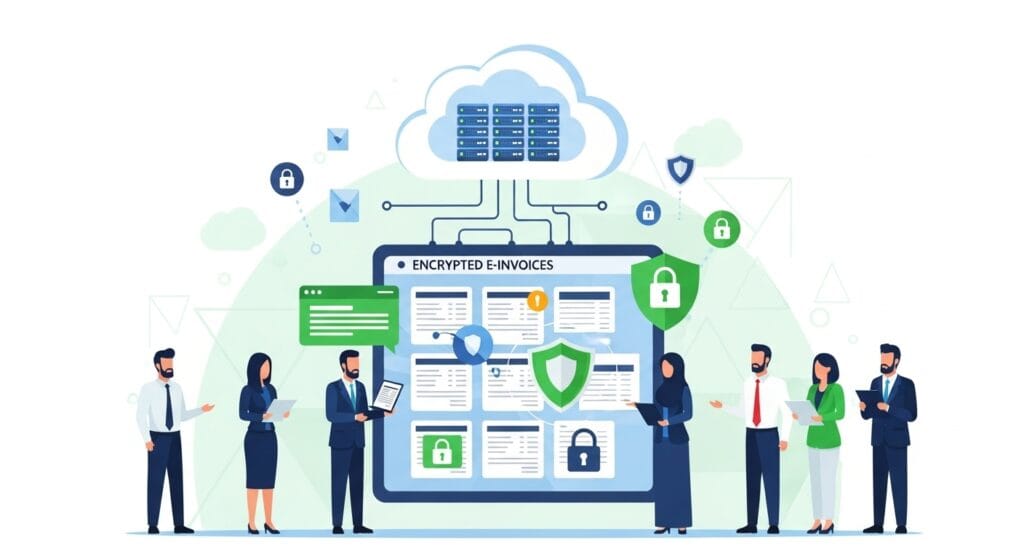
Access-Controlled XML/PDF/A-3 Storage
To maintain credibility, invoices must be stored in a format that guarantees long-term readability and security. The PDF/A-3 format is an ISO-standardized version of the Portable Document Format specialized for digital preservation. It embeds the machine-readable XML file directly within the human-readable PDF. When these files are stored in access-controlled cloud environments for the mandatory 5-year period, they create an encrypted archive that is safe from physical destruction, natural disasters, and unauthorized internal access.
Audit-Proof History and Non-Repudiation
Because modern e-invoicing platforms maintain a strict, change-logged history of every action taken within the system, they provide an “audit-proof” trail. If a user logs in to issue a credit note or update a client file, the system records the user’s ID and the exact time of the action. This blockchain-ready architecture ensures “non-repudiation”—meaning no party can successfully dispute the validity of a contract or a transaction, as the cryptographic evidence is irrefutable.
Simplified Monitoring, Auditing, and Fraud Reduction
One of the greatest challenges for Chief Financial Officers (CFOs) and external auditors in the past was the laborious process of cross-referencing physical receipts with bank statements. E-invoicing has revolutionized this workflow.
Live Dashboards and Centralized Logs
With automatic submission to ZATCA, modern ERP systems pull that same data to populate live sales dashboards. Management can monitor cash flow, outstanding receivables, and tax liabilities in real time from a centralized console. Whether you are managing a single boutique in Jeddah or a nationwide chain of retail stores, the data is consolidated instantly. This makes internal and external audits a matter of granting software access rather than spending weeks sorting through filing cabinets.
For businesses looking to fully integrate their entire operational flow—from inventory to HR to tax compliance—investing in a comprehensive odoo implementation saudi arabia ensures that every department feeds accurate data into a single, unified, and highly transparent system.
Eradicating Fraud and Manipulation
Internal fraud, such as backdating invoices, skimming cash, or altering invoice values after the customer has paid, costs businesses millions annually. Electronic invoicing structurally eradicates these manual fraud opportunities. Because digital signatures and UUID hashing block any post-issuance alterations, rogue employees cannot manipulate the numbers to cover up theft. The transparent nature of the system forces absolute accountability at every level of the organization.
Quantifying the Business Benefits of Transparency
Transparency and credibility are not just ethical imperatives; they have a direct, quantifiable impact on business growth, brand reputation, and operational efficiency.
Table: Business Benefits Quantified
|
Strategic Benefit |
Quantifiable Impact Metric |
Real-World Application |
|
Brand Reputation |
+25% increase in client trust |
B2B clients prefer partners with transparent, instant, and error-free digital billing. |
|
Executive Decisions |
80% faster analytics & reporting |
Real-time data allows CFOs to make rapid decisions on pricing, purchasing, and scaling. |
|
Legal Compliance |
0% fines with API linkage |
Direct ERP integration ensures absolute compliance with ZATCA Phase 1 and Phase 2. |
|
Operational Savings |
70% reduction in paper costs |
Eliminating printing, physical mailing, and physical storage costs boosts the bottom line. |
Real Saudi Success Stories: Transparency in Action
To understand the true power of e-invoicing, we can look at how leading organizations in Saudi Arabia have utilized the technology to overhaul their operations.
The STC Transformation
The Saudi Telecom Company (STC), one of the largest telecom operators in the Middle East, handles millions of transactions. By transitioning to a fully integrated e-invoicing system, STC reported a massive 40% cut in invoice processing times. Furthermore, the automation of these financial workflows resulted in a 30% savings in administrative costs. Perhaps most importantly, the clarity, speed, and transparency of their new billing system contributed to a 15% rise in overall customer satisfaction, proving that financial transparency directly impacts the consumer experience.
Jarir Bookstore’s Retail Revolution
Jarir Bookstore, a titan in the Saudi retail sector, faced the challenge of managing massive volumes of B2C and B2B invoices across dozens of branches. Prior to upgrading their systems, complex corporate invoices could take up to 48 hours to issue and verify. By integrating a sophisticated ERP with ZATCA’s FATOORA portal, Jarir reduced their issuance time from 48 hours to a mere 2 hours. Additionally, the centralized, tamper-proof nature of the digital system resulted in an 80% reduction in internal invoicing discrepancies and fraud risks.
Analyzing Saudi E-Invoicing Competitors
As the ZATCA mandate expands, the Saudi software market has responded with various solutions. Choosing the right platform is critical for maintaining the credibility and transparency we have discussed.
Table: Leading Saudi E-Invoicing Platforms
|
Platform |
Core Transparency Edge |
Estimated Annual Cost |
Best Suited For |
|
Daysum ERP |
FATOORA sync, Salla/Zid integration, and real-time Gold market pricing. |
From $3,600 SAR |
Retailers, e-commerce, and specialized industries (like jewelry). |
|
ClearTax |
Enterprise middleware with 150+ pre-submission ZATCA smart checks. |
Custom Pricing |
Large multinational corporations using legacy SAP/Oracle systems. |
|
Qoyod |
Excellent audit trails paired with free accounting workshops for users. |
From $2,400 SAR |
Small service-based businesses and independent contractors. |
While various platforms offer basic compliance, businesses with physical inventory, retail fronts, or e-commerce presence require more robust solutions. For example, if you operate a jewelry brand, standard invoicing software falls short. You need the best gold accounting software that can transparently separate volatile gold weights from making charges on the e-invoice—a specialty where platforms like Daysum excel.
Why Daysum is the Ultimate Choice for Financial Credibility
Daysum is not just an invoicing tool; it is a comprehensive ecosystem designed to elevate your company’s financial transparency to world-class standards.
Speed, Localization, and Unmatched Synchronization
Daysum understands the urgency of the Saudi market. They offer rapid 24 to 72-hour system activation, ensuring your business experiences zero downtime. Built specifically for the region, Daysum features full Arabic and English support, ensuring that your staff can navigate the software with confidence.
What truly sets Daysum apart is its unparalleled synchronization capabilities. Whether you are running a brick-and-mortar store or operating online, Daysum acts as a top-tier retail erp saudi arabia. It seamlessly syncs your physical Point of Sale (POS) terminals with leading e-commerce platforms like Salla and Zid.
Phase 2 Ready and Audit-Proof
Daysum auto-generates 100% compliant XML and QR code invoices, pushing them directly to the FATOORA portal. With automated VAT reporting, secure cloud archiving for the mandatory 5-year period, and real-time inventory tracking, Daysum reduces your financial processing workload by 80%.
Don’t let your business fall behind in the era of digital transparency. Start your Daysum free trial today, achieve full ZATCA compliance in minutes, and build unshakeable financial credibility with your clients and investors.
Frequently Asked Questions (FAQs)
The Universally Unique Identifier (UUID) is a 128-bit cryptographic label attached to every e-invoice. Its primary function is to ensure that no two invoices in the world share the same identification number. This enhances transparency by making it impossible for a business to accidentally or intentionally duplicate an invoice, ensuring that all revenue reported to ZATCA and stakeholders is 100% accurate and uniquely traceable.
No. Once an e-invoice is generated and digitally stamped via a certified Cryptographic Service Provider (CSP), it becomes immutable. If an error is made (such as an incorrect price or quantity), the original invoice cannot be deleted or edited. Instead, the business must issue an electronic Credit Note or Debit Note that references the original invoice's UUID. This strict protocol ensures complete financial transparency and leaves a clear audit trail.
Saudi law mandates that all tax invoices and associated financial data must be retained securely for a minimum of five years. Cloud archiving ensures that these highly structured XML and PDF/A-3 files are protected against physical loss, hardware failure, or tampering. Furthermore, cloud storage allows government auditors or internal accountants to search and retrieve specific invoices instantly from anywhere, greatly simplifying the auditing process.
Daysum is built with advanced, open API connectivity designed specifically for the Saudi e-commerce ecosystem. When a customer places an order on your Salla or Zid store, the transaction data is instantly pulled into the Daysum ERP. Daysum automatically generates a ZATCA-compliant e-invoice, emails it to the customer, updates your financial ledgers, and deducts the item from your live inventory, providing seamless, transparent multi-channel management without any manual data entry.