In today’s hyper-competitive commercial landscape, achieving sustainable Sales growth requires much more than a charismatic sales team and a robust marketing budget. Whether you are managing a large-scale Business-to-Business (B2B) manufacturing enterprise, a sprawling wholesale distribution network, or a premium retail brand, the secret to dominating your market lies in how efficiently you manage your data. At the very core of this data management is your Customer relationship strategy. Modern consumers and corporate clients alike demand personalized experiences, rapid response times, and seamless transactions. To meet and exceed these expectations, forward-thinking enterprises are rapidly transitioning away from fragmented software tools and embracing the Odoo CRM system.
Unlike conventional, standalone Customer Relationship Management tools that merely act as glorified digital address books, an integrated Odoo CRM system serves as the dynamic front-end of a comprehensive Enterprise Resource Planning (ERP) ecosystem. By natively linking your sales front-lines directly to your backend operations, inventory, and finance departments, this revolutionary platform empowers businesses to capture every opportunity, streamline their workflows, and definitively convert fleeting prospects into permanent, high-value clients. In this ultimate guide, we will explore the profound mechanics of the Odoo ecosystem, detailing how bridging your CRM with your core ERP architecture will inevitably double your sales and secure long-term commercial success.
1. The Critical Failure of Disconnected Sales Tools
To appreciate the transformative power of an integrated platform, business leaders must first recognize the severe limitations of isolated software. For many years, companies invested heavily in standalone CRM applications to manage their sales efforts. While these tools were adequate for basic contact management, they created a dangerous operational chasm between the sales department and the rest of the organization.
When a CRM operates in a vacuum, a phenomenon known as “data siloing” occurs. A sales representative might successfully nurture a prospect and close a major deal within the CRM, but because the software does not communicate with the warehouse or the accounting department, the actual fulfillment of that order requires manual data entry. This manual handover is fraught with severe risks:
- Lost Information: Critical customer preferences recorded in the CRM fail to reach the operational teams executing the order.
- Delayed Fulfillment: Manually copying closed deals into an ERP delays production and shipping, instantly damaging the newly formed Customer relationship.
- Inaccurate Promises: Sales reps using a disconnected CRM cannot see live inventory levels. They frequently sell products that are out of stock, forcing the company to backtrack and apologize, which severely cripples Sales growth.
To solve these systemic failures, companies must adopt a unified technological approach. Discover how shifting to a unified platform provides all-in-one business control with Odoo ERP software, ensuring that your sales team is always perfectly aligned with your operational reality.
2. Mastering the Sales Pipeline and Intelligent Lead Tracking
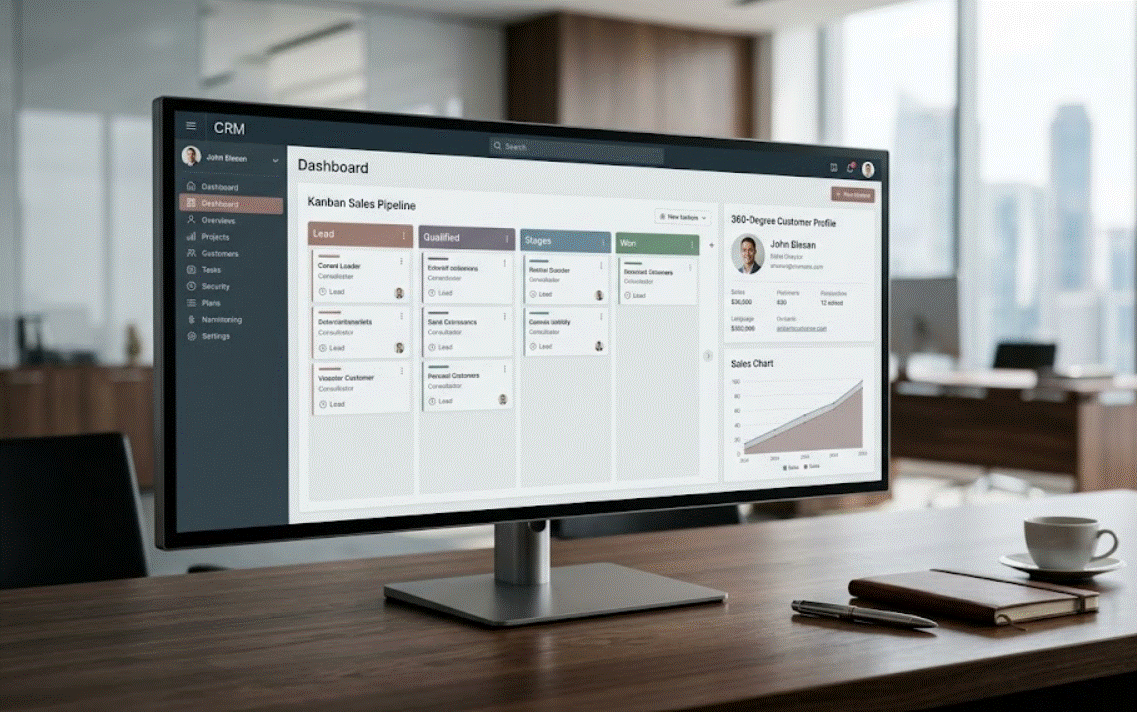
The primary function of the Odoo CRM system is to bring absolute clarity and structure to your revenue-generating activities. This is achieved through a highly visual, deeply customizable Sales pipeline. Instead of relying on chaotic spreadsheets or confusing email threads, sales managers and representatives are provided with a pristine, Kanban-style dashboard where every single opportunity is represented as a movable card.
The Anatomy of Flawless Lead Tracking
Effective Lead tracking is the engine of corporate revenue. The moment a prospective client interacts with your business—whether they fill out a contact form on your website, send an email inquiry, or hand a business card to a rep at an industry trade show—the Odoo system automatically generates a lead in the pipeline.
From that moment on, the system meticulously tracks every interaction. It logs phone calls, archives email correspondence, schedules follow-up meetings, and sets automated reminders. This ensures that no potential client ever “slips through the cracks.” Sales representatives are prompted exactly when to reach out, ensuring that the prospect receives the right information at the precise moment they need it.
Dynamic Pipeline Management
As the prospect moves closer to a purchasing decision, the sales rep simply drags and drops the opportunity card from one stage to the next (e.g., from “New” to “Qualified,” to “Proposition,” and finally to “Won”). Managers can instantly evaluate the health of the Sales pipeline, analyzing conversion rates, identifying bottlenecks where deals stall, and accurately forecasting quarterly revenue based on the weighted probability of closing each deal.
Standalone CRM vs. Integrated Odoo CRM System
| Sales Capability | Standalone / Isolated CRM Tools | Integrated Odoo CRM System | Direct Impact on Corporate Sales Growth |
| Lead Tracking & Capture | Requires manual input from various marketing channels. | Automated capture from websites, emails, and VoIP integrations. | Maximizes the number of leads entering the funnel and prevents data loss. |
| Sales Pipeline Visibility | Static lists that are difficult to update and analyze. | Dynamic, drag-and-drop Kanban boards with real-time forecasting. | Empowers managers to identify stalled deals instantly and deploy rescue strategies. |
| Quote Generation | Sales reps must switch to Word or Excel to build pricing quotes. | Quotes are generated instantly within the CRM using live ERP product data. | Drastically reduces response times, allowing you to beat competitors to the punch. |
| Inventory Awareness | Sales teams fly blind, unaware of actual stock levels in the warehouse. | Native integration provides live stock levels directly on the prospect’s quote. | Eliminates the embarrassment of selling out-of-stock items, securing client trust. |
3. The Ultimate Added Value: Unifying CRM with ERP and POS
The true brilliance of the Odoo ecosystem, and the definitive secret to doubling your sales, lies in its interconnected architecture. Generating a lead is only the first step; the ultimate goal is converting that interest into a permanent, paying client. This conversion is practically guaranteed when your CRM is structurally bonded to your core Enterprise Resource Planning (ERP) platform.
From Prospect to Permanent Client seamlessly
In the Odoo CRM system, the journey of a client is completely frictionless. When a B2B lead agrees to a proposal, the sales representative clicks “Confirm” on the digital quotation. Because the CRM is linked directly to the ERP, this single click triggers a massive automated workflow:
- Inventory Allocation: The ERP instantly reserves the requested products in the warehouse, updating live stock levels.
- Delivery Orders: A delivery order is automatically pushed to the logistics team’s scanners, ready for immediate picking and packing.
- Financial Invoicing: The accounting module generates a legally compliant tax invoice, ready to be sent to the client.
By automating the administrative heavy lifting, sales representatives are freed to do what they do best: sell. They spend less time doing paperwork and more time nurturing the next major Customer relationship. If you want to facilitate better supply chain management and data analytics, check out Company.
Omnichannel Excellence with Integrated POS
This integration extends powerfully into the physical retail environment. For businesses that operate physical showrooms alongside B2B wholesale channels, the CRM connects directly to the Point of Sale (POS) system. If a client who initially inquired online walks into your retail store, the cashier can pull up their CRM profile directly on the POS screen. The cashier instantly sees their past quotes, previous purchases, and specific preferences. This level of personalized recognition astounds customers and drastically increases the likelihood of high-value upselling.
To understand why building such a holistic framework is the right strategic move for your enterprise, explore why choose Odoo open-source ERP for your growing business and discover how native integrations outmaneuver fragmented software.
4. Elevating Customer Service and Forging Unshakable Loyalty
In modern commerce, acquiring a new customer is significantly more expensive than retaining an existing one. Therefore, sustainable Sales growth is heavily dependent on maximizing Customer Lifetime Value (CLV). The Odoo CRM system provides the exact tools required to turn one-time buyers into lifelong brand advocates.
The 360-Degree Customer View
When a client contacts your support team with a question or an issue, exceptional Customer service demands immediate context. Because the CRM is unified with the ERP, your support agents have a “360-degree view” of the client. On a single screen, the agent can see the client’s entire history: every email exchanged, every product purchased, the status of their current open deliveries, and any pending accounting invoices.
This total visibility empowers your team to resolve issues rapidly and intelligently without forcing the customer to repeat their story to multiple departments. When clients feel understood and valued, their Loyalty to your brand deepens immensely.
Data-Driven Loyalty Programs
Furthermore, this wealth of centralized data allows marketing and sales teams to construct highly targeted retention campaigns. If the CRM indicates that a B2B client typically reorders raw materials every six months, the system can automatically prompt the sales rep to reach out at month five with a personalized offer. You can also utilize purchasing data from the POS to enroll retail customers in automated rewards programs.
This proactive approach to Customer relationship management ensures that you remain at the forefront of your clients’ minds. For deeper insights into how digital transparency and efficient administrative processes forge stronger client bonds, read about how e-invoicing contributes to improving customer experience. Additionally, you can review specific industry case studies, such as the impact of customer experience on sales, to see these principles in action.
Strategic ROI of Odoo CRM System Features
| Odoo CRM Feature | Operational Execution | Direct Impact on Loyalty and Revenue |
| Automated Lead Scoring | System assigns point values to leads based on their engagement (email opens, website visits). | Focuses sales reps exclusively on “hot” leads, significantly increasing the close rate. |
| 360-Degree Client Profiles | Consolidates all sales, POS, support, and accounting data onto one unified screen. | Empowers world-class Customer service, reducing churn and driving repeat purchases. |
| Integrated Quotation Builder | Pulls live product pricing, images, and descriptions directly from the ERP inventory. | Delivers stunning, highly accurate proposals instantly, projecting absolute corporate professionalism. |
| Automated Activity Scheduling | Generates tasks for reps to call, email, or visit clients based on pipeline stages. | Ensures consistent follow-up, keeping prospects engaged and driving them toward a final sale. |
Pairing Odoo CRM with an odoo gold sales module lets your team quote live gold-plus-making-charge pricing directly inside the deal pipeline instead of switching to a separate calculator. See it running on a live pipeline in a Daysum demo.
5. Odoo Community: The Ultimate Sales Engine for B2B Operations
When evaluating software solutions for complex enterprise environments, the underlying architecture of the platform is just as important as its front-end features. For large-scale B2B operations, generic, proprietary CRM tools are often too rigid. They force companies into restrictive subscription tiers and make deep customizations prohibitively expensive.
This is where the strategic deployment of the Odoo Community edition, tailored by a professional integration partner like Daysum, becomes an undeniable competitive advantage. The Odoo Community framework is open-source, providing an infinitely customizable foundation. It allows businesses to adapt the Odoo CRM system to perfectly match their unique corporate hierarchy, specific multi-stage approval processes, and highly complex B2B pricing matrices.
By partnering with an expert integrator, your enterprise ensures that the CRM does not just record data, but actively enforces your specific sales strategies. Integrators can deeply localize the system to accommodate regional tax requirements, multi-currency B2B contracts, and customized Sales pipeline workflows that reflect exactly how your industry operates. This unparalleled flexibility ensures that your technological infrastructure actively supports your Sales growth ambitions rather than restricting them.
Conclusion
The days of relying on fragmented, isolated software to drive commercial success are definitively over. In a business environment where speed, personalization, and operational accuracy dictate market leadership, clinging to standalone sales tools is a strategic vulnerability. The Odoo CRM system represents a paradigm shift in how modern enterprises manage their revenue streams. By seamlessly linking impeccable Lead tracking and dynamic Sales pipeline management directly to your core ERP and POS infrastructure, you eradicate manual data entry and operational bottlenecks. You empower your team to deliver spectacular Customer service, foster unshakable client Loyalty, and execute transactions with flawless precision. Embrace the limitless potential of a unified Odoo Community framework, and transform your sales department from a simple contact management center into an unstoppable, automated revenue-generating engine.
Frequently Asked Questions (FAQs)
The system prevents lead leakage through aggressive, automated Lead tracking and activity scheduling. When a lead enters the Sales pipeline, the software forces the assigned sales representative to schedule a "Next Activity" (such as a follow-up call or email). The system color-codes these activities: green for future, yellow for today, and red for overdue. This visual urgency, combined with automated daily notifications, ensures that sales reps maintain constant engagement with every single prospect until the deal is closed.
Absolutely. One of the most powerful features of the Odoo ecosystem is its native omni-channel capability. The Odoo CRM system integrates directly with the Odoo POS modules. If a registered B2B client or a frequent retail shopper walks into your physical store and provides their phone number or name, the cashier can instantly access their unified profile. The cashier can view their specific price lists, past orders, and available loyalty points, guaranteeing a highly personalized and efficient checkout experience.
In an isolated CRM, a sales rep must manually type out a quote, wait for client approval, and then hand the paperwork over to the operations or finance team to manually re-enter the data to create an invoice and shipping order. By linking the CRM to the ERP, this entire cycle is digitized. The rep creates a quote using live ERP inventory data. When the client digitally signs or approves the quote online, the ERP instantly and automatically generates the corresponding delivery order for the warehouse and the draft tax invoice for accounting, reducing the fulfillment cycle from days to mere minutes.
B2B clients expect your enterprise to be fully aligned regarding their account status. If a client calls to complain about a delayed shipment, it is unacceptable for the Customer service agent to be unaware of the client's massive recent purchase. The 360-degree view within the CRM aggregates data from the Sales pipeline, the helpdesk ticketing system, the warehouse, and the accounting ledger onto one screen. The agent can instantly see that the client is a top-tier purchaser with a delayed delivery and resolve the issue with the appropriate urgency and respect, thereby preserving vital corporate Loyalty.