The showroom is where jewelry is sold, but the workshop is where value is created, restored, and sometimes, unfortunately, lost. Whether a Saudi business operates a large-scale manufacturing facility or a small back-room repair bench, handling raw precious metals and customer-owned diamonds carries immense financial and reputational risk.
Historically, workshops have operated on trust, memory, and handwritten paper slips. In a modern retail environment, these analog methods are unacceptable. A misplaced repair envelope or a miscalculated gold melt can cost a business thousands of riyals and permanently destroy customer trust. Implementing a specialized Jewelry Workshop ERP through the Daysum platform replaces operational ambiguity with strict digital accountability. This guide details the transformation of workshop processes, focusing on intake security, labor tracking, and the critical financial management of material loss.
The Financial Cost of Workshop Chaos
Before addressing the solution, management must understand the specific vulnerabilities of a disorganized workshop. Relying on basic point-of-sale systems or paper ledgers creates distinct points of failure.
- Disputed Item Conditions: A customer drops off a diamond ring for resizing. Two weeks later, they pick it up and claim a side stone is missing or the band is scratched. Without photographic proof taken at the exact moment of intake, the store is forced to absorb the cost of the repair or replacement to avoid a negative review.
- Lost and Mixed Inventory: When a workbench is cluttered with ten different customer rings requiring polishing, a goldsmith working without digital work orders can easily mix up similar items, returning the wrong ring to the wrong customer.
- Unbillable Labor: A repair might initially seem simple (e.g., soldering a chain), but upon inspection, the goldsmith realizes it requires rebuilding a clasp. If the system cannot seamlessly update the quote and request customer approval, the workshop performs unbillable labor, destroying its profit margin.
- Inventory Blind Spots: While a piece is in the workshop, standard retail software often removes it from active inventory without assigning it a secure location. This makes it impossible for management to know exactly how much capital is sitting on the repair benches at any given time.
Executing a Secure Digital Intake Process
The foundation of goldsmith management begins the moment the customer hands the piece over the counter. Daysum digitizes this exchange, protecting both the client and the business.
The “Job Bag” Creation
When an item is received, the sales associate opens the jewelry repair software module within Daysum and creates a new “Job Bag” or work order.
- Detailed Description: The system prompts the associate to log the exact metal type, purity, and the specific nature of the requested repair or custom design.
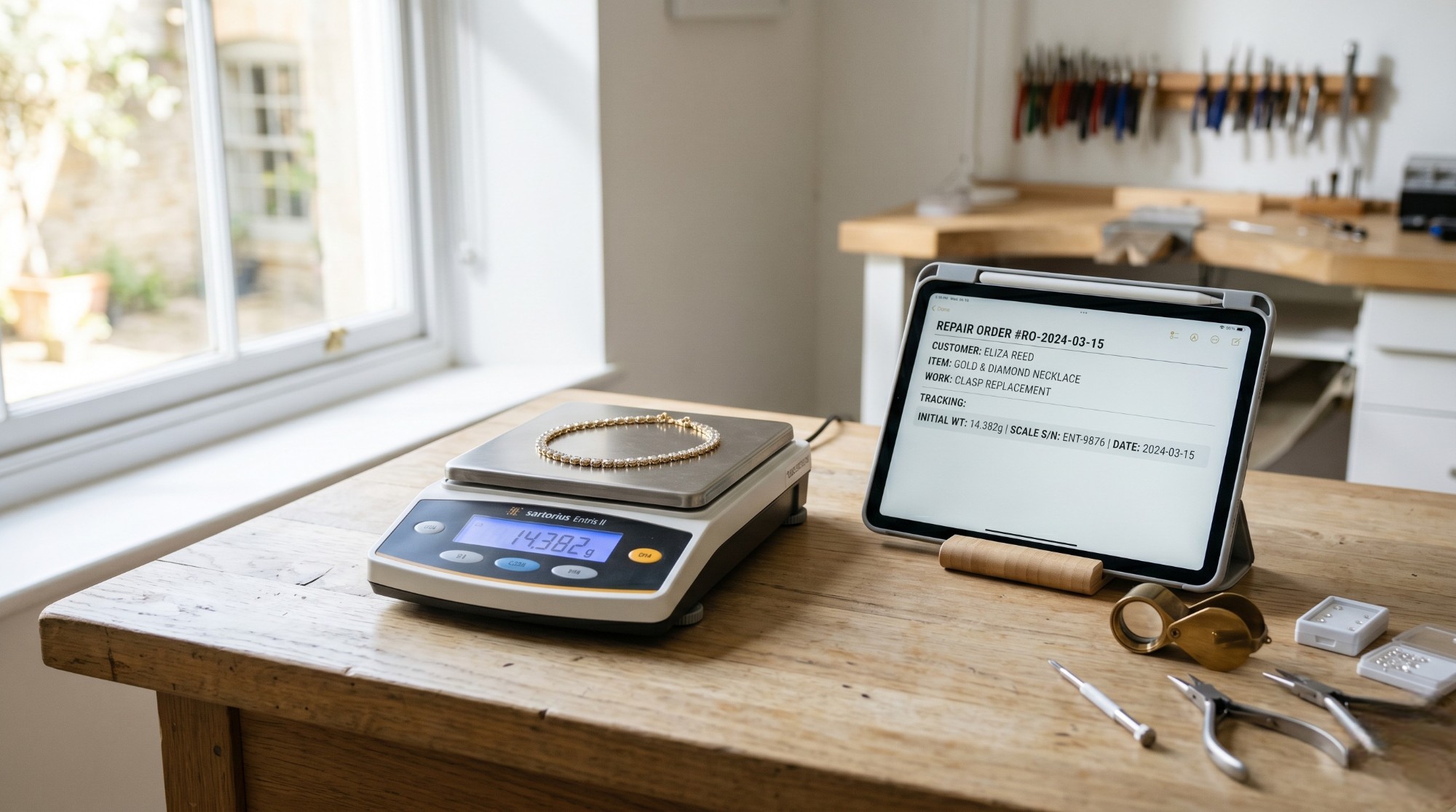
- Photographic Evidence: The associate uses a tablet or connected camera to take high-resolution photos of the item from multiple angles. These photos are permanently attached to the digital work order, documenting the item’s exact condition upon arrival.
- Precise Weighing: The item is weighed on a digitally connected scale. The exact gram weight is logged into the ERP, ensuring the customer receives the exact same mass of gold back (accounting for authorized polishing loss).
- Customer Agreement: The system generates a digital receipt detailing the estimated cost, expected completion date, and terms of service. The customer signs this digitally, and a copy is sent instantly to their WhatsApp or email.
Tracking Order Status and Goldsmith Routing
Once the intake is complete, the physical item is placed in a secure, barcoded envelope that matches the digital work order. The item is then routed to the workshop.
Centralized Workflow Management
A Jewelry Workshop ERP acts as an air traffic control system for your manufacturing floor.
- Task Assignment: The workshop manager reviews the digital queue and assigns specific work orders to specific goldsmiths based on their specialty (e.g., assigning stone-setting to one artisan and rhodium plating to another).
- Status Updates: As the piece moves through the workshop, the goldsmith updates its status on their designated terminal (e.g., “In Progress,” “Awaiting Parts,” “Quality Control,” “Ready for Pickup”).
- Automated Customer Service: Daysum eliminates the need for customers to call the store asking for updates. When the goldsmith changes the status to “Ready for Pickup,” the ERP automatically triggers a customized WhatsApp message to the client, confirming the item is ready and detailing the final balance due.
Table: Paper Repair Logs vs. Daysum Workshop ERP
| Operational Aspect | Traditional Paper Envelopes | Daysum Workshop ERP |
|---|---|---|
| Intake Documentation | Brief handwritten notes; prone to illegibility. | High-res photos, exact digital weights, and signed terms. |
| Order Tracking | Requires physically searching the workshop benches. | Instant live status visible from any store dashboard. |
| Customer Updates | Manual phone calls taking up staff time. | Automated SMS/WhatsApp notifications triggered by status changes. |
| Labor Accountability | Difficult to track which goldsmith worked on which piece. | Digital audit trail logs exactly who performed the work and when. |
| Cost Variations | Hard to adjust initial quotes without messy paperwork. | Quotes updated dynamically; digital approval requested from client. |
Metal Loss Calculation and Accountability
The most critical financial component of goldsmith management is handling shrinkage. Working with gold and silver naturally produces dust and scrap during filing, cutting, and polishing.
Differentiating Allowable Loss from Shrinkage
Management must differentiate between acceptable manufacturing loss (metal dust suspended in polishing liquids or ventilation filters) and unacceptable loss (internal theft or carelessness).
Daysum automates metal loss calculation by enforcing strict weighing protocols:
- Before: The goldsmith logs the exact weight of the raw materials (e.g., gold casting grain and wire) issued for a custom bespoke order.
- During: If the goldsmith requires additional solder or wire during the process, it must be digitally requested and added to the work order’s material cost.
- After: Upon completion, the final polished piece is weighed, alongside any identifiable scrap metal returning to the vault.
The software automatically calculates the variance between the issued weight and the returned weight. Management configures an “Allowable Loss Percentage” within the ERP (e.g., allowing a 3% variance for heavy polishing). If a goldsmith returns a job with a 6% metal loss, the system instantly flags the work order for managerial review, preventing continuous, silent financial leaks.
By deploying Daysum’s comprehensive workshop module, Saudi jewelers protect their margins, secure their clients’ assets, and transform a historically chaotic back-room operation into a highly efficient, trackable profit center. Implementing the right billing strategy is much easier when you read about Tax Invoice Requirements And How To Apply Them In Saudi Arabia.
Frequently Asked Questions (FAQ)
Yes. The intake process has a specific workflow for "Customer Provided Materials." The system logs the exact weight and purity of the old gold the customer brings in, calculates its current market value, and applies it as a financial credit against the final labor and material cost of the new custom design.
When a repair is marked "Completed," and the customer arrives for pickup, the Daysum POS pulls the final billable amount directly from the workshop module. It then generates a ZATCA-compliant invoice that clearly separates the cost of any new materials (e.g., a replacement clasp) from the labor charges, applying the correct VAT to each segment.
Absolutely. The jewelry repair software treats workshop consumables as standard inventory. When a goldsmith uses a 14K lobster clasp for a repair, they scan its barcode. The system adds the cost of the clasp to the customer's bill and deducts the item from the workshop's raw material inventory.
Yes. Daysum allows you to build a comprehensive service catalog. You can pre-program specific prices for standard services (e.g., Ring Resizing Down = 150 SAR, Chain Soldering = 75 SAR). This speeds up the intake quoting process and prevents cashiers from guessing the cost of repairs.
Because the system requires high-resolution photos during intake, you have an immutable baseline. If an item is damaged during the repair process, the digital work order provides the exact specifications needed to replace or compensate for the piece accurately, and the system logs the incident against the specific goldsmith's performance metrics.
Yes. If you do not have an in-house goldsmith and outsource complex repairs, Daysum tracks the "Out of Store" status. The ERP generates a B2B transfer manifest for the third-party workshop, tracking the date it left your store, the expected return date, and the wholesale cost owed to the external contractor.