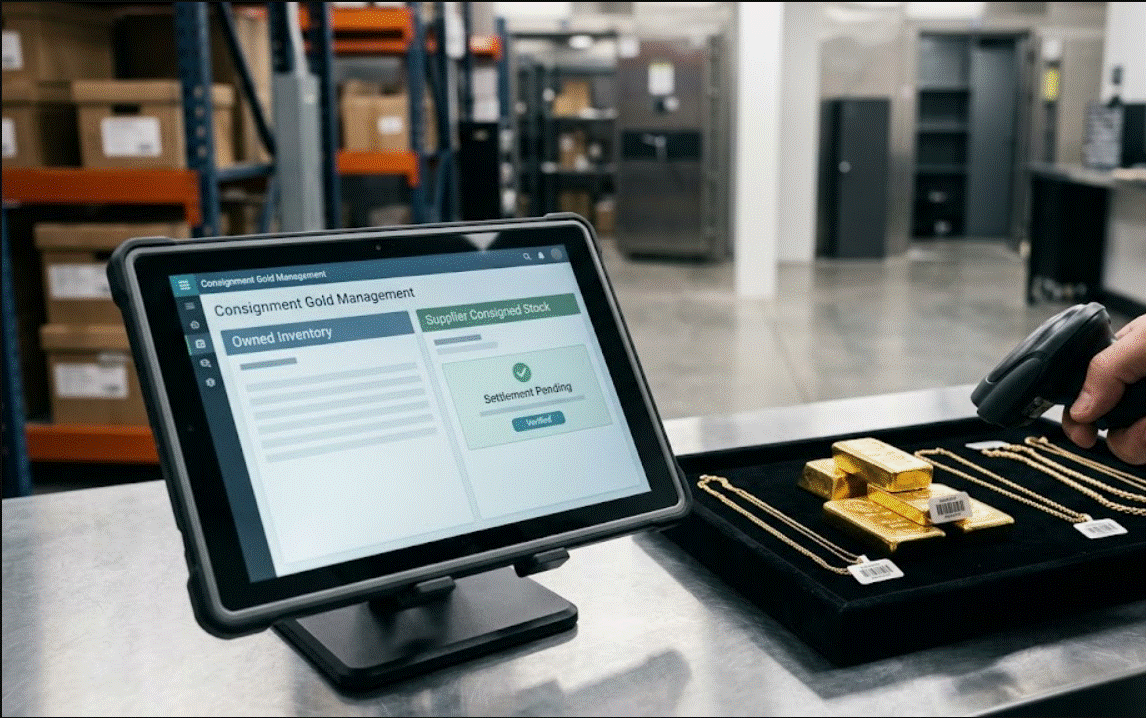
In the intricate, high-value ecosystem of the B2B wholesale gold and jewelry market, liquidity is king. Wholesalers and jewelry distributors are constantly seeking ways to maximize their product range and market reach without tying up their entire working capital in physical inventory. The Consignment gold model has emerged as the industry’s most effective strategy for solving this liquidity challenge. In a consignment arrangement, suppliers provide high-value gold and jewelry to a distributor, retaining ownership of the goods until they are sold to an end buyer.
While this model is a brilliant financial lever, it is also one of the most operationally demanding practices in the precious metals industry. Managing “borrowed” inventory requires a level of ledger precision that standard retail accounting cannot support. When you hold supplier-owned assets, you are essentially the custodian of someone else’s capital. Any discrepancy, delay in reporting, or failure in the settlement process doesn’t just damage a B2B partnership—it introduces immense financial risk. This guide explores how to leverage robust ERP systems to manage consignment inventory, ensuring that your records are pristine, your supplier relationships are secure, and your losses are non-existent.
1. The B2B Dynamics of Consignment Gold
In the B2B gold trade, consignment is a relationship built on trust, yet governed by data. The supplier provides the gold—often in the form of investment-grade ingots or manufactured jewelry—and the distributor holds it in their vault or showroom. The gold remains an asset on the supplier’s balance sheet until the moment it is sold. At that instant, a “consignment settlement” is triggered, moving the title of the asset to the distributor and then to the final client.
For the distributor, the benefit is clear: you can display or stock millions of dollars in gold without having purchased it upfront. For the supplier, the benefit is wider market penetration. However, the operational complexity is immense. You must differentiate between:
- Owned Inventory: Gold you have already purchased and added to your financial ledger.
- Consigned Inventory: Gold in your possession, but owned by a supplier, which must be tracked as a “Liability” or “Off-balance-sheet asset” until sold.
The failure to maintain this distinction is why many jewelry businesses struggle. Without specialized software, tracking “borrowed” stock is a manual nightmare of spreadsheets, where items are easily misplaced or miscounted. To truly succeed, businesses need to utilize benefits of using gold and jewelry management software to ensure that every gram of gold is accounted for by owner.
2. The Accounting Complexity: Why Traditional Methods Fail
The greatest danger in managing consignment gold is the “commingling of assets.” If your warehouse staff treats supplier-consigned gold the same way they treat owned inventory, the financial accounting will inevitably collapse.
When you perform a physical count, you must know exactly how much of the gold in your safe belongs to you and how much belongs to your various suppliers. If you sell a piece that was on consignment, the system must trigger two things:
- A debt to the supplier.
- A reduction in the supplier’s consignment stock level.
Traditional accounting software treats all stock as “Inventory.” It does not understand the nuance of “Ownership.” Consequently, at the end of the month, when it is time to reconcile Balances and process payments, finance teams are left frantically searching through emails to confirm which pieces were sold. This leads to Shortage of funds, disputes over payment amounts, and, in severe cases, the termination of valuable supplier partnerships.
Inventory Management: Consignment vs. Traditional Procurement
| Operational Metric | Traditional Procurement (Purchased) | Consignment Inventory (Borrowed) |
| Ownership Status | Owned by the distributor. | Retained by the supplier. |
| Balance Sheet Impact | Asset (Inventory). | Off-balance-sheet or Liability-matched. |
| Settlement Trigger | Immediate upon purchase. | Upon sale to the final client. |
| Risk of Loss | Borne by the distributor. | Contract-dependent; requires rigorous tracking. |
| Reconciliation Frequency | Simple periodic audit. | Continuous, real-time reconciliation. |
3. Integrating ERP to Master Supplier Accounting
The only way to manage consignment gold without losing your margins is through a highly automated Supplier accounting framework. Your ERP system must be the “broker of trust” between you and the supplier. By implementing an automated ERP, you create a digital environment where the supplier’s inventory is siloed into a “Virtual Consignment Location” within your system.
Real-Time Tracking of Consigned Gold
When a shipment arrives from a supplier on consignment, it is entered into the system as “Consignment Stock.” It is not entered as an asset purchase; it is entered as a custody movement. The system tags this gold with the supplier’s ID. As your sales representatives move this stock to the showroom or fulfill a wholesale order, the barcode scanner captures the item ID.
Automated Settlements
The magic happens at the point of sale. When a piece of consigned jewelry is sold, the ERP system detects the owner. Because the system knows it is “Consignment Gold,” it automatically executes a split-entry process:
- It records the sale to your client.
- It simultaneously triggers a “Purchase” transaction from your supplier.
- It logs the amount due in the Settlements queue for that specific supplier.
This automation ensures that you never miss a payment and that your supplier never has to chase you for their share of the revenue. It transforms the relationship from an adversarial “chasing for money” model into a professional, data-driven partnership. For more on comparing these automated methods with outdated practices, see the comparison between gold accounting software and traditional methods.
4. Managing Balances and Preventing Shortages
One of the most persistent issues in consignment jewelry is the “missing item” discrepancy. In a busy jewelry store or wholesale hub, items can be misplaced, stolen, or damaged. If you are operating on a consignment basis, a missing item is not just a loss of your potential profit—it is a debt you owe to your supplier.
Proactive Shortage Prevention
By using an ERP to manage consignment, you force accountability. Every piece of consigned gold must be associated with a specific user or location. If a piece goes missing, you have the digital breadcrumbs to identify exactly when it was last seen.
Furthermore, real-time Inventory reporting allows you to provide your suppliers with weekly or monthly digital reports. You are no longer guessing what is on hand; you are providing the supplier with a live view of their stock within your facility. This transparency reduces the frequency of physical audit requests from suppliers and increases their willingness to consign larger, higher-value shipments to your business.
To understand how to further bolster your operational integrity, investigate new inventory management technologies for gold stores.
The Settlement Cycle in Consignment Gold
| Process Step | Manual Handling | Automated ERP Handling |
| Stock Reception | Paper logbook entry; high chance of error. | Barcode scan into “Supplier Custody” location. |
| Sale Completion | Manual spreadsheet update. | Automatic purchase trigger from supplier. |
| Financial Reporting | End-of-month manual reconciliation. | Real-time Balances and automated payout reports. |
| Loss Detection | Only identified during annual physical audit. | Immediate flagging of missing stock per consignment ID. |
5. Strategic Benefits of Digital Consignment Management
For the B2B gold wholesaler, digitizing the consignment process provides three distinct competitive advantages.
1. Enhanced Cash Flow Efficiency
By effectively managing consignment, you reduce the capital you have to invest in gold bullion or finished jewelry. You can carry a much wider range of inventory than your competitors because your cash is not tied up on your balance sheet as unsold inventory. The ERP ensures you only pay for what you sell, making your cash flow cycle extremely lean.
2. Strengthened Supplier Relationships
Suppliers are more likely to offer their best pieces to a distributor who provides detailed, transparent, and prompt reports. When you use a system that offers automated Settlements, you remove the friction from the payment process. You become the partner of choice because your accounting is professional, consistent, and error-free.
3. Scaling Your Business
You cannot grow a wholesale operation if your back-office is drowning in manual consignment reconciliations. Automation allows you to add more suppliers and take on more consignments without needing to add more accountants. The system handles the complexity, allowing the business to focus on sales and distribution strategy. To reduce administrative overhead and track employee hours accurately, consider the insights on 5 Common Mistakes In Attendance And Payroll Management.
6. Implementing Digital Consignment: A Roadmap
Implementing a digital consignment system requires more than just installing software; it requires a disciplined approach to process management.
Step 1: Standardize the Contractual Terms
Ensure your ERP is configured to reflect your actual consignment contracts. Do you pay a fixed fee? A percentage of the sale? Does the supplier cover the VAT on the original gold cost? These business rules must be hard-coded into the software’s “Product Price Rules” so the system calculates the payout correctly every time.
Step 2: Establish Digital Chain of Custody
Every gold item, whether from your own stock or a supplier’s consignment, must have a unique identifier. Without this, the system cannot differentiate between the two. Use barcode labels that indicate the supplier ID clearly.
Step 3: Regular Automated Reconciliations
Don’t wait for year-end. Use the ERP to run a “Consignment Reconciliation” report once a month. This compares the system’s “Virtual Consignment” balance with the physical gold on your shelves. Address any discrepancies immediately. For any business ready to elevate their tech stack, looking at the guide to choosing the best gold management software is vital for long-term planning.
Conclusion
Consignment gold is a powerful B2B strategy, but it is not a “set-and-forget” model. It requires the high-level discipline of a sophisticated ERP system to ensure that your financial balances match your physical inventory. By digitizing your consignment tracking, you move from a model of uncertainty and trust-by-chance to one of operational rigor and transparent accounting.
This precision protects your company from losses, streamlines your payments, and solidifies your reputation as a premier business partner. In an industry where trust and accuracy are the pillars of success, an automated ERP is the ultimate tool to maintain those pillars. Whether you are dealing in small, bespoke jewelry sets or massive shipments of investment gold, the ability to account for every milligram of consigned material is the hallmark of a truly mature gold wholesale operation.
Frequently Asked Questions (FAQs)
The system treats consignment stock as a "Virtual Location" in your warehouse. When an item is sold, the ERP automatically triggers a purchase order to the supplier for that specific item. This purchase order then moves into your Accounts Payable (AP) ledger. You only generate a payment for the items that have successfully transitioned from "Consignment Custody" to "Sold."
A robust ERP allows for "Inventory Adjustment" workflows specifically for consignment items. When damage occurs, the system provides a digital form to record the reason for the damage (e.g., handling mishap, store display damage). Depending on your contract with the supplier, this will either trigger a return to the supplier or a mandatory purchase/write-off, ensuring the financial record is adjusted immediately.
Yes. In a professional consignment agreement, the price paid to the supplier is usually locked at the time of sale (or based on the market price of the day the sale is finalized). Because the ERP system is connected to live gold price feeds, it can automatically determine the settlement price for the supplier based on the date the item was actually sold, shielding the distributor from price speculation risk.
Absolutely. The ERP handles this through "Location Management." Your own inventory is kept in your "Store Location," while consigned gold is held in a "Supplier Consignment Location." The system allows you to generate reports that show your total inventory combined, or separated by owner, providing total transparency for both your internal accounting and your external supplier reporting.