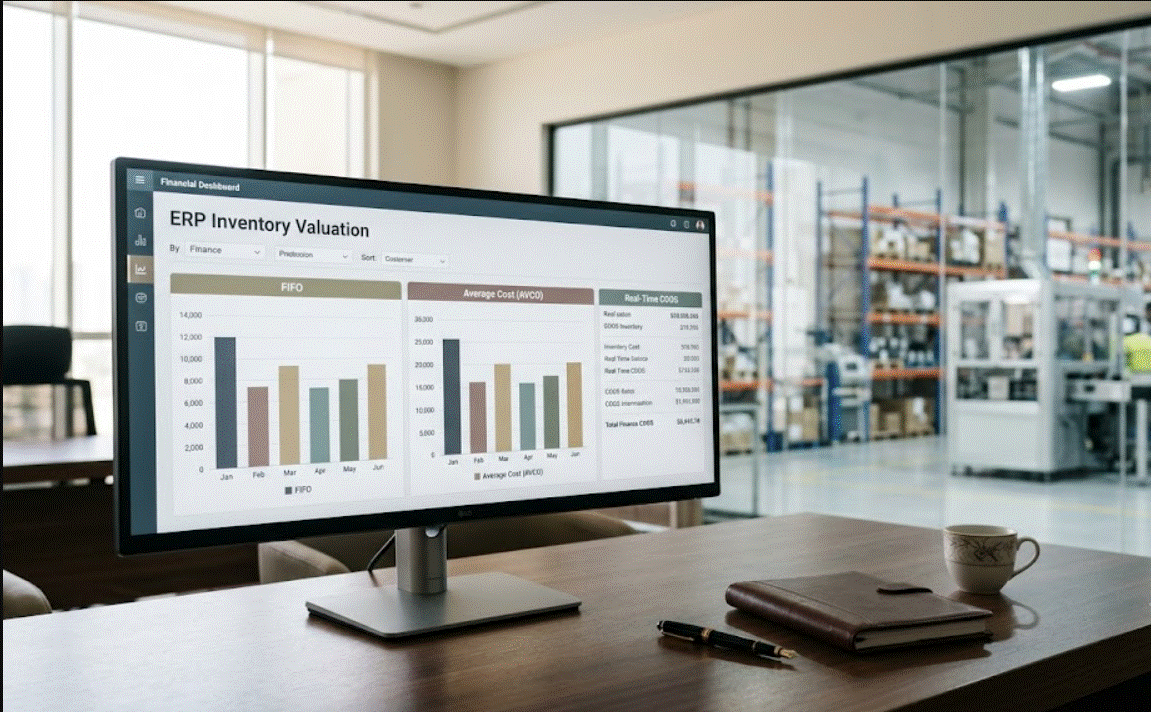
For a Chief Financial Officer (CFO) or a Financial Controller, the integrity of the balance sheet is paramount. At the heart of this integrity lies inventory valuation—a critical component of financial reporting that directly influences the Cost of Goods Sold (COGS), Gross Profit, and ultimately, the Net Income of the enterprise. In the modern, highly regulated business landscape, the choice of an inventory valuation method is not merely an operational setting; it is a sophisticated financial strategy that dictates tax liabilities, investor perception, and cash flow efficiency.
As enterprises evolve from fragmented, manual accounting systems to integrated digital platforms, the transition to Odoo inventory valuation methods marks a significant professional milestone. Odoo’s architecture provides a perpetual inventory framework that automates the accounting entries for every stock movement, ensuring that financial managers have access to real-time, audit-ready data. Whether your organization opts for First-In, First-Out (FIFO) or the Average Cost (AVCO) method, Odoo ERP bridges the chasm between warehouse operations and the general ledger, providing the precision necessary for high-level financial stewardship. This guide explores the accounting logic, strategic implications, and the role of Odoo in maintaining financial accuracy.
The CFO’s Perspective: Why Valuation Strategy Matters
Inventory valuation is often misconstrued as a warehouse management task. For the CFO, it is fundamentally an accounting process. The cost assigned to inventory on the balance sheet represents an asset, while the cost assigned to goods sold represents an expense. Therefore, the method chosen to calculate these values determines the volatility of your income statement and the accuracy of your internal reporting.
When commodity prices are unstable, or when procurement costs fluctuate due to supply chain disruptions, the valuation method creates a divergence in reported earnings. Choosing the wrong method can mask inefficiencies or, conversely, create artificial tax burdens. Furthermore, financial managers must ensure that the chosen method aligns with international financial reporting standards (IFRS) and local tax regulations. Odoo ERP addresses this by offering a transparent, perpetual system where inventory valuations are updated instantaneously, effectively ending the era of waiting for manual end-of-period reconciliations.
Organizations navigating these complexities often find that a robust ERP category setup is the foundation for achieving true financial clarity and operational scale.
Odoo’s Perpetual Inventory Framework
To understand valuation in Odoo, one must first grasp the concept of “Perpetual Inventory.” In traditional accounting models, periodic inventory systems rely on a physical count at the end of the year to determine the value of stock. This creates “black boxes” of uncertainty where the actual inventory value remains unknown for months at a time.
Odoo ERP operates on a perpetual inventory principle, meaning the system generates an automated accounting entry for every single stock movement. When a product is received in the warehouse, the system debits the inventory asset account. When it is sold, it credits the inventory account and debits the COGS account. This real-time automation is the key to professional accounting. It ensures that the General Ledger is a perfect reflection of the physical reality of the warehouse.
This framework allows the financial team to monitor margins, perform variance analysis, and assess the impact of cost fluctuations immediately. For companies undergoing a transition, integrating this level of financial automation is often a highlight of their digital transformation case studies.
First-In, First-Out (FIFO) in Odoo
The FIFO method is grounded in the logical assumption that the items purchased or manufactured earliest are the first ones to be sold. In an Odoo environment, FIFO is a highly disciplined valuation method. It tracks each purchase “layer” (a specific quantity bought at a specific price) and maintains the cost associated with that layer until it is cleared.
The Accounting Logic of FIFO
When a sale occurs in Odoo using FIFO, the system is designed to retrieve the cost of the oldest available inventory batch in the warehouse.
Financial Impact: In an inflationary environment—where the cost of goods is rising—FIFO will result in lower COGS, as the cheaper, older items are expensed first. This leads to higher reported gross profits. While this makes the company’s financial health appear robust, it also increases the tax burden.
Asset Valuation: The inventory remaining on the balance sheet is valued at the most recent, and typically higher, costs. This provides a balance sheet that represents the current replacement cost of the stock.
When to Use FIFO
CFOs generally favor FIFO when:
The organization deals with goods that have an expiration date (perishables).
The company operates in a market where supply costs are generally increasing.
The goal is to maintain a balance sheet that reflects the current market value of assets.
Average Cost (AVCO) in Odoo
The Average Cost method is a powerful tool for organizations that prioritize operational simplicity without sacrificing financial accuracy. Unlike FIFO, which requires tracking individual cost layers, AVCO calculates a moving weighted average of all units in stock.
The Accounting Logic of AVCO
Every time new inventory is purchased or produced at a new price, Odoo’s calculation engine updates the average cost of that product. If you have 100 units at $10 each and you purchase another 100 units at $12 each, the system updates the inventory cost to $11 per unit. When a sale occurs, the COGS is calculated based on this current average, regardless of which specific batch was physically removed from the shelf.
Why CFOs Choose AVCO
Volatility Mitigation: It smoothens out price fluctuations. If your suppliers have erratic pricing models, AVCO prevents the wild swings in COGS that would occur under a FIFO method.
Operational Ease: It significantly reduces the burden on accounting staff, as it does not require tracking individual inventory layers.
Stability: It provides a stable and predictable margin analysis, which is highly beneficial for internal decision-making.
Comparative Impact of Valuation Methods
| Impact Factor | FIFO (First-In, First-Out) | Average Cost (AVCO) |
|---|---|---|
| COGS Basis | Cost of oldest stock layer. | Weighted average of all stock layers. |
| P&L Volatility | Higher; influenced by recent price spikes. | Lower; smoothens price trends. |
| Best Used For | Industries with rapid cost changes or perishables. | High-volume, standardized stock items. |
| Profitability | Tends to show higher profit in rising markets. | Shows more conservative, stable profit. |
| Complexity | High; requires tracking specific batches. | Low; single moving average per product. |
Standard Cost and Variance Analysis
Beyond actual cost methods (FIFO and AVCO), Odoo provides a third powerful option: Standard Cost. This method is the primary tool for managerial accounting, especially in manufacturing-heavy industries.
The Role of Standard Costing
Under Standard Cost, a company pre-determines the cost of an item—covering material, labor, and overheads. This standard is not changed with every purchase invoice. Instead, when the actual cost is realized, the system calculates the “Variance”—the difference between the expected cost and the actual cost.
This is the ultimate tool for a CFO performing operational analysis. If the variance is positive, it signals an inefficiency. Perhaps the raw material price spiked, or the production process was slower than expected. This analysis allows leadership to identify operational leakages that remain hidden under FIFO or AVCO methods.
For businesses deep in the manufacturing sector, specifically in specialized fields like the gold industry, managing these variances and costs is vital for profitability. Learn more about Gold ERP features that support such high-level accounting strategies. Optimizing your precious metals inventory becomes seamless when you leverage Advantages Of Using Accounting Software In The Gold Industry. An odoo gold configuration lets you value inventory by FIFO or Average Cost at the karat level, not just by unit count, which is exactly what jewelry accounting requires. Ask our Odoo team to model both methods on your current stock.
Landed Costs: The Hidden Factor in Valuation
An accurate valuation is impossible if you ignore the “landed costs”—the incidental expenses associated with procurement. Landed costs include customs duties, freight, insurance, and handling fees. These costs must be capitalized into the value of the inventory, rather than being expensed immediately.
Odoo handles this via its “Landed Cost” feature. When a shipping invoice arrives, the finance team can split these costs across the specific purchase orders that incurred them. Odoo then automatically recalculates the inventory value. If the goods have already been sold, it even generates the necessary journal entries to adjust the COGS retrospectively. This level of technical accounting professionalism ensures that the actual cost of the item is never understated. Valuation accuracy starts upstream, at the moment goods are received — see how Odoo’s supply chain module feeds clean cost data into these calculations.
Financial Statement Impact of Valuation Methods
| Market Condition | FIFO Method Impact | Average Cost Method Impact |
|---|---|---|
| Inflationary Prices | Higher Profit, Higher Tax Burden. | Stable Profit, Stable Tax Burden. |
| Deflationary Prices | Lower Profit, Lower Tax Burden. | Stable Profit, Stable Tax Burden. |
| Transparency | High; tracks actual flow. | High; tracks weighted averages. |
| Audit Suitability | High; layer-based traceability. | High; logic-based consistency. |
The CFO’s Role: Ensuring Systemic Accuracy
A robust ERP, no matter how sophisticated, requires systemic discipline. The “Accounting Identity” of an organization is maintained by ensuring that the valuation methods are correctly configured in Odoo from day one and that the team understands the accounting impact of every inventory movement.
The Importance of Implementation
The implementation phase is where the CFO’s influence is most critical. During the setup of attendance and payroll integration or inventory modules, financial managers must ensure that the accounting teams are involved. The accounting setup—including the definition of the Chart of Accounts, the creation of valuation accounts, and the selection of cost methods—is the foundation upon which all future reporting will rest.
A professional integration, typically managed by specialized partners like Daysum, ensures that these accounting rules are not just set but validated through rigorous testing. This prevents the “garbage in, garbage out” phenomenon that plagues many unoptimized ERP deployments.
Conclusion: Accurate Inventory Valuation
Inventory valuation is far more than a technical compliance exercise; it is a financial strategy that dictates how a corporation presents its performance to the world. By adopting FIFO or Average Cost methods within Odoo’s perpetual inventory framework, CFOs can achieve the precision required for high-level fiscal management. FIFO offers a precise, layer-by-layer view that shines in inflationary markets, while Average Cost offers the stability and simplicity necessary for high-volume operations.
When bolstered by Standard Costing and meticulous Landed Cost management, Odoo ERP transforms inventory accounting from a back-office burden into a source of competitive advantage. It provides the visibility required to make informed decisions, the auditability necessary for regulatory compliance, and the consistency needed for long-term strategic forecasting. For the modern financial manager, the Odoo ERP environment provides the tools to move beyond simple accounting, allowing for deeper insights into the company’s operational reality.
Frequently Asked Questions (FAQs)
Switching valuation methods is a complex accounting transition. While Odoo is flexible, changing from FIFO to Average Cost mid-stream requires careful planning, often necessitating the creation of new product categories and a comprehensive re-valuation of existing stock. It is strongly advised to conduct this process at the beginning of a fiscal year and in coordination with your financial auditors to ensure consistent reporting.
Odoo separates these via distinct accounting workflows. The "Purchase Price" (raw material cost) is recorded upon the receipt of the purchase order. Later, when invoices for freight, insurance, or duties arrive, the "Landed Cost" module is used to distribute these expenses across the items in that shipment. The system automatically updates the valuation of the inventory, ensuring the accounting ledger reflects the true cost of the product at the warehouse door.
In an inflationary market, FIFO assumes that the older, cheaper goods are sold first, leaving the newer, more expensive items in stock. This lowers the Cost of Goods Sold (COGS), which increases the Gross Profit. While this leads to higher taxable income, some companies prefer it for financial reporting purposes because it shows stronger profitability, which can be advantageous when seeking investment or financing.
IFRS standards require accurate, real-time financial reporting. Because Odoo uses a perpetual inventory model, every transaction—purchases, manufacturing, sales, and scrap—is immediately reflected in the General Ledger. This provides the continuous tracking of inventory value and COGS that IFRS demands, ensuring that your financial statements are not just snapshots in time, but dynamic and verifiable records of the company's financial performance.