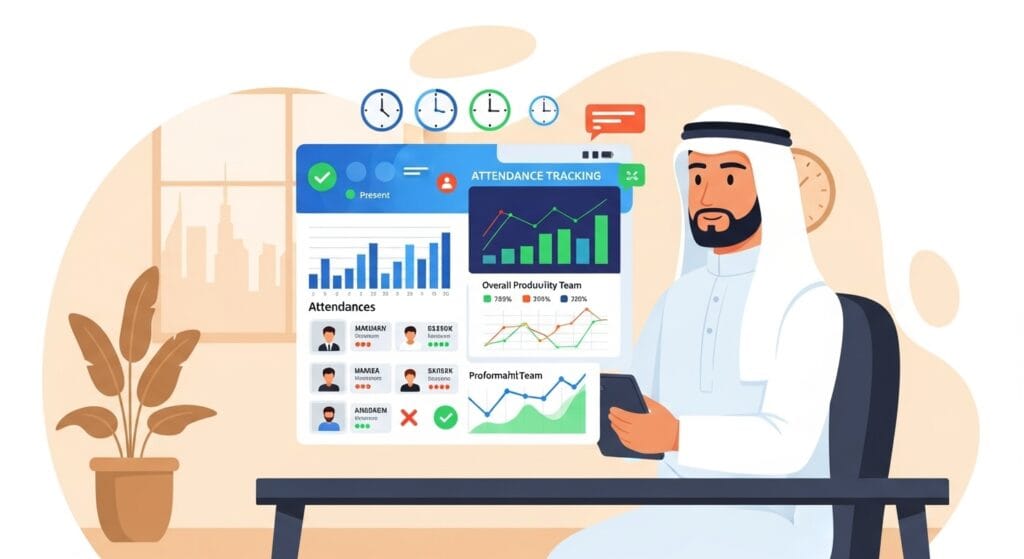
Attendance systems have evolved into a critical nerve center for modern workforce management. In the era of digital transformation, AI in attendance management has emerged as a definitive game-changer, moving beyond the simple “clock-in, clock-out” mechanics toward a sophisticated ecosystem of data integrity and behavioral insight. Traditionally, businesses relied on manual punch cards, handwritten timesheets, or basic biometric scanners—methods notoriously prone to inefficiencies, human error, and “buddy punching.” Today, the integration of Artificial Intelligence ensures that attendance tracking is not only precise but also a strategic asset for organizational security and productivity.
In the Kingdom of Saudi Arabia, this shift is accelerating. The cloud attendance system market is currently witnessing a robust annual growth rate of 12.6%, fueled by the mandates of Saudi Vision 2030. As enterprises strive for higher operational standards, the demand for precision has moved the benchmark for facial recognition accuracy to a staggering 99%. By leveraging these advanced technologies, organizations can finally eliminate the friction of manual oversight while achieving total regulatory alignment.
Achieve full compliance and automation with advanced e invoicing Saudi Arabia tools.
The Strategic Importance of AI in Attendance Management
Artificial Intelligence is fundamentally reshaping how organizations perceive time and attendance. It is no longer just about compliance; it is about the “intelligence” behind the presence. AI-driven systems address systemic challenges that have plagued HR departments for decades.
Eliminating Fraud and “Buddy Punching”
One of the most persistent drains on payroll integrity is proxy attendance, where one employee clocks in for another. AI-powered biometric systems, specifically those utilizing facial recognition with anti-spoofing technology, make this physically impossible. By analyzing unique physiological traits that cannot be replicated or forged, AI ensures that the person being paid is the person actually on-site.
Reducing Administrative Friction
Manual data entry is the enemy of the modern HR department. Every manual log carries a 1% to 5% risk of error, which compounds during payroll processing. AI automates the capture and validation of data, reducing administrative workloads by up to 70%. This allows HR professionals to shift their focus from auditing spreadsheets to strategic workforce development.
Ensuring Qiwa and Regulatory Compliance
In Saudi Arabia, maintaining accurate records is vital for Qiwa and Nitaqat compliance. AI-based systems provide a transparent, immutable audit trail. When a cloud attendance system is integrated with local labor laws, it automatically flags discrepancies, ensuring that the organization remains on the right side of government regulations while protecting employee rights.
Core AI Technologies Powering Modern Systems
The accuracy of an attendance system is only as good as the technology beneath it. Modern AI frameworks utilize a combination of computer vision, location-based services, and machine learning to create a fail-safe tracking environment.
Core AI Technologies Table
|
Technology |
Key Capabilities |
Strategic Benefit |
|
Facial Recognition |
Anti-spoofing, 99% accuracy, touchless verification. |
Eliminates fraud and promotes hygiene. |
|
GPS & Geofencing |
Location-based attendance for field staff. |
Secures remote and project-site operations. |
|
IoT Sensors |
Automated entry logging via smart gates. |
Frictionless, “invisible” attendance tracking. |
|
Predictive Analytics |
Absence forecasting and trend analysis. |
Enables proactive workforce planning. |
Facial Recognition: The Gold Standard
By identifying unique facial landmarks, AI-driven facial recognition provides a touchless and highly secure method of verification. Advanced systems can now recognize faces even with masks or in low-light conditions, maintaining a 99% accuracy rate that basic biometric systems cannot match.
Geofencing for the Remote Workforce
For companies with field operations—such as construction, maintenance, or logistics—cloud attendance system providers like Daysum utilize Geofencing. This creates a virtual perimeter around a job site. Employees can only clock in when their GPS coordinates match the site location, preventing off-site attendance fraud and ensuring that labor costs are accurately attributed to specific projects.
Improving Attendance Accuracy with AI: Quantifiable Gains
The primary objective of improving attendance accuracy is to create a direct link between physical presence and financial compensation. Machine learning models are uniquely equipped to handle this by detecting anomalies that the human eye might miss.
- Anomaly Detection: AI learns the “normal” behavior of a workforce. If an employee who typically arrives at 8:00 AM suddenly clocks in at 4:00 AM, the system flags this for review. This prevents duplicate entries and erroneous logs.
- Reduced Payroll Discrepancies: By automating corrections and providing a full audit trail, AI-powered systems reduce payroll discrepancies by an average of 15%. This transparency fosters a culture of trust between the employer and the workforce.
- Real-Time Data Streams: Unlike traditional systems that sync at the end of the day, AI-driven cloud hrms solutions provide real-time visibility. Managers can see exactly who is on-site at any given second, which is critical for safety in manufacturing and industrial sectors.
The Competitor Landscape: Choosing the Right Saudi Partner
The Saudi market for attendance tech is highly competitive, ranging from hardware-focused giants to agile cloud-based innovators.
Saudi Market Landscape Table
|
Provider |
Market Position |
Key Differentiator |
Pricing Model |
|
ZKTeco |
Biometrics Leader (65% share) |
Massive hardware infrastructure. |
Device-based ($1000+) |
|
Daysum |
Seamless Payroll & Geofencing sync. |
SaaS Subscription |
|
|
IOTee |
Field Operations Specialist |
Mobile GPS + Face focus. |
Custom Enterprise |
|
Bacuratec |
Multi-site Deployments |
Specialized RFID & Hand Geometry. |
Tailored Packages |
While ZKTeco dominates the hardware space, the shift toward a cloud attendance system has made Daysum a preferred choice for enterprises requiring deep integration. When an organization undergoes an odoo implementation saudi arabia, having an attendance system that communicates natively with the ERP’s payroll and accounting modules is essential for minimizing data silos.
ROI in the Saudi Context: Beyond the Price Tag
Investing in AI-powered attendance solutions in the Saudi market—currently valued at approximately $1.2B—offers a multi-dimensional return on investment.
Time Savings and Operational Efficiency
HR departments in Saudi Arabia are increasingly burdened by administrative compliance. Automating attendance tracking saves hundreds of man-hours per month. In sectors like manufacturing, where shift management is complex, AI can automatically calculate overtime, night-shift premiums, and holiday pay, ensuring that the cloud hrms solutions are always in sync with the current budget.
Cost Efficiency
Preventing “buddy punching” alone can save a company 2% to 5% of its total payroll cost. When combined with the reduction in manual processing errors, the system often pays for itself within the first six months of deployment. Furthermore, by ensuring that employees are accurately tracked according to labor laws, companies avoid the heavy fines associated with non-compliance.
Future Trends: The Road to 2030
The convergence of AI with other emerging technologies will continue to push the boundaries of what is possible in attendance management.
- Predictive AI: Future systems will not just report on who is absent; they will use historical data to predict who might be absent during peak seasons, allowing managers to adjust staffing levels proactively.
- Wearable Integration: Smartwatches and biometrically-enabled ID badges will allow for seamless, “walk-through” attendance marking, removing the need for employees to interact with a terminal at all.
- HRMS Convergence: The future lies in end-to-end integration. A cloud hrms solutions platform will manage everything from recruitment and attendance to performance and payroll, providing a unified data layer for the entire organization.
Implementation: A Step-by-Step Blueprint
For a successful, Vision 2030-compliant deployment, Saudi businesses should follow a structured implementation path:
- Requirement Audit: Identify if your primary need is for office-based facial recognition or field-based Geofencing.
- Data Cleansing: Ensure that your employee database is updated and ready for biometric enrollment.
- ERP Integration: If you are planning an odoo implementation saudi arabia, ensure your attendance provider has the necessary API hooks to sync data instantly.
- Pilot and Training: Run a pilot program at a single site to gather feedback and train staff on the new touchless technology.
Conclusion
AI in attendance management has evolved from a luxury to a strategic necessity. By transitioning to AI-powered attendance solutions, Saudi businesses can achieve 99% accuracy, eliminate fraud, and ensure total compliance with local labor mandates. For organizations aiming for operational excellence, the time to move to a cloud attendance system is now.
Ready to transform your HR operations with precision? Contact Daysum today for a personalized consultation and discover how our innovative AI solutions can secure your workforce and streamline your path to Vision 2030 compliance!
Frequently Asked Questions (FAQs)
AI uses facial recognition with "liveness detection." This means it can distinguish between a real person and a photograph or video. It analyzes the depth and texture of the face in 3D, ensuring that only the actual employee can record their presence, regardless of how many people are entering the facility at once.
Yes. By using Geofencing and GPS tracking through mobile applications, AI systems ensure that employees can only clock in when they are physically within the predefined boundaries of the job site. This is ideal for construction and maintenance companies across the Kingdom.
Absolutely. Platforms like Daysum are built with the Saudi market in mind. They integrate with hrms cloud solutions to automatically calculate overtime and deductions in accordance with Saudi labor laws, and they provide the data required for Qiwa and GOSI reporting.
Advanced AI attendance systems use encryption and data hashing. Instead of storing actual images of faces, the system converts facial landmarks into a mathematical code (a hash). This ensures that even if the database were accessed, no personal images could be retrieved, protecting the privacy of your workforce.