In the contemporary corporate landscape of Saudi Arabia, digital transformation is no longer a distant vision—it is an immediate operational requirement. At the heart of this transformation lies electronic invoicing, a cornerstone for improving operational efficiency, streamlining financial transactions, and ensuring absolute transparency. As the Kingdom moves closer to its Vision 2030 goals, the adoption of e-invoicing represents a monumental shift from traditional, error-prone manual methods to a sophisticated, integrated digital ecosystem.
For businesses aiming to stay competitive, understanding the nuances of the Zakat, Tax, and Customs Authority (ZATCA) regulations and leveraging the right technology is critical. This guide explores how e-invoicing serves as a catalyst for growth and why choosing a high-performance e invoicing software saudi arabia is the most strategic move a modern enterprise can make.
What is E-Invoicing? Beyond the Digital Image
Many businesses initially mistake a scanned PDF or a digital photo of an invoice for an electronic invoice. However, under the ZATCA framework, an e-invoice is far more complex. It is a digital document generated, shared, and stored in a structured electronic format.
The Technical Foundation: XML and PDF/A-3
A compliant e-invoice in Saudi Arabia consists of two primary components:
- The Human-Readable Part: Usually a PDF/A-3 file that looks like a traditional invoice.
- The Machine-Readable Part: An embedded XML (Extensible Markup Language) file. This allows ZATCA’s systems and your ERP to “read” the data without manual entry, eliminating 100% of interpretation errors.
The Fatoora Platform Integration
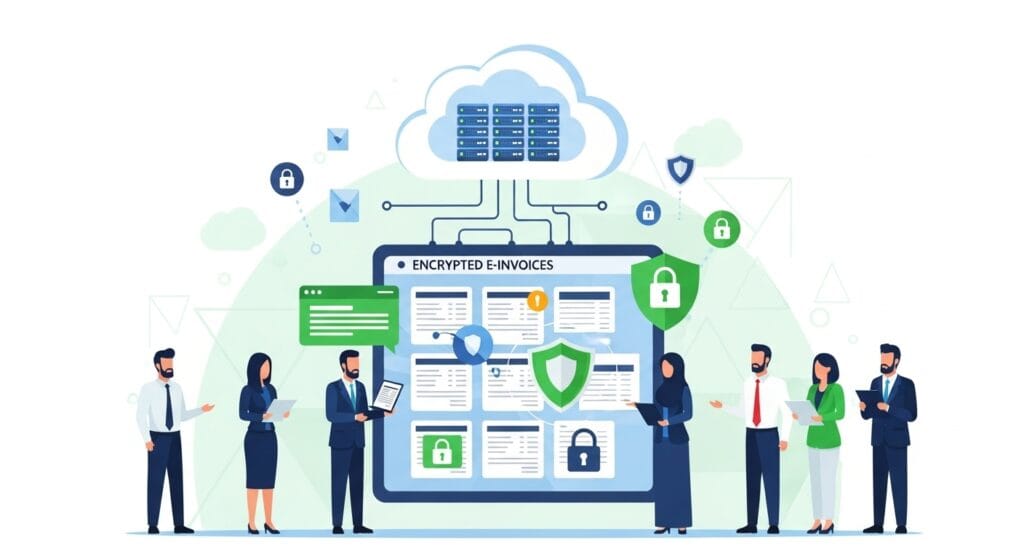
Under Phase 2 (the Integration Phase), invoices are not just stored locally; they are shared via API with ZATCA’s “Fatoora” platform. This system incorporates:
- CSID (Cryptographic Stamp Identifier): A digital “seal” that proves the invoice was issued by your specific system and has not been tampered with.
- QR Codes: Advanced codes containing the seller’s VAT number, timestamps, and total amounts, readable by the ZATCA VAT app for instant verification.
- UUID and Hashing: Each invoice contains a unique identifier and a “hash” of the previous invoice, creating an unbreakable chain that prevents the deletion or modification of records.
The Efficiency Shift: Why E-Invoicing is a Game-Changer
Adopting a robust e invoicing zatca solution is not just about staying on the right side of the law; it is about reclaiming lost time and capital. Studies show that e-invoicing cuts manual errors by up to 80% and processing time by 60% for Saudi businesses.
1. Drastic Reduction in Accounting Errors
Manual data entry is the primary cause of financial discrepancies. Whether it’s a misplaced decimal point or a miscalculated VAT rate, human error can lead to costly audits. E-invoicing automation eliminates 95% of these mistakes. By integrating electronic payment systems directly with your billing, the data remains consistent from the moment of sale to the final entry in the general ledger.
2. Significant Time and Resource Savings
Traditional invoicing is a slow-motion process: printing, mailing, following up, and manual filing. E-invoicing drops the “invoice-to-payment” cycle from an average of 30 days to just 5 days. This frees up nearly 70% of administrative time, allowing your finance team to move away from clerical tasks and toward strategic financial planning.
3. Unprecedented Transparency and Audit Readiness
Real-time ZATCA tracking means your business is effectively “pre-audited.” Because the data is shared instantly with the authority, the risk of disputes or lengthy investigations is minimized. This transparency builds 5x higher credibility with clients and government bodies alike.
Enhancing Operational Efficiency through ERP Integration
The true power of an e invoice saudi arabia system is unlocked when it is not a standalone tool, but a part of an integrated Enterprise Resource Planning (ERP) solution. Daysum specializes in providing this seamless link, ensuring that every invoice issued triggers a cascade of automated efficiency throughout the company.
Linking Sales and Inventory
When an e-invoice is generated in a Daysum-integrated system:
- Inventory is updated instantly: Stock levels drop in real-time, preventing overselling.
- Financials are logged: The revenue and VAT liability are automatically posted to the correct accounts.
- Costing is accurate: The system calculates margins immediately, providing the management team with live data for better strategic decision-making.
This level of integration can cut operational costs by 25-40% by reducing the need for manual reconciliation between different departments.
ZATCA Compliance: The Evolution of Phase 1 and Phase 2
Saudi Arabia’s approach to e-invoicing has been structured to allow businesses to adapt gradually. However, as we move into 2025, the “Integration Phase” (Phase 2) is being fully enforced across most revenue tiers.
The Timeline of Transformation
- Phase 1 (Generation Phase – Dec 2021): Focused on the issuance and storage of invoices. Businesses were required to stop using handwritten or manual Word/Excel invoices and switch to a technical solution.
- Phase 2 (Integration Phase – 2023 onwards): Mandates the API integration between the taxpayer’s system and ZATCA. This includes the requirement for XML formats and digital signatures.
- The 2025 Landscape: By 2025, Phase 2 targets near-universal adoption. Businesses that fail to integrate face severe consequences, including fines that can reach 50,000 SAR for serious violations like tampering with records or preventing ZATCA access.
Top E-Invoicing Solutions Comparison: Why Daysum Leads
When choosing a partner for your digital transition, it is vital to compare how different solutions handle the rigors of Saudi law and operational scale.
|
Solution |
ZATCA Phase 2 |
ERP Integration |
Error Rate |
Cost Level |
Best For |
|
Daysum |
Full API/XML |
Native (Odoo) |
<1% |
Medium |
Comprehensive Operations |
|
ClearTax |
Certified |
API Add-on |
<2% |
Low-Med |
Tax-Focused Firms |
|
Qoyod |
Full |
Basic |
<3% |
Low |
SMBs / Startups |
|
AlBadr |
Compliant |
Sales Only |
5% |
Low |
Small Retail |
The Daysum Advantage
While standalone tools like ClearTax are excellent for tax-focused reporting, they often lack the depth needed for inventory management and manufacturing. Daysum provides a native odoo implementation saudi arabia that builds e-invoicing into the DNA of your business. This ensures that you don’t just meet a compliance checkbox, but actually gain a 25% productivity boost via unified data.
Real Business Gains: The Numbers Behind the Switch
The shift to e-invoicing with Daysum delivers measurable results that impact the bottom line:
- 85% Faster Payments: Automated follow-ups and easy digital payment links ensure customers pay on time.
- 30% Cost Savings: Eliminating paper, printing, and physical storage costs adds up to significant annual savings.
- VAT Accuracy >95%: Automated calculations ensure your VAT returns are always accurate, protecting you from the “hidden cost” of tax penalties.
Moreover, providing an electronic invoice payment system significantly enhances the customer experience. Modern B2B and B2C customers value the speed and professionalism of receiving a compliant digital invoice immediately upon purchase.
Scaling with Integrated Systems
E-invoicing is often the “entry point” for deeper digital transformation. Once a business realizes the efficiency of automated billing, the logical next step is automating other administrative burdens.
For instance, many of our clients integrate their billing with cloud hrms solutions to manage employee expenses and payroll in the same ecosystem where their revenue is tracked. This unified approach provides a “Single Source of Truth” for the entire organization, from the warehouse floor to the CEO’s office.
Conclusion: Turning a Burden into an Asset
E-invoicing has become an indispensable tool for achieving operational efficiency, reducing costs, and increasing transparency. While it began as a regulatory mandate, successful Saudi businesses have realized that it is actually a powerful asset for growth. Adopting this system is no longer optional; it is essential for businesses aiming to stay competitive in today’s dynamic, high-speed market.
Daysum transforms e-invoicing from a compliance burden into a primary driver of efficiency. Our systems ensure you are 100% ZATCA ready while simultaneously amplifying the value of your entire ERP setup.
Start today with Daysum and discover how our integrated systems can enhance your business efficiency while ensuring full compliance with Saudi Arabia’s e-invoicing regulations.
Frequently Asked Questions (FAQ)
Non-compliance can lead to various fines. For example, failing to issue an e-invoice or not including the required QR code can result in fines starting from 1,000 SAR. More serious violations, such as deleting or modifying invoices after issuance, or using a system that does not meet ZATCA’s technical specifications, can incur penalties as high as 50,000 SAR.
Yes. Daysum is designed specifically to handle the "Integration Phase" (Phase 2). We provide the necessary API links to connect your ERP directly to the Fatoora platform, manage the generation of CSIDs, and ensure all XML data is validated before submission to prevent errors.
Yes. E-invoicing is mandatory for all VAT-registered taxpayers in the Kingdom of Saudi Arabia, regardless of the size of the business. The rollout of Phase 2 depends on specific revenue waves, but eventually, every VAT-registered entity will be required to comply with the integration standards.
When e-invoicing is integrated into an ERP like Daysum, every transaction is automatically categorized. The system tracks both input and output VAT in real-time. This means that when it is time to file your return, the data is already compiled, accurate, and ready to be submitted, saving hours of manual work and reducing the risk of calculation errors.