In the heart of the Middle East’s most ambitious economic transformation, the Kingdom of Saudi Arabia is setting a global benchmark for digital governance. Central to this evolution is the Zakat, Tax, and Customs Authority (ZATCA) mandate for electronic invoicing, a move designed to harmonize financial processes, eliminate the “shadow economy,” and foster a culture of transparency. As the Kingdom marches toward its Vision 2030 milestones, the transition to e invoicing saudi arabia has shifted from a mere regulatory hurdle to a fundamental pillar of business survival and growth.
For every VAT-registered business operating within Saudi borders, compliance is no longer a static goal but a dynamic process. The “Fatoora” project, as it is locally known, is a sophisticated ecosystem that demands real-time data exchange, high-level encryption, and seamless ERP integration. Whether you are a small startup or a massive enterprise, understanding the technical nuances of Phase 1 and the complex integration requirements of Phase 2 is critical. This guide provides a deep-dive into how e-invoicing ensures absolute compliance, the technical specifications required by ZATCA, and how Daysum serves as a primary driver for a successful digital transition.
1. The Strategic Roadmap: ZATCA E-Invoicing Phases
ZATCA has strategically divided the e-invoicing rollout into two primary phases to allow businesses time to adapt their technological infrastructure. Understanding where your business sits on this roadmap is the first step toward avoiding hefty non-compliance penalties.
Phase 1: The Generation Phase (Enforced since December 2021)
The first step of the Fatoora project focused on the foundational change from manual or paper-based invoicing to a technical digital solution. During this phase, businesses were required to:
- Generate and store invoices electronically: Scanned copies, handwritten notes, or simple Word/Excel templates became prohibited.
- Include Mandatory Fields: Invoices must contain the supplier’s Commercial Registration Number (CRN), VAT registration details, and a dynamic QR code.
- Prevent Prohibited Functions: Systems used must not allow for the deletion of invoices, modification of logs, or the creation of multiple invoice sequences.
Phase 2: The Integration Phase (The Real-Time Revolution)
Phase 2 is where the true digital transformation occurs. Rolling out in revenue-based waves—with Wave 23 targeting firms with over SAR 750,000 in revenue by March 2026—this phase demands direct API connectivity to ZATCA’s Fatoora portal. This is no longer just about generating a PDF; it is about a live, validated exchange of data.
To navigate this, many firms are seeking a professional odoo implementation saudi arabia to ensure their system can “talk” to the government’s servers without interruption. Phase 2 requires:
- XML/PDF-A-3 Formats: Every invoice must be generated in a specific structured data format (XML) that ZATCA’s servers can read instantly.
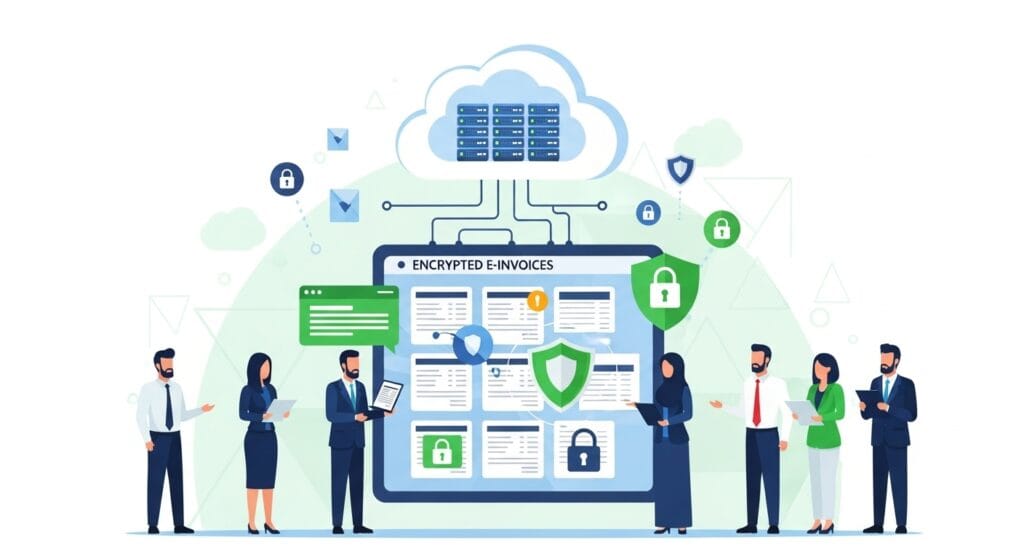
- Cryptographic Stamping: Each invoice is digitally “signed” by the system, ensuring that it has not been tampered with since its creation.
- Real-Time Clearance: For B2B transactions, the invoice must be cleared by ZATCA before it is shared with the buyer. For B2C transactions, reporting must occur within 24 hours.
2. Key Compliance Requirements: The Technical Breakdown
Compliance under the ZATCA mandate is a technical discipline. It is not enough to simply send a digital bill; the electronic invoice ksa must meet rigorous structural and security standards to be considered legal.
Structured Data and UUIDs
Every compliant invoice must contain a Universally Unique Identifier (UUID), a 128-bit number that ensures no two invoices in the Kingdom share the same ID. This prevents sequence duplication and aids in the forensic auditing of financial records. Furthermore, the invoice must be generated as a PDF/A-3 file with an embedded XML. This “hybrid” format allows humans to read the invoice as a traditional document while computers process the underlying data.
Cryptographic Stamps and Digital Certificates
In Phase 2, your system must obtain a digital certificate from the ZATCA portal. This certificate is used to apply a cryptographic stamp to every document. Think of this as a high-security digital wax seal. If a single digit in the invoice total is changed after the stamp is applied, the seal breaks, alerting ZATCA to potential fraud.
The Sandbox and Live Integration
Before a business can go live with Phase 2, ZATCA requires a period of “Sandbox” testing. This is a simulated environment where Daysum and other providers test the API connectivity. The system must successfully generate, stamp, and send invoices to the sandbox portal without errors. Only after passing this rigorous testing does the business receive its live digital certificate.
3. Top Competitors Overview: How Daysum Compares
As Saudi platforms see a surge in searches for compliant tools, several providers have emerged as leaders. However, the depth of compliance and the ease of ERP integration vary significantly.
|
Provider |
Key Features |
ZATCA Phase 2 Support |
Pricing & Best For |
|
Daysum |
Full ERP Automation, AI Analytics, Odoo Native |
Full API/XML/Sandbox Support |
Competitive; Mid-to-Large Enterprises |
|
FatooraPlus |
User-friendly UI, basic analytics |
Full Integration |
Good for small SMEs |
|
Singleclic |
On-premise/Cloud options |
API for ERPs |
Local support focus |
|
Qoyod |
Sales & Inventory management |
Cloud-based XML/QR |
Ideal for startups |
|
Webtel |
SAP/Oracle integration specialists |
100% Accuracy focus |
Big brand use cases |
|
SowaanERP |
Bilingual XML, live testing |
End-to-end support |
Cloud-focused scaling |
Why Daysum Stands Out
While standalone tools like Qoyod are excellent for small retail businesses, they often act as “data silos.” The advantage of using Daysum lies in the e invoicing zatca integration within a broader ERP environment. Daysum ensures that when an invoice is cleared by ZATCA, your inventory is updated, your sales commissions are calculated, and your financial reports are generated instantly. This unified approach eliminates 40% of administrative errors by removing the need for manual data transfer between disjointed apps.
4. The Impact of Compliance on Business Operations
Compliance is often viewed as a cost, but in reality, it is a catalyst for efficiency. By adopting a top gold accounting software or a comprehensive general ERP, Saudi businesses unlock several operational benefits that go far beyond avoiding fines.
Avoiding Penalties and Fines
ZATCA does not take non-compliance lightly. Fines can range from SAR 5,000 for failing to include a QR code to over SAR 50,000 for tampering with electronic logs. For many businesses, a single major violation can wipe out their annual profit margin. E-invoicing automation serves as an insurance policy, ensuring every transaction is “compliant by design.”
Enhancing Trust and Credibility
In the B2B world, transparency is currency. When you provide a ZATCA-cleared invoice, you are proving to your client that your business is legitimate, tax-compliant, and professional. This builds long-term trust with suppliers and high-value clients, making it easier to secure contracts and expand into global markets where digital transparency is the standard.
Efficiency and Speed
Manual invoice preparation is slow and prone to “fat-finger” errors. E-invoicing automates the generation of tax invoices, reducing the time spent on administrative tasks. Businesses using Daysum report that their audit readiness has increased 5x, as their digital records are always organized, timestamped, and ready for inspection.
5. Benefits for Saudi Businesses: The ROI of Digital Transformation
Beyond the “stick” of government fines, there is the “carrot” of massive operational ROI. Digital transformation, when done correctly, pays for itself through cost reduction and increased velocity.
- Reduction in Operational Costs: Moving away from paper, printing, and physical storage saves thousands of riyals annually.
- Improved Cash Flow: Digital invoices are delivered instantly. With integrated e-payment links, businesses see an average 30% reduction in the “Day Sales Outstanding” (DSO) metric.
- Real-Time Data Visibility: Management can view live sales data, VAT liabilities, and inventory levels from a single dashboard. This allows for faster, more accurate decision-making in a fast-moving market.
- Scalability: Modern e-invoicing systems are cloud-based. Whether you open one new branch or ten, the system scales effortlessly to handle the increased transaction volume while maintaining compliance.
6. How Daysum Drives Your Compliance Journey
Daysum is more than a software provider; we are a strategic partner in your digital transformation. We recognize that every Saudi business has unique workflows, and a “one size fits all” approach rarely works for complex industries like gold trading, manufacturing, or large-scale retail.
The 6-Phase Success Methodology
Daysum follows a rigorous methodology to ensure your Odoo or ERP system is ZATCA-ready:
- Discovery: Analyzing your current invoicing and sales workflows.
- Gap Analysis: Identifying what is missing to meet Phase 2 requirements.
- Customization: Developing the specific XML templates and cryptographic stamp modules required.
- Testing: Rigorous sandbox testing against ZATCA’s validation servers.
- Training: Bilingual (Arabic/English) workshops to ensure your staff understands the new digital workflow.
- Go-Live: 24/7 support during the critical transition period to ensure zero downtime.
Conclusion: Don’t Wait for the Next Wave
The ZATCA e-invoicing mandate is a cornerstone of a more efficient, transparent, and digital Saudi Arabia. While Phase 1 was the “warm-up,” Phase 2 is the “main event.” Businesses that wait until the last minute to integrate often face rushed implementations, technical errors, and the looming threat of massive fines.
Compliance with ZATCA’s regulations is not only mandatory but also a strategic step to enhance operational efficiency and build a strong reputation for your business. By moving to an automated system, you are securing your company’s future in the Vision 2030 economy.
Start today with Daysum to upgrade your invoicing system and ensure full compliance with e-invoicing regulations in Saudi Arabia. Our advanced tools are tailored specifically for Saudi operations, ensuring your digital journey is smooth, compliant, and profitable.
Frequently Asked Questions (FAQ)
Daysum’s Odoo implementation provides a "native" compliance experience. Unlike standalone apps, our system links e-invoicing directly to your general ledger, inventory, and HR. This means that when an invoice is issued, the entire business ecosystem is updated instantly. Furthermore, we provide a localized Arabic interface and a 24/7 Saudi-based support team, ensuring that you have expert help whenever you need it.
Yes. All VAT-registered taxpayers in the Kingdom, including branches of foreign companies and businesses with non-resident owners, must comply with the ZATCA e-invoicing regulations. If your branch generates revenue within the Kingdom and is registered for VAT, you must follow the Phase 1 and Phase 2 mandates exactly like a local entity.
Missing your specific revenue wave deadline is a serious compliance failure. ZATCA may impose fines starting from SAR 5,000 for non-compliance with the integration phase, and these fines can escalate quickly. More importantly, your business may lose its ability to generate legal tax invoices, effectively halting your operations until the system is brought into compliance.
It depends on whether your existing ERP is "integration-ready." Many legacy systems cannot generate the specific XML/PDF-A-3 hybrid files or handle the real-time API communication required by the Fatoora portal. Daysum specializes in either upgrading these systems or providing a seamless migration to Odoo, which is natively designed to handle all Phase 2 technical requirements out of the box.