
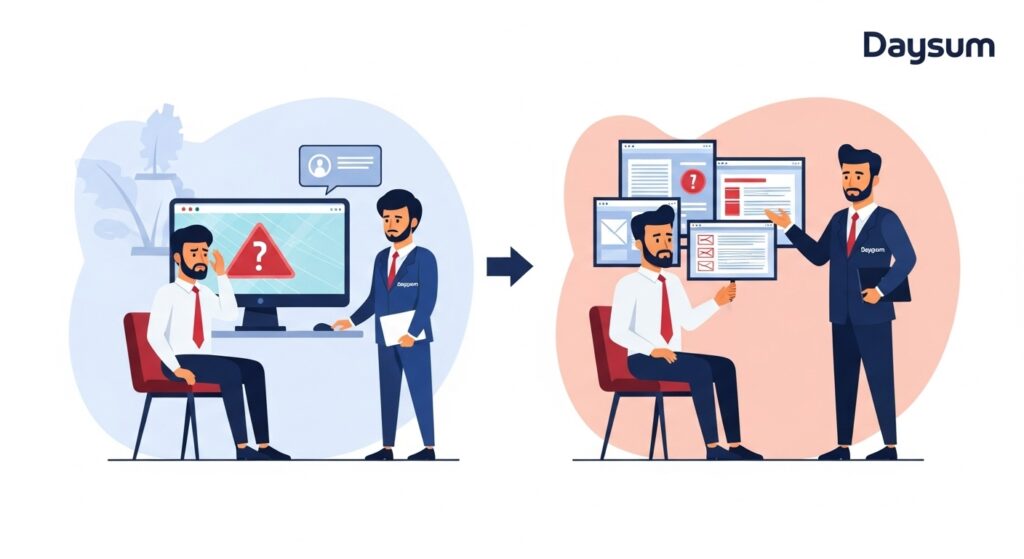
Odoo

Odoo project has stopped ? With Daysum your project is completing

Odoo project has stopped ? With Daysum your project is completing

In today’s hyper-accelerated digital landscape, an Enterprise Resource Planning (ERP) system is no longer a luxury; it is the absolute central nervous system of any growing enterprise. For companies operating within the Kingdom of Saudi Arabia, aligning with the ambitious modernization goals of Vision 2030 requires flawless, automated, and highly scalable business processes. Among the myriad of platforms available globally, Odoo has emerged as a premier choice due to its open-source flexibility, extensive modularity, and comprehensive application ecosystem. However, the path to seamless digital transformation is rarely without its severe hurdles. What happens when your monumental ERP investment grinds to a sudden halt? Whether your stalled implementation is the result of catastrophic technical glitches, poorly coded third-party integrations, a severe lack of localized customization, or an implementation partner who simply abandoned the project, a failed ERP rollout is a commercial nightmare. Odoo projects that stall or fail completely can cost Saudi firms millions of Riyals in operational delays, paralyzed productivity, and devastating regulatory fines. This exact crisis scenario is where Daysum Information Technology steps in. Recognized as the leading Saudi enterprise in reviving stalled and failing Odoo projects, Daysum offers highly tailored rescue operations, free initial gap-analysis consultations, and a professional recovery team. If your project has stalled, do not panic. By securing professional odoo implementation saudi arabia rescue services through Daysum, you can restore your system’s efficiency and seamlessly meet all your strategic business needs. In this exhaustive, definitive guide, we will dissect the root causes behind Odoo project failures, evaluate how to select the ultimate rescue partner, and illustrate exactly how Daysum transforms stalled disasters into triumphant, highly profitable operational assets. 1. Common Odoo Failure Causes: Why Do Projects Stall? It is a harsh industry reality that ERP projects, including those built on Odoo, experience a failure or severe stalling rate of 30% to 50% globally. In the Saudi market, these failures are incredibly costly. Understanding exactly what causes your Odoo program to fail is the critical first step toward engineering a successful revival. The Dangers of Inadequate Local Expertise and ZATCA Non-Compliance A primary and highly destructive reason for project failure is partnering with international or generic implementation teams that possess basic programming skills but completely lack Saudi-specific business expertise. The Saudi commercial landscape is heavily regulated. A generic Odoo setup will immediately face ZATCA (Zakat, Tax and Customs Authority) non-compliance issues. The Saudi government demands highly specific electronic invoicing protocols under Phase 1 and Phase 2 regulations. Implementers who do not understand local tax mapping, Arabic invoicing requirements, or the complex cryptographic stamping processes (CSID) will inevitably deliver a system that is legally unusable. This causes the entire project to halt as management refuses to go live and risk massive government fines. Securing proper e invoicing saudi arabia compliance is not just a feature; it is a legal imperative that generic developers constantly fail to deliver. Unclear Requirements and Rushed Rollouts Industry statistics reveal that up to 65% of Odoo implementation failures trace directly back to unclear business requirements, poor initial process analysis, or aggressively rushed rollouts. When an implementation partner fails to thoroughly map out a company’s specific, nuanced workflows—such as unique manufacturing routing, complex wholesale discounting rules, or multi-warehouse logistics—they end up forcing the business to adapt to standard, rigid Odoo modules. This misalignment frustrates employees, paralyzes daily operations, and ultimately forces management to suspend the rollout. Performance Bottlenecks and Integration Gaps Modern enterprises do not use a single software application; they require a breathing, interconnected ecosystem. A lack of technical expertise in integrating Odoo with legacy accounting systems, third-party logistics (3PL) providers, or local payment gateways (like Mada or STC Pay) leads to severe data silos. Furthermore, poor server architecture and unoptimized custom Python code lead to catastrophic performance bottlenecks. If the system takes minutes to load a simple sales order or crashes during peak hours, productivity plummets, operational costs increase, and the project is abandoned by frustrated users. 2. Choosing the Right Rescue Partner to Fulfill Your Company’s Requirements When your Odoo project stalls, your next decision is the most critical one you will make. You cannot afford to hire another inexperienced vendor or a freelance developer promising cheap fixes. You require a highly specialized “rescue partner” capable of forensically analyzing broken code, untangling messy PostgreSQL databases, and realigning the software with your corporate objectives. The Importance of Certified Learning Partners Look exclusively for companies that combine proven, documented experience in rescuing Odoo projects with official software certifications. Odoo Learning Partners possess an in-depth, verified understanding of the system’s underlying infrastructure. Furthermore, a local Saudi support team is an absolute non-negotiable requirement. Having an Arabic-speaking technical team on the ground that intuitively understands the local market’s needs, consumer behaviors, and labor laws drastically reduces communication friction and cuts issue resolution time by over 40%. Partner Comparison: Who Can Rescue Your System? To make an informed, data-driven decision, let us objectively compare the leading entities in the Saudi market that handle Odoo implementations and complex rescues: Partner Name Project Revival Success Rate ZATCA Phase 2 Compliance 24/7 Local Arabic Support Core Industry Specialties Daysum 95% Revival Success Fully Certified & Native Yes (Dedicated Local Team) Complex ERP, Gold/Jewelry, Retail Perfect Tech High Full Compliance Yes Heavy Construction & Basic AI OdooManics Good (Generalist) Compliant Limited (Often outsourced) Basic Manufacturing & Trading Machinser Medium Basic Integration Yes Generic bug fixes & small retail As the evaluation matrix clearly illustrates, while competitors like Perfect Tech and OdooManics offer competent services for specific niches like construction or basic trading, Daysum stands in an elite category of its own. Daysum uniquely excels in reviving highly complex, stalled enterprise projects, particularly in highly regulated sectors requiring absolute mathematical precision, such as the retail erp saudi arabia sector, precious metals trading, and large-scale manufacturing. 3. What Sets Daysum Information Technology Apart? In a crowded, noisy IT sector, merely claiming to fix software is insufficient. Daysum has engineered a specialized rescue division dedicated entirely to salvaging failed ERP investments.
Read more
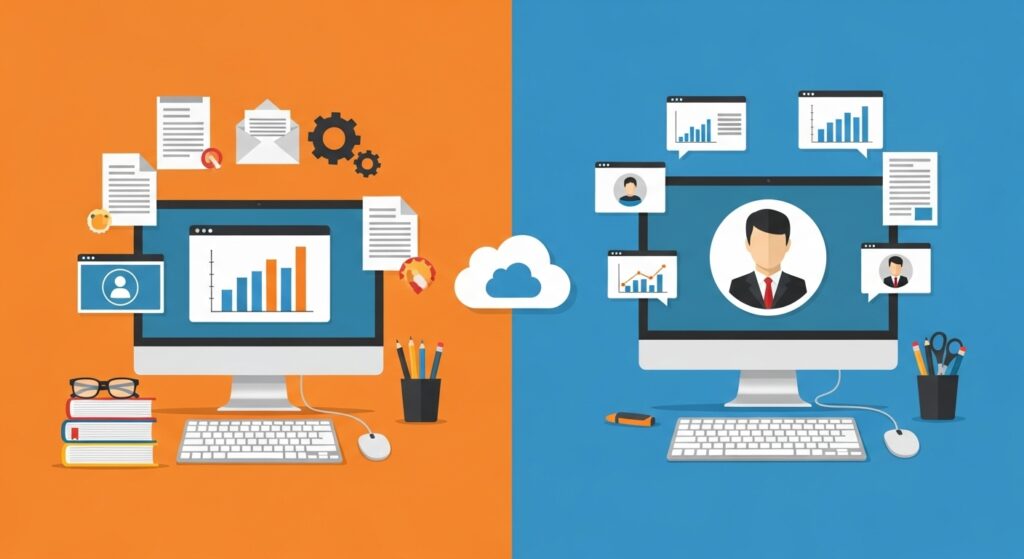
Is Desktop Applications cheaper than Cloud-Based

Is Desktop Applications cheaper than Cloud-Based?!

The business landscape in the Kingdom of Saudi Arabia is undergoing a massive, unprecedented digital revolution. Driven by the ambitious goals of Saudi Vision 2030 and the strict regulatory frameworks implemented by the Zakat, Tax and Customs Authority (ZATCA), local businesses are being forced to modernize their financial and operational infrastructures. In this era of rapid digitization, one of the most critical decisions a business owner or IT director will make is choosing the right foundational software architecture. For decades, the standard approach was to purchase a desktop-based application—an on-premise software installed directly onto local office computers or in-house servers. Today, however, the paradigm has shifted dramatically toward cloud computing. Recent market data reveals that 75% of businesses locally have already adopted or are in the process of adopting cloud technologies. Yet, a persistent myth remains among some traditional business owners: the belief that paying a one-time fee for a desktop application is ultimately cheaper than paying a recurring subscription for a cloud-based system. This comprehensive guide will thoroughly debunk that myth. By analyzing the Total Cost of Ownership (TCO), scalability, security, and compliance requirements, we will demonstrate how a cloud-based ERP like Daysum saves Saudi Small and Medium Enterprises (SMEs) between 40% and 60% in the long term compared to legacy desktop systems. With no upfront hardware costs, automatic ZATCA compliance updates, and fully included technical support, the cloud is not just the more advanced option—it is significantly more cost-effective. The Financial Cost: Uncovering the “One-Time Payment” Trap The most common argument in favor of desktop applications is the illusion of the one-time purchase. A business owner sees a price tag for a perpetual software license and assumes their software expenses are settled for the next decade. However, evaluating business software requires looking at the Total Cost of Ownership (TCO) over a multi-year period. The Hidden Costs of On-Premise Desktop Systems When you purchase a desktop application, the initial software license is merely the tip of the iceberg. A standard enterprise-grade desktop license in Saudi Arabia typically demands an upfront investment of SAR 5,000 or more per device. However, the software cannot run in a vacuum. You must purchase dedicated, high-performance local servers to host the database, which can easily cost tens of thousands of Riyals. Furthermore, desktop software providers usually charge mandatory annual maintenance fees—often around SAR 2,000 per year—just to keep the software functioning and to retain access to basic support. Additionally, managing local servers requires hiring dedicated IT personnel, paying for the electricity to cool the server room 24/7, and purchasing expensive physical backup drives. When you factor in the rising costs of maintaining an on-premise system that complies with modern electronic invoice ksa mandates, the financial burden becomes overwhelming for a growing SME. The Daysum Cloud Financial Advantage In stark contrast, Daysum operates on a Software as a Service (SaaS) model. There are no surprise costs, no hardware investments, and no expensive server maintenance fees. Daysum offers an all-inclusive, highly powerful cloud ERP starting at just SAR 750 per year. This transparent subscription covers the software, the cloud hosting, daily backups, automated security, and 24/7 technical support. By eliminating the need for server purchases, IT maintenance payroll, and expensive localized hardware upgrades, transitioning to a cloud ERP cuts the total cost of ownership by 30% to 35% over a five-year period. For a Saudi SME, preserving this capital means more money can be injected directly into marketing, inventory, and business expansion. The Update Process: Keeping Pace with ZATCA Regulations In the modern Saudi economy, software updates are no longer just about getting new features; they are a strict legal requirement. ZATCA is continuously rolling out new phases of its e-invoicing mandate, requiring businesses to dynamically connect their invoicing systems to the government’s FATOORA portal. The Agony of Desktop Upgrades Updating a desktop application to meet new government mandates is a notoriously painful process. It requires manual intervention, often necessitating an IT specialist to visit your office to install the new patches on every single computer. Historically, major desktop ERP upgrades can take an average of 3 months to fully deploy across an organization, causing massive operational downtime. Furthermore, these major compliance upgrades are rarely free; legacy software vendors frequently force users to pay for the “new version” of the software to remain legally compliant. Instant Compliance in the Cloud Daysum eliminates update anxiety entirely. Because the software is hosted in the cloud, updates are pushed automatically to the central servers without any user intervention or business downtime. As ZATCA rolls out Phase 2 integration requirements—which dictate that XML invoices must be instantly cleared or reported to the government—Daysum updates its core infrastructure behind the scenes. When your employees log in the next morning, the system is already 100% compliant with the latest laws. There are no installation disks, no IT visits, and no additional upgrade fees. It is no surprise that 93% of modern enterprises prefer cloud solutions precisely because of this seamless, stress-free approach to zatca e-invoicing compliance. Technical Support: Remote Resolution vs. Costly Onsite Visits When your billing system goes down, your business effectively stops making money. The speed and quality of technical support directly impact your bottom line. Desktop Support Limitations Technical support for desktop applications is fundamentally flawed. Because the software lives on your local hardware, diagnosing a complex database error often requires a technician to physically travel to your office. These onsite visits are highly disruptive and incredibly expensive, often costing upwards of SAR 1,000 per visit in Saudi Arabia. Even if the issue can be handled remotely, legacy providers typically restrict their support to standard business hours, leaving you stranded if your retail store encounters a critical system failure during a busy weekend evening. Daysum’s 24/7 Cloud Support With Daysum’s cloud ERP, the technical support paradigm is completely transformed. Because your database is securely hosted on Daysum’s servers, their engineering team can diagnose and resolve 80% of technical issues remotely and instantaneously. Daysum provides 24/7 support via live

Read more
top
Business Challenges

Digital Transformation

Security

Automation

Gaining Efficiency