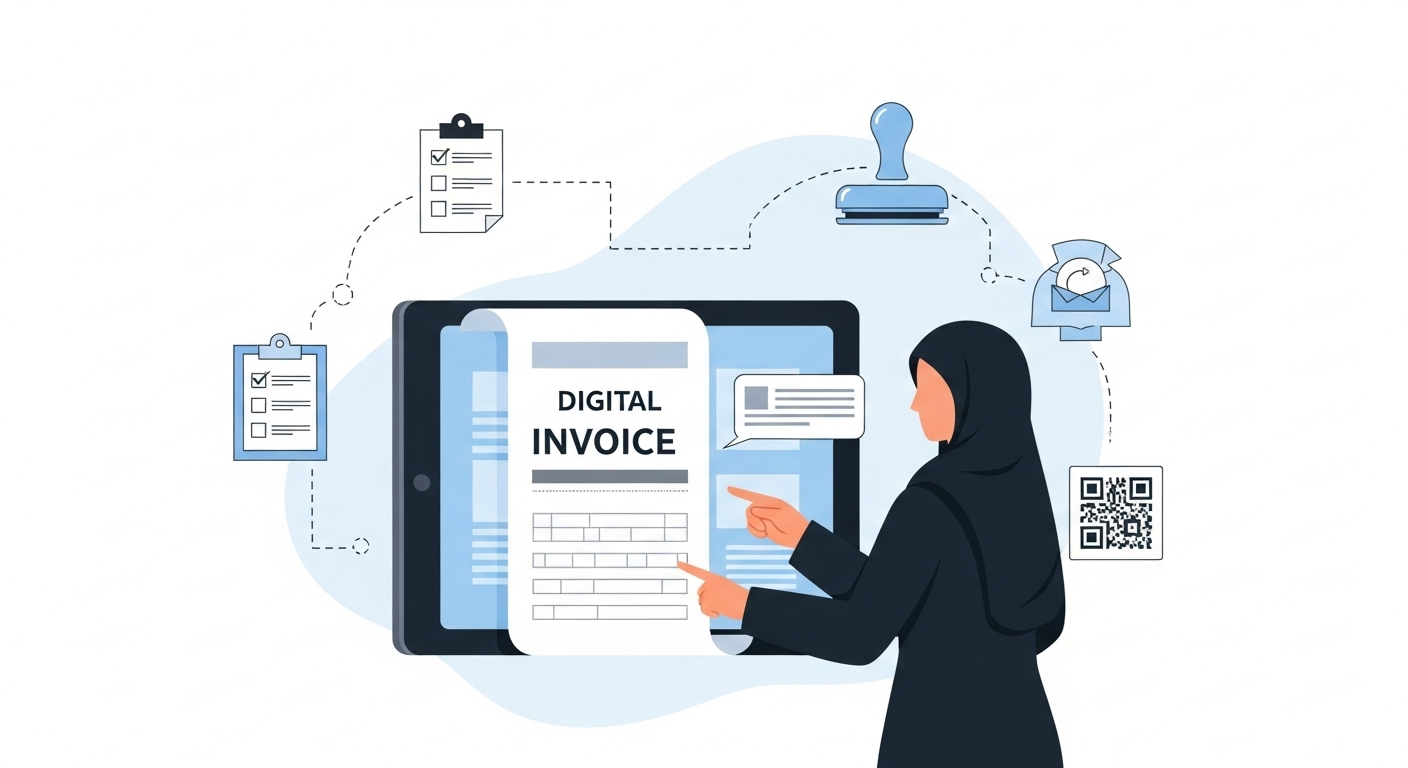
Under the ambitious framework of Vision 2030, the Zakat, Tax, and Customs Authority (ZATCA) has fundamentally transformed how businesses interact with the state through the “Fatoorah” project. In 2026, the tax invoice has become far more than a simple receipt.
For businesses operating in the Kingdom, absolute compliance with VAT laws and e-invoicing regulations is a non-negotiable prerequisite for success. As we move deeper into Phase 2—the Integration Phase—the requirements have become significantly more technical, demanding real-time connectivity between a company’s ERP system and ZATCA’s Fatoora portal. Failing to meet these standards doesn’t just result in administrative headaches; it opens the door to severe financial penalties and operational disruptions. This guide provides a definitive overview of the tax invoice requirements in Saudi Arabia for 2026, offering a strategic roadmap for implementation and compliance.
What is a ZATCA Tax Invoice? Definition and Strategic Importance
A tax invoice in Saudi Arabia is a legal document issued by a VAT-registered person that proves the sale of goods or the provision of services, explicitly detailing the amount of Value Added Tax (VAT) owed. Unlike traditional invoices, a ZATCA-compliant electronic invoice is generated, stored, and shared in a structured electronic format (XML or PDF/A-3 with embedded XML).
Why the Tax Invoice Matters
The primary purpose of the tax invoice is to ensure absolute transparency in commercial transactions. By mandating a standardized format, ZATCA can monitor the movement of goods and services across the Kingdom in real-time. For businesses, the tax invoice is the legal basis for:
- Input Tax Recovery: To claim back the VAT paid on business expenses, a company must possess a valid, compliant tax invoice from its suppliers.
- Audit Readiness: During a ZATCA audit, the first items requested are the sequential, tamper-proof tax invoices that document the company’s revenue.
- Operational Integrity: Modern e invoice saudi arabia systems pull invoice data straight from your sales and inventory records, which removes the re-keying step where most manual accounting errors originate.
Standard vs. Simplified Tax Invoices: Key Differences in 2026
One of the most critical aspects of compliance is choosing the correct type of invoice for each transaction. In Saudi Arabia, invoices are broadly categorized into “Standard” and “Simplified.”
Standard Tax Invoice (B2B / B2G)
A Standard Tax Invoice is primarily used for Business-to-Business (B2B) and Business-to-Government (B2G) transactions. In 2026, under Phase 2, these invoices follow a “Clearance Model.” This means that before you can legally share the invoice with your client, your system must send the XML file to the ZATCA Fatoora portal. ZATCA validates the invoice in real-time, applies a cryptographic stamp, and returns a “cleared” version. Only then is it considered a valid tax document.
Simplified Tax Invoice (B2C)
A Simplified Tax Invoice is used for Business-to-Consumer (B2C) transactions, typically where the buyer does not need to use the invoice for input VAT deduction (e.g., retail sales, restaurants). These follow a “Reporting Model.” The invoice is issued to the consumer at the point of sale (containing a mandatory QR code), and the business is required to report the transaction to the ZATCA portal within 24 hours.
| Feature | Standard Tax Invoice (B2B) | Simplified Tax Invoice (B2C) |
|---|---|---|
| Primary Audience | Businesses and Government Entities | Individual Consumers / Retail |
| ZATCA Model | Clearance (Real-time approval) | Reporting (Within 24 hours) |
| Buyer Details | Mandatory (Name, Address, VAT No.) | Not Mandatory |
| QR Code | Mandatory in Phase 2 | Mandatory in Phase 1 and 2 |
| Format | XML or PDF/A-3 | XML or PDF/A-3 |
| Input VAT Claim | Used by the buyer to claim VAT | Generally not used for VAT claims |
Mandatory Fields and Technical Requirements for Phase 2
As we move into 2026, ZATCA has established a rigorous checklist of data elements that must be present on every invoice. A single missing field can trigger a non-compliance alert.
Basic Information Fields
Every valid tax invoice must contain the following “human-readable” information:
- Document Title: Clearly labeled as “Tax Invoice” or “Simplified Tax Invoice.”
- Seller Details: Legal name, registered address, and the 15-digit VAT registration number.
- Invoice Number: A unique, sequential serial number that cannot be altered or deleted.
- Dates: The date of issuance and the “Date of Supply” (if different from the issue date).
- Line Item Details: A clear description of the goods or services, unit price, quantity, and total amount before VAT.
- VAT Breakdown: The applicable VAT rate (standard 15%, zero-rated, or exempt) and the exact VAT amount for each line.
- Total Amount: The gross total including VAT, displayed in Saudi Riyals (SAR).
Advanced Technical Requirements (Phase 2 Specifics)
Beyond the visible text, your e invoicing zatca solution must generate several “invisible” technical components:
- UUID (Universally Unique Identifier): A 128-bit number that ensures each invoice is globally unique.
- Invoice Hash: A mathematical “fingerprint” of the invoice data that prevents tampering.
- Cryptographic Stamp: A digital signature that verifies the origin and integrity of the document.
- Invoice Counter: A sequential tracker that prevents the insertion or deletion of records in your ledger.
Getting the format wrong costs more than a fine — make sure your ZATCA E-Invoicing setup is fully compliant with Daysum before your next audit.
ZATCA Phase 2 Integration Waves: The 2026 Deadlines
Phase 2 of e-invoicing is being implemented in “waves” based on a company’s VAT-taxable revenue. The threshold has now fallen to a level where effectively every VAT-registered business in the Kingdom is inside the integration scope.
The 2026 Integration Roadmap
If your business falls into the following revenue brackets, you must complete your integration with the Fatoora platform by the specified deadlines:
| Integration Wave | Targeted Revenue (VAT-taxable) | Integration Deadline | Status |
|---|---|---|---|
| Wave 23 | Exceeding SAR 750,000 (2022, 2023 or 2024) | March 31, 2026 | Closed |
| Wave 24 | Exceeding SAR 375,000 (2022, 2023 or 2024) | June 30, 2026 | Closed |
If your revenue crossed SAR 187,500 in any of those four years and you have not yet integrated, Wave 25 is your deadline. ZATCA notifies targeted taxpayers directly at least six months before their integration date.
The Penalty Waiver Grace Period
ZATCA’s “Cancellation of Fines and Exemption of Financial Penalties Initiative” has been extended for a further six months, effective from July 1, 2026 and running until December 31, 2026. It waives penalties for late registration, late payment, late filing of returns, and VAT return corrections — but it does not cover tax evasion violations, fines already paid, or fines attached to any return that falls due after June 30, 2026. ZATCA has also confirmed that if the initiative is extended past December 2026, that extension will not reach returns due after June 30, 2026. To qualify, you must be registered with ZATCA, file all outstanding returns, and settle the full principal tax due (an approved installment plan is acceptable if applications are made while the initiative is live).
Choosing the Right ERP Solution (Daysum vs. Others)
While some businesses opt for standalone billing tools, market leaders are increasingly moving toward integrated systems that link their invoices directly to their operations.
The Daysum Advantage: Integrated Automation
Daysum, an Odoo-based ERP solution, provides a “native” integration experience. This means that your retail erp saudi arabia does not just “send” a file to ZATCA; it builds the tax logic into your sales and inventory workflows. For specialized sectors, such as the jewelry industry, using a top gold accounting software ensures that complex factors like gold weight, craftsmanship fees, and VAT are calculated with 100% accuracy before the invoice is even generated.
| Comparison Factor | Daysum (Odoo-Based) | Standalone Tools (e.g., Qoyod/Daftra) | Global ERPs (e.g., SAP/Oracle) |
|---|---|---|---|
| ZATCA Phase 2 | Full Native API Integration | Basic API Support | Requires expensive custom middleware |
| Inventory Linking | Real-time (Auto-adjusts stock) | Generally manual or basic sync | High complexity |
| Localization | Saudi-specific (Arabic/ZATCA) | Good | Often lacks deep KSA localization |
| Cost | Scalable for SMEs to Enterprise | Low | Very High |
Why Advanced Integration Matters
By using a comprehensive e invoicing software saudi arabia, businesses can automate their reporting. For example, when a sale is made, Daysum automatically:
- Generates the XML and PDF/A-3 hybrid file.
- Obtains the CSID and cryptographic stamp from ZATCA.
- Updates the general ledger and VAT liability report.
- Reconciles the “cleared” invoice status within the system.
Practical Steps to Apply Tax Invoice Requirements
If you are just starting your compliance journey or moving into Phase 2, follow this step-by-step checklist to ensure a smooth transition:
Step 1: Verification of Tax Registration
Ensure your business is properly registered with ZATCA and has a valid 15-digit VAT number. You cannot issue a legal tax invoice without this number.
Step 2: System Selection
Choose an e-invoicing solution that is officially “ZATCA integration-ready.” Look for providers that have passed the “Sandbox” testing and can generate XML and PDF/A-3 formats.
Step 3: Onboarding on the Fatoora Portal
Register your technical solution on the ZATCA Fatoora portal. This involves generating a One-Time Password (OTP) and obtaining your digital certificates (CSID).
Step 4: Staff Training
The technical system is only half the battle. Your sales and accounting teams must understand the difference between B2B and B2C invoices and know how to handle “rejected” invoices if the ZATCA portal identifies an error.
Step 5: Secure Archiving
Establish a digital archive that is tamper-proof and accessible for at least six years. Daysum’s cloud-based storage ensures that your invoices are archived in a structured, audit-ready format.
Penalties for Non-Compliance in 2026
ZATCA has tightened its field audits and technical monitoring. In 2026, the “Cost of Non-Compliance” has never been higher.
- Failure to Issue or Store E-Invoices: Penalties for this category run from SAR 5,000 up to SAR 50,000, and ZATCA escalates them with each repeated violation rather than applying a flat figure.
- Tampering with Logs or Records: One of the most serious violations, carrying fines up to SAR 50,000.
- Preventing ZATCA Access: Fines for obstructing an audit or preventing ZATCA from accessing your electronic records can reach SAR 50,000.
- Missing QR Codes: On simplified invoices, a missing or unreadable QR code is an immediate operational violation.
The waiver window now closes on December 31, 2026, and it will not cover returns falling due after June 30, 2026. For any business still running unintegrated billing, the arithmetic is simple: correcting your status inside the window costs setup effort, correcting it afterwards costs setup effort plus penalties.
Conclusion: Compliance as a Gateway to Efficiency
Modernizing your billing through electronic tax invoices allows you to expedite payment processes, obtain accurate financial insights, and build a relationship of trust with both your customers and the state.
Start today with Daysum to implement an easy, accurate, and fully compliant electronic tax invoicing system.
Frequently Asked Questions (FAQ)
Yes. According to VAT regulations, all Tax Invoices and Simplified Tax Invoices must be in Arabic. While you can include English as a secondary language (bilingual invoices), the Arabic text remains the mandatory legal requirement for compliance and auditing.
It depends on your system's technical capabilities. To be Phase 2 compliant, your system must be able to connect via API to ZATCA’s servers, generate XML or PDF/A-3 formats, and support cryptographic stamping. If your current software lacks these features, you will need to upgrade to a compliant solution like Daysum.
Under Saudi VAT law, a Standard Tax Invoice (B2B) must generally be issued by the 15th day of the month following the month in which the supply took place. However, for B2C transactions (Simplified Invoices), the invoice is typically issued immediately at the point of sale.
ZATCA requires businesses to store their electronic invoices, credit notes, and debit notes for a minimum period of six years. For certain sectors, such as real estate, the retention period can be much longer (up to 15 years). These records must be stored in a structured electronic format that is safe from unauthorized alterations.