Running a retail business is generally a straightforward mathematical equation: you purchase inventory at a specific wholesale cost, mark it up by a certain percentage, and sell it to the consumer for a profit. However, the moment you step into the world of precious metals, this standard retail equation completely shatters.
Jewelry store owners do not deal with static commodities. They operate in a highly volatile market where the underlying value of their primary raw material — gold — fluctuates by the minute based on global economic indicators, currency strengths, and geopolitical events. A necklace sitting in a display case on a Monday morning might literally be worth a different amount by Wednesday afternoon, entirely independent of any action taken by the store owner.
Beyond the fluctuating baseline price, the valuation of a single piece of jewelry is incredibly intricate. It involves calculating the exact karat purity (18k, 21k, 22k, 24k), factoring in the precise weight down to the milligram, adding the labor costs associated with crafting the piece (making charges), and accounting for the microscopic amounts of metal lost during the manufacturing process (wastage). If a piece includes precious stones or diamonds, an entirely separate layer of valuation and certification must be integrated into the final price.
Attempting to manage this multi-layered complexity using generic spreadsheets or standard retail management tools is a recipe for disaster. Generic tools treat a gold ring like a pair of shoes — a static SKU with a fixed cost. They cannot comprehend live market rates, nor can they accurately process the exchange of old scrap metal from a customer as partial payment for a new piece. This massive operational gap is precisely why transitioning to specialized digital infrastructure is no longer an optional upgrade for modern jewelers; it is a fundamental requirement for survival and growth.
Also read: Steps for Creating an Effective Accounting System for Gold Stores
What Are the Tangible Benefits of Upgrading Your Financial Tools?
When a jewelry business transitions from manual ledgers or generic software to a platform built specifically for the precious metals trade, the impact is felt across every single department. The transformation goes far beyond simply keeping the books balanced. It alters how sales are closed, how inventory is secured, and how executives plan for the future.
Eliminating Manual Errors in Complex Cost Calculations
The most immediate and critical benefit is absolute mathematical accuracy. In the precious metals industry, a calculation error of a few percentage points on a high-weight transaction can completely wipe out the profit margin for that entire sale.
Specialized platforms automate the most stressful parts of the checkout process. They pull live market rates directly into the point-of-sale interface. When a piece is scanned, the system automatically runs the formula: (Live Metal Rate x Item Weight x Purity Factor) + Labor Charges + Wastage + Applicable Taxes. By removing the human element from this complex equation, businesses eliminate the risk of accidental underpricing or overcharging, ensuring that every single transaction is perfectly optimized for profitability. For businesses aiming to secure their margins, finding the best gold accounting software is the first critical step toward financial accuracy.
Streamlining Daily Operations and Enhancing Customer Experience
The modern consumer expects a frictionless purchasing journey. If a customer has to wait twenty minutes at the counter while the sales representative manually calculates the value of their old gold trade-in, calculates the price of the new item, and drafts a handwritten receipt, the excitement of the purchase quickly turns into annoyance.
An advanced integrated accounting system connects the front-end sales counter directly with the back-office ledgers. Invoicing becomes instantaneous. The system can easily handle split payments, process trade-ins, generate digital warranties, and issue precise tax invoices in a matter of seconds. This operational efficiency not only reduces the administrative burden on the staff but also dramatically elevates the perceived professionalism of the brand in the eyes of the customer.
Empowering Leadership with Real-Time Decision Making
Relying on end-of-month financial reports is like driving a car while looking only in the rearview mirror; you see where you have been, but you cannot react to what is right in front of you. Because the value of inventory fluctuates daily, jewelry store owners need a live pulse on their financial health.
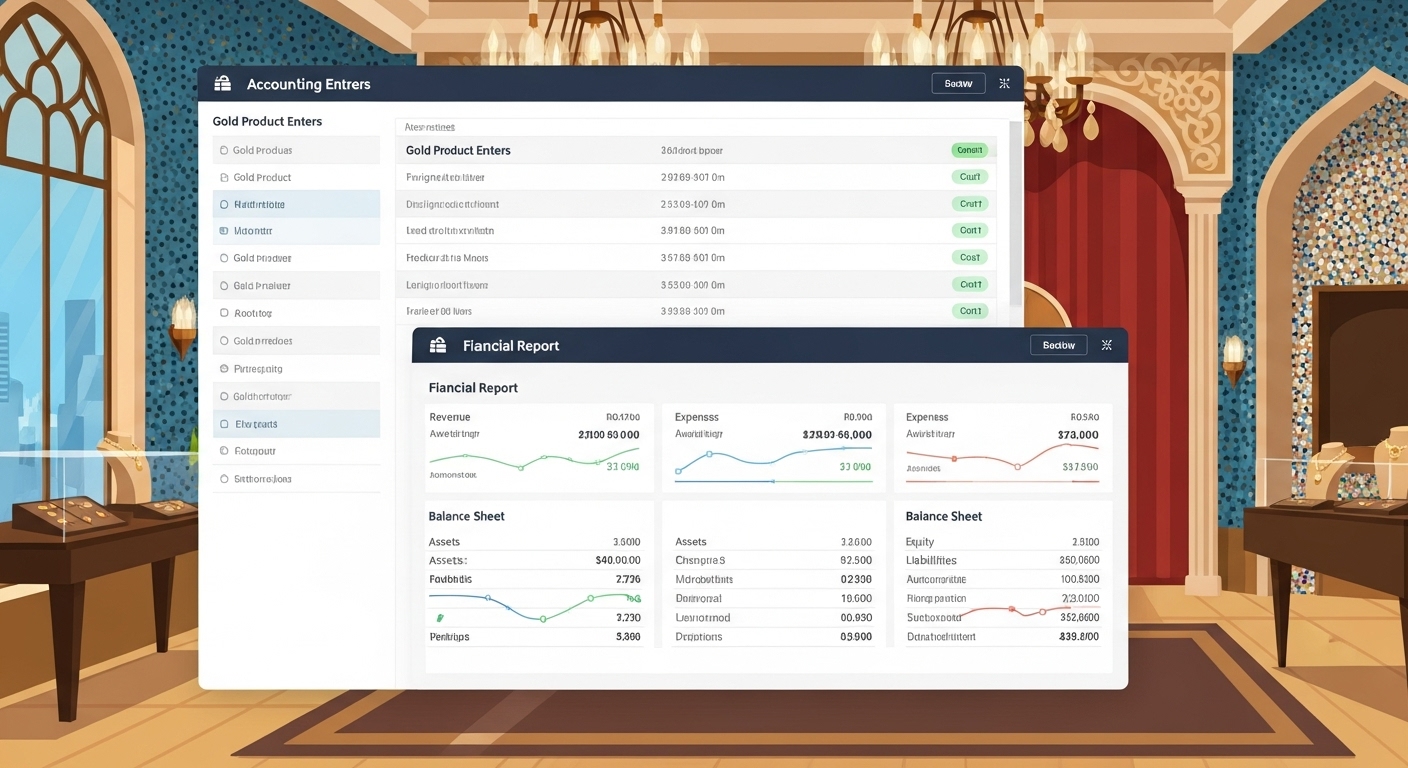
Modern digital tools provide real-time Profit and Loss (P&L) dashboards. If the global market price spikes unexpectedly, management can instantly see the exact adjusted value of their entire showroom inventory. They can identify which specific designs are moving quickly and which are tying up capital, allowing them to make immediate, data-backed decisions about purchasing, melting down slow-moving stock, or adjusting their marketing strategies.
Establishing Unbreakable Inventory Control
“Shrinkage” is a polite retail term for theft, loss, or misplacement. In a standard clothing store, losing a t-shirt is a minor annoyance. In a jewelry store, losing a single high-purity bangle is a severe financial blow.
Advanced systems treat inventory control with the seriousness it deserves. Every single item is assigned a unique serial number or lot number, tied to an item-level barcode. This level of granular tracking means management knows exactly when an item was manufactured, which artisan worked on it, which display case it currently sits in, and which salesperson showed it to a customer last. This meticulous tracking deters internal theft and makes daily auditing a fast, highly accurate process rather than a stressful, days-long ordeal — and it is the foundation of any serious effort at reducing shrinkage in the jewelry workshop.
Bulletproofing Your Financial Data Security
A jewelry business’s database contains incredibly sensitive information: high-net-worth client profiles, massive inventory valuations, and detailed banking data. Protecting this information from external cyber threats and unauthorized internal access is paramount.
Top-tier software platforms deploy enterprise-grade security protocols. They utilize end-to-end encryption for all data transfers, ensuring that even if intercepted, the information is unreadable. Furthermore, they implement strict role-based access controls. A junior sales associate might only have permission to view the selling price of an item, while only the branch manager has the credentials to view the actual manufacturing cost or the supplier details. Automated, encrypted cloud backups ensure that a physical disaster at the storefront does not result in the permanent loss of the company’s financial history. These measures are covered in depth in our guide to cloud ERP cybersecurity for jewelry stores.
How Do You Select the Perfect System for Your Store?
The market is flooded with software vendors promising to revolutionize your business. However, selecting the right partner requires a deep understanding of your own operational bottlenecks. Buying a system with features you do not need is a waste of capital, while buying a system that lacks critical industry-specific functions will only create new frustrations.
To navigate this decision, executives must evaluate potential platforms against a strict set of criteria tailored specifically to the precious metals trade.
| Core Factor | Priority Focus for Jewelry and Gold Businesses |
|---|---|
| Specialized Inventory Features | Must support detailed lot/serial tracking, varied metal purity classifications, gemstone management, and seamless syncing with live global market rates. |
| Advanced Cost Accounting | Must handle Multi-level Bills of Materials (BOM) for manufacturing, easily calculate variable making charges, and accurately account for material wastage. |
| Comprehensive Reporting | Must generate customized P&L statements tailored to metal trading, and provide rigorous tax compliance reporting (including automated VAT and ZATCA e-invoice output). |
| Deep Integration Capabilities | Must offer native connections between Point of Sale (POS) terminals, Customer Relationship Management (CRM) tools, and backend manufacturing modules. |
| Long-Term Scalability | Must be capable of handling an expanding database without slowing down, supporting growth from a single retail boutique to a multi-branch wholesale network. |
| Uncompromising Security | Must provide secure bank synchronization, encrypted data storage, and detailed, unalterable audit trails to track every interaction with precious assets. |
Unpacking the Selection Criteria for High-Volume Retailers
Understanding the table above is crucial, but digging into why these factors matter will guide you toward making the most profitable software investment. Let’s break down these critical selection criteria.
1. Why Are Generic Inventory Features Insufficient?
When working through how to choose the right gold management software, you must scrutinize how the system handles the physical items. A generic system tracks quantity. A specialized system tracks identity.
In the jewelry trade, you might have twenty rings that look identical to the naked eye, but each has a slightly different weight and a different diamond clarity. The software must be able to generate and read highly specific item-level barcodes that instantly pull up the exact specifications of that unique piece. Furthermore, if the system cannot automatically update the pricing of your entire inventory based on a live feed of the global spot price, it is fundamentally useless for a modern jeweler.
2. The Necessity of Multi-Level Cost Accounting
Manufacturing jewelry is a complex, multi-stage process. You might buy raw bullion, hand it over to an artisan who melts it down (incurring a weight loss), mixes it with alloys to reach a specific karat purity, sets stones provided by a different supplier, and then returns the finished product.
Applying sound gold accounting principles requires a system that can track this entire journey. It must use a Bill of Materials (BOM) feature that links the cost of the raw metal, the cost of the specific artisan’s labor, the value of the lost wastage, and the cost of the stones into one unified “Cost of Goods Sold” figure. Without this, you are merely guessing at your true profit margins — which is why workshop and repair order management has to live inside the same system as your ledger, not beside it.
3. Reporting and Strict Tax Compliance
Taxation in the precious metals industry is heavily scrutinized by regulatory bodies. In Saudi Arabia specifically, that means Value Added Tax on making charges and trade-ins, plus the Phase 2 e-invoicing mandate from the Zakat, Tax and Customs Authority (ZATCA), which requires every invoice to be generated in a compliant format, cryptographically stamped, and reported — not typed up after the fact.
If your staff has to manually calculate which portion of a trade-in transaction is taxable, mistakes will happen, leading to severe audit penalties. The ideal platform automatically separates the taxable labor charges from the raw material exchange according to the applicable treatment, and generates compliant digital invoices instantly, securing your operations against regulatory fines. Generating an accurate, compliant electronic invoice must be an automated background process, not a manual chore.
Stay compliant and error-free; integrate ZATCA E-Invoicing seamlessly into your daily operations with our gold-specialized software.
4. Seamless Integration Across All Departments
A disconnected business is a slow business. If your sales team is using one software at the counter, your accounting department is using separate software in the back office, and your workshop is tracking their orders on paper, data gets lost in the gaps.
A true Enterprise Resource Planning platform unifies these departments. When a customer orders a custom engagement ring at the POS, the CRM updates their profile, the workshop immediately receives a digital manufacturing ticket with the design specs, and the accounting ledger automatically reserves the raw materials from the vault inventory. This unified ecosystem entirely eliminates double data entry and the associated human errors.
5. Securing the Future Through Scalability
The system you choose today must be able to support the business you intend to become in five years. Many lightweight applications run perfectly fine when managing a single store with two registers. However, when that business expands to five branches across different cities, a central warehouse, and a dedicated manufacturing facility, those lightweight applications crash under the weight of the data.
You must select a cloud-based infrastructure that is designed to scale horizontally. It should allow you to add new branches, onboard hundreds of new employees, and manage tens of thousands of SKUs without experiencing any lag or requiring massive hardware upgrades. If expansion is on your roadmap, read our comparison of multi-branch jewelry ERP setups before you commit.
How Does Daysum Resolve the Unique Challenges of the Precious Metals Trade?
Recognizing these massive industry hurdles is exactly what led to the development of Daysum. We understand that jewelry store owners are tired of trying to force their complex operations into generic retail software boxes. Daysum was engineered from the ground up to respect the unique mathematics, the high stakes, and the rapid pace of the precious metals market.
Implementing a dedicated gold ERP system through Daysum means you are adopting a system that speaks your language. Our platform natively understands the difference between 21k and 18k, it effortlessly manages the complex calculations of making charges and wastage, and it provides your sales team with an incredibly fast, intuitive point-of-sale interface.
Daysum brings the power of enterprise-level automation to your showroom. From flawlessly executing multi-item trade-in transactions to generating real-time profitability dashboards for the executive team, every feature is designed to reduce administrative drag and protect your margins. By utilizing advanced cloud architecture, Daysum ensures that whether you are managing a single boutique or a nationwide chain of showrooms, your inventory is secure, your pricing is mathematically perfect, and your business is fully equipped to scale confidently into the future.
Conclusion: Advantages of Using Accounting Software in the Gold Industry
The gap between a generic accounting package and a gold-specialized one is not a difference in feature count — it is a difference in whether the software understands the product at all. A price that moves by the minute, a weight and karat attached to every item, making charges that vary by workshop, wastage that has to be booked, and a tax treatment that changes the moment a customer trades in old metal: any system that does not treat those five as design assumptions will keep asking your staff to cover the gap with calculators and paper. Choosing the specialized system is what moves a showroom from being run on personal experience to being run on a documented, auditable number.
Frequently Asked Questions
Actually, the opposite is true. On-premise servers are highly vulnerable to physical theft, hardware failure, fires, and local power surges. If the server in your back room breaks, your entire business halts. Premium cloud-based platforms store your encrypted data in massive, highly secure data centers with multiple redundancies. This guarantees that your financial records are safe from physical store damage and can be accessed securely from anywhere if an emergency occurs.
Specialized platforms are built exactly for this scenario. The software provides a unified checkout screen where the sales associate can ring up the new item (automatically calculating its price based on the live rate) and simultaneously input the details of the customer's old gold. The system automatically calculates the current meltdown value of the scrap, subtracts it from the cost of the new item, and clearly displays the remaining balance to be paid in cash or by credit card, generating a fully itemized receipt.
In most cases, no. Modern cloud-based systems are designed to be hardware-agnostic, meaning they run entirely through secure web browsers. You can typically use your existing desktop computers, laptops, or even tablets. While you may want to upgrade your barcode scanners or receipt printers to take full advantage of the software's speed, the core system does not require you to invest in expensive, proprietary computer hardware.
This is a common concern, but high-quality software is designed with user experience as the primary focus. The backend mathematics are incredibly complex, but the front-end interface that the staff uses is designed to be as simple and intuitive as a smartphone app. With proper onboarding and a few days of hands-on practice, even the least tech-savvy staff members generally find that the software makes their daily jobs significantly easier and far less stressful.
Live-rate integrated systems are designed to handle this volatility seamlessly. The software connects to a live feed that updates the spot price continuously. When a sales associate begins a transaction, the system usually "locks" the current rate for a specific, short window of time (e.g., 5 or 10 minutes) to allow the customer to complete the checkout process fairly. If the transaction takes longer, the system will prompt the associate to refresh the screen to reflect the newest market reality, ensuring neither the store nor the customer is disadvantaged by sudden market swings.