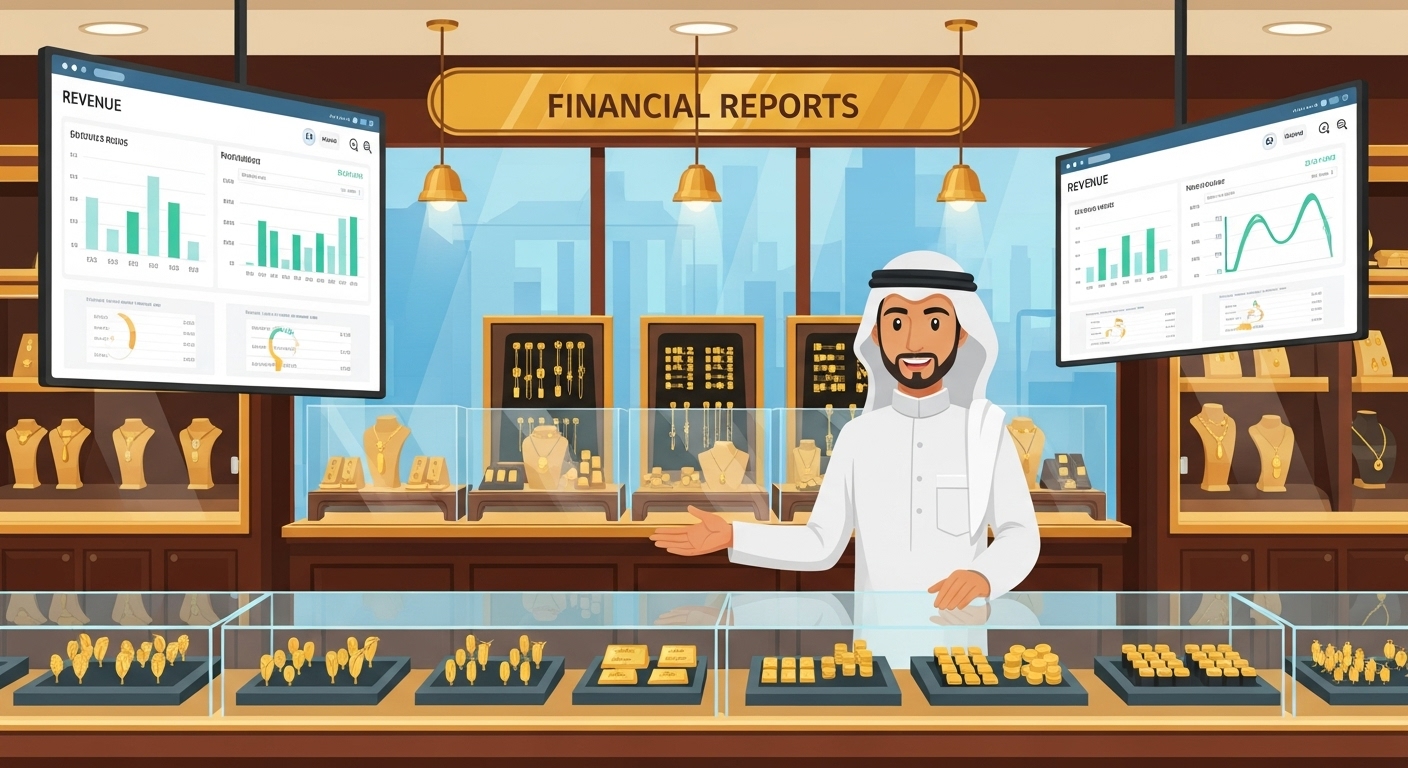
Running a retail enterprise is a complex endeavor in any sector, but operating a jewelry and precious metals business introduces an entirely different tier of financial complexity. If you own a furniture store, the cost of a wooden dining table remains static from the moment it enters your warehouse until the moment a customer buys it. You understand your exact profit margin before the customer even walks through the door. The precious metals industry, however, completely defies this traditional retail logic.
In this highly specialized trade, you are dealing with a commodity whose underlying value fluctuates continuously based on global economic shifts, currency exchange rates, and international geopolitical events. The raw materials sitting in your display vaults are technically worth a different monetary amount today than they were yesterday. This constant state of flux means that relying on generic bookkeeping methods or manual spreadsheets is not just inefficient; it is actively dangerous to the survival of the business.
Without a crystal-clear, mathematically perfect view of where your money is tied up, how quickly your assets are moving, and what your true profit margins are after factoring in variable making charges and metal wastage, you are essentially flying blind. Understanding the importance of financial analysis in the gold industry is the first major step toward transforming a vulnerable retail shop into a highly resilient, data-driven enterprise. Comprehensive reporting is the only mechanism that allows business owners to separate actual, realized profits from temporary, on-paper gains caused by a sudden spike in the global market rate.
When management teams have access to pristine, accurate documentation, they no longer have to guess about the health of their company. They can see exactly which operational components are bleeding cash and which are generating substantial revenue, allowing them to pivot their strategies with absolute confidence.
What Specific Core Benefits Do Accurate Reports Bring to the Showroom?
The creation of financial documents is often viewed as a tedious chore required only for tax authorities or external auditors at the end of the fiscal year. This mindset severely limits a company’s potential. When utilized correctly, these documents act as a powerful diagnostic tool that highlights the immediate strengths and weaknesses of the daily operations.
Implementing proper accounting gold principles and generating consistent analytical documents provides three massive, non-negotiable benefits to the business owner:
-
Preventing Devastating Liquidity Crises Through Cash Flow Tracking:
The jewelry business is notoriously capital-intensive. Purchasing just a few kilograms of high-purity bullion or restocking heavy bridal sets requires a massive outlay of cash. If a store owner does not strictly monitor the flow of cash coming in from daily sales versus the cash going out to suppliers and overhead, they can easily encounter a liquidity crisis. This happens when the store is highly profitable “on paper” because of massive inventory reserves, but physically lacks the cash required to pay the monthly rent, disburse employee salaries, or capitalize on a sudden dip in the global spot price to buy cheap raw materials. Accurate reporting acts as an early warning system, ensuring sufficient liquid funds are always available.
-
Maintaining an Honest and Accurate Inventory Valuation:
Your inventory is your biggest asset, but how much is it actually worth right now? If you purchased a heavy 24-karat piece six months ago when the market was peaking, and the market has since cooled down, carrying that item on your balance sheet at its original purchase price provides a false sense of financial security. Advanced documentation automatically adjusts the value of your unsold stock based on the current reality of the market. This truthful valuation is critical because it prevents management from making aggressive expansion decisions based on inflated asset numbers.
-
Building Unshakable Trust with Investors and Financial Institutions:
Growth requires capital. Whether you are looking to secure a substantial business loan from a major bank to open a second branch, or you are seeking private investors to fund a new manufacturing workshop, you must prove your financial stability. Banks do not lend money based on beautiful showroom displays; they lend money based on cold, hard data. Presenting potential partners with meticulously maintained, error-free financial histories demonstrates professional competence, significantly lowering their perceived risk and increasing your chances of securing the necessary funding at favorable interest rates.
Which Essential Documents Dictate the Financial Health of a Jewelry Business?
While there are dozens of different analytical metrics a business can track, there are three fundamental documents that form the undeniable core of any serious financial strategy. Understanding how to read, interpret, and act upon these specific reports is what separates struggling retailers from market leaders.
To completely understand the mechanics of these documents, we must look at how they function specifically within the context of a precious metals operation.
|
Essential Report |
Primary Purpose |
Crucial Impact on the Precious Metals Trade |
|
The Profit & Loss Statement (P&L) |
To summarize all revenues, costs, and expenses incurred during a specific period. |
It clearly separates the revenue generated from the metal’s weight versus the revenue generated from labor and making charges, highlighting the true source of your profit. |
|
The Cash Flow Statement |
To track the exact movement of liquid cash flowing into and out of the business. |
It ensures the store always has the liquidity needed to make urgent, bulk purchases from bullion suppliers without relying on high-interest emergency loans. |
|
The Inventory Turnover Report |
To measure the exact velocity at which stock is sold and replaced over a given timeframe. |
It identifies which heavy, capital-draining pieces are sitting in the vault unsold, preventing the business from over-investing in unpopular designs. |
Deep Dive: The Profit & Loss (P&L) Statement
Often referred to as the Income Statement, the P&L is the ultimate scorecard for your business over a specific month, quarter, or year. In a standard business, a P&L is relatively simple. However, utilizing gold accounting software allows jewelers to break down their P&L into highly specific industry categories.
A specialized P&L will show you the exact “Cost of Goods Sold” (COGS). For a jeweler, COGS is not just the price paid to the wholesaler. It includes the original cost of the raw bullion, the exact amount paid to artisans for crafting the piece, the financial value of the metal lost during the melting and polishing process (wastage), and any fees associated with hallmarking or certification. By subtracting this highly detailed COGS from your total sales revenue, you arrive at your Gross Profit. If your P&L reveals that your Gross Profit is shrinking despite high sales volume, it immediately signals that either your manufacturing costs are too high, your wastage is out of control, or your retail markup is not keeping pace with the rising cost of raw materials.
Deep Dive: The Cash Flow Statement
A business can be highly profitable and still go bankrupt if it runs out of cash. The Cash Flow statement is divided into three distinct sections: Operating Activities (cash from selling jewelry and paying daily bills), Investing Activities (cash used to buy new display cases or security vaults), and Financing Activities (cash from bank loans or paying dividends to owners).
For a gold store, the Operating Activities section is paramount. If you notice a trend where cash outflow consistently exceeds cash inflow, it means your capital is getting trapped in the display cases. You are buying inventory faster than you are selling it. This document forces the management team to align their purchasing habits with their actual sales velocity, ensuring the company never faces a paralyzing cash drought.
Deep Dive: The Inventory Turnover Report
This document measures the heartbeat of your showroom. Inventory turnover calculates how many times you have sold and replaced your entire stock over a year. A low turnover ratio is a massive red flag. It indicates that you have significant amounts of capital frozen in pieces that customers simply do not want to buy. Every day a piece sits in the vault, it incurs holding costs (insurance, security, storage) that quietly eat away at your profit margins.
Conversely, an unusually high turnover ratio might seem like a good thing, but it often indicates that your store is chronically understocked, meaning you are likely missing out on potential sales because customers cannot find the variety they desire. Finding the perfect velocity—where stock moves quickly enough to generate consistent cash but is deep enough to satisfy customer demand—is impossible without the precise mathematics provided by this report.
How Do Data Analytics Shift the Focus from Survival to Market Dominance?
Generating the reports is only half the battle; the true power lies in extracting actionable insights from the numbers. When leadership teams actively analyze sales data to improve strategies, the entire operational methodology of the business shifts from a defensive posture to an aggressive, growth-oriented mindset.
Here is exactly how diving into the data transforms daily decision-making across the organization:
- Engineering Superior Pricing Strategies:
Not all jewelry is created equal. The data might reveal that your lightweight 18-karat daily wear items sell incredibly fast but yield a very thin profit margin per item. Meanwhile, your heavy 21-karat bridal sets might only sell once a month, but they generate massive profit margins. Understanding this dynamic allows you to optimize your pricing. You can afford to offer slight discounts on the fast-moving items to drive massive foot traffic, knowing that the real revenue is secured by maintaining strict pricing on the high-value bridal sets. - Ruthless Cost Reduction and Supplier Negotiation:
Financial reports act as a spotlight on hidden inefficiencies. By analyzing the data, you might discover that your holding costs are spiraling out of control due to excessive insurance premiums on overstocked vaults. More importantly, data gives you immense leverage when dealing with suppliers. If your reports show that Supplier A consistently delivers pieces with a 4% wastage rate, while Supplier B maintains a 1.5% wastage rate for identical quality, you now have the hard evidence needed to renegotiate contracts with Supplier A or shift your purchasing entirely to the more efficient vendor. - Tracking Key Performance Indicators (KPIs):
To maintain market dominance, you must monitor specific metrics continuously. One of the most critical KPIs for this industry is the Gross Margin Return on Investment (GMROI). This metric tells you exactly how much gross profit you earn for every single dollar invested in inventory. If your GMROI is declining, it is an immediate signal that your inventory is too expensive relative to the price your customers are willing to pay. Tracking these KPIs ensures that the executive team is never surprised by end-of-quarter results, as they have been monitoring the trends weekly.
How Does Daysum Empower Owners with Flawless Financial Intelligence?
Understanding the critical necessity of these documents is easy; actually producing them flawlessly in a volatile market is incredibly difficult. Forcing generic retail accounting software to handle the complex variables of making charges, live spot prices, and varying karats is a frustrating process that almost always results in corrupted data and inaccurate reports.
This massive operational gap is precisely why the most forward-thinking businesses in the region are migrating their infrastructure to Daysum. Daysum is not just a digital ledger; it is a comprehensive gold erp system engineered specifically from the ground up to handle the unique physics of the precious metals trade.
Daysum completely removes the manual burden of financial reporting. By creating a unified digital ecosystem, Daysum connects your front-end Point of Sale terminals directly to your back-end accounting ledgers. When a sales associate completes a transaction involving a complex trade-in of old metal for a new piece, Daysum instantly updates the inventory, calculates the exact gross margin based on the live market rate, processes the applicable taxes, and feeds that data directly into the Profit & Loss statement in real-time.
Furthermore, Daysum understands the role of financial reports in improving store performance. The platform provides executive leadership with highly visual, interactive dashboards. Instead of waiting weeks for the accounting department to compile a spreadsheet, owners can view their live cash flow status, their current inventory valuation, and their exact profitability metrics with a single click from their smartphone or desktop. By choosing Daysum, you are eliminating the guesswork, entirely eradicating manual calculation errors, and giving your organization the exact analytical clarity required to dominate the market and scale your operations with absolute confidence.
Frequently Asked Questions
While large corporations might rely on quarterly reviews, the volatility of the precious metals market requires a much tighter feedback loop. Store owners should conduct a high-level review of their P&L weekly to catch any immediate pricing anomalies or sudden spikes in expenses. A deep, comprehensive analysis of the P&L should be conducted monthly to adjust purchasing strategies and ensure the overall health of the business remains fully aligned with the yearly goals.
If you are using outdated or generic software, the answer is no; you must manually calculate the new value of your stock, which is nearly impossible. However, when utilizing a specialized, industry-specific ERP platform, the system connects to a live market feed. It automatically recalibrates the financial value of your entire unsold inventory based on the current global spot price, ensuring your balance sheet always reflects absolute reality.
The most common and devastating mistake is confusing "revenue" with "liquid cash." A jeweler might sell a massive volume of pieces during a holiday season, generating huge revenue figures. However, if they immediately use all of that incoming cash to pay off long-term debts or buy illiquid assets (like new store fixtures) instead of reserving capital to pay their immediate suppliers or staff salaries, they will trigger a severe liquidity crisis despite having a record-breaking sales month.
Absolutely. Suppliers respect and respond to hard data. If you can approach a workshop and show them a pristine report detailing exactly how much volume you have moved for them over the past twelve months, you possess immense bargaining power. You can clearly demonstrate your value as a consistent client, allowing you to confidently demand lower making charges, better payment terms, or prioritized delivery schedules based on your proven track record.
In the past, compiling a completely accurate Cash Flow statement or a detailed Inventory Turnover report could take an accounting team several days of intense manual cross-referencing. With a fully integrated, cloud-based platform, these reports are generated instantaneously. Because every transaction, purchase order, and expense is logged centrally in real-time, compiling the data takes literally seconds, allowing leadership to spend their time analyzing the numbers rather than waiting for them to be calculated.