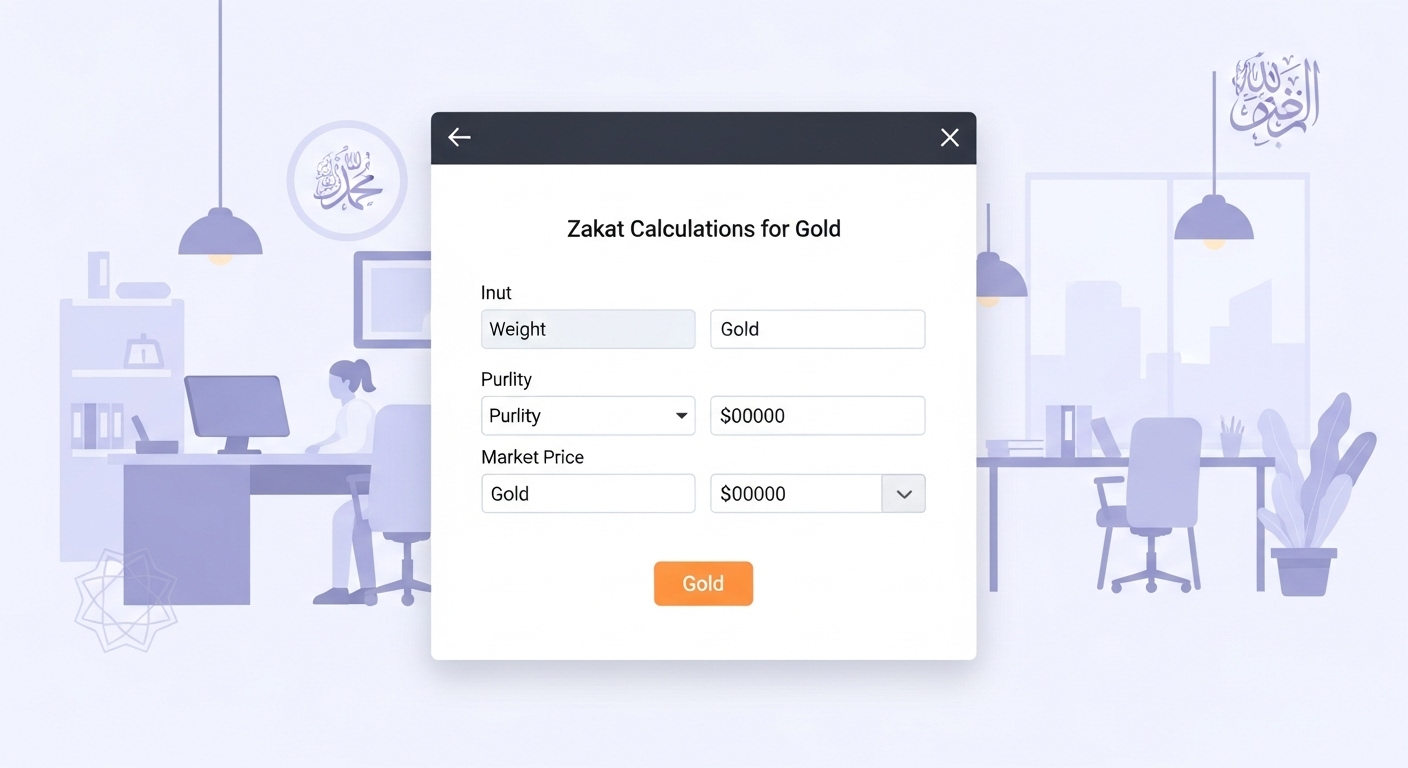
Managing financial obligations within the precious metals industry requires a unique blend of commercial precision and strict adherence to religious principles. For Muslim business owners and investors, wealth is not merely a tool for economic expansion; it carries a profound spiritual responsibility. Distributing a specific portion of accumulated wealth to those in need is a foundational practice, ensuring that capital circulates within the community rather than remaining entirely consolidated among a few entities.
However, translating this noble spiritual concept into precise mathematical execution across a massive retail showroom or a wholesale distribution network is incredibly complex. A jewelry store is not a static bank account. It is a highly dynamic environment where physical assets are constantly bought, sold, traded, and remanufactured. The baseline value of these assets shifts continuously alongside global commodity indices. Attempting to calculate religious financial dues using outdated administrative methods exposes business owners to severe risks—both spiritual and financial. Modernizing this workflow through advanced enterprise technology is the only reliable method to guarantee absolute compliance while protecting the company’s operational cash flow.
Also read: Gold for Gold: How to Legally Calculate Price Differences and VAT on Exchanges
The Core Mechanics of Islamic Wealth Distribution
Before exploring the technical solutions, it is essential to establish a firm understanding of the fundamental rules governing this obligation. The requirement to contribute 2.5% of qualifying wealth is a non-negotiable pillar for those who meet specific financial criteria. Unlike standard corporate taxes that are often levied on net profits or sales transactions, this contribution is assessed on the total accumulated value of the capital and inventory itself, provided it meets strict conditions.
Defining the Absolute Minimum Threshold
The obligation is not universally applied to every single gram of metal owned. It is only triggered when the total wealth reaches a specific minimum baseline, known as the Nisab.
For precious metals, Islamic jurisprudence has clearly defined this threshold. The Nisab is universally recognized as the equivalent of 85 grams of pure, 24-karat gold. If an individual’s or a business’s total qualifying inventory falls below this specific weight (or its equivalent cash value), they are completely exempt from the obligation for that period.
Understanding the Lunar Timeframe
Reaching the 85-gram threshold is only the first condition. The second mandatory requirement is the passage of time, specifically referred to as the Hawl
The wealth must remain in the owner’s possession, consistently above the minimum threshold, for one complete Islamic lunar year (approximately 354 days). This creates an immediate administrative challenge for modern corporations that operate their fiscal years, tax filings, and payroll systems entirely on the standard 365-day Gregorian calendar. Running two separate, overlapping calendars for different financial obligations requires meticulous record-keeping to ensure dates are not miscalculated.
How Do You Calculate the Threshold Across Different Karats?
One of the most significant complications in retail environments is that showrooms rarely stock only pure 24-karat items. The display cases are filled with diverse alloys—18-karat necklaces, 21-karat bridal sets, and 22-karat bangles. Because the 85-gram threshold is strictly based on pure gold, a store owner cannot simply place all their inventory on a scale and use the gross weight.
Every single item must be mathematically converted to its 24-karat equivalent before the final assessment can be made. The conversion relies on isolating the exact percentage of pure metal within the alloy.
| Karat Purity | Pure Gold Percentage | Conversion Formula Example (for a 100g item) | Equivalent 24k Weight |
|---|---|---|---|
| 24 Karat | 99.9% – 100% | 100g × (24 ÷ 24) | 100.00 grams |
| 22 Karat | 91.6% | 100g × (22 ÷ 24) | 91.66 grams |
| 21 Karat | 87.5% | 100g × (21 ÷ 24) | 87.50 grams |
| 18 Karat | 75.0% | 100g × (18 ÷ 24) | 75.00 grams |
If an individual privately owns 100 grams of 18k gold, the 75 grams of pure metal it contains falls below the 85-gram threshold. For a commercial store, the assessment works differently: trade inventory (Urud al-Tijarah) is measured by market value and combined with cash and receivables against the Nisab — so a showroom rarely falls below the threshold on metal weight alone. However, a retail store holds thousands of pieces across all these categories. Manually applying these fractional formulas to thousands of individual items is an administrative nightmare.
Where Do Traditional Accounting Methods Fall Short?
For decades, jewelers relied on pen, paper, and basic desktop calculators to manage these annual audits. Eventually, many transitioned to spreadsheet software like Excel. While spreadsheets offer basic automated arithmetic, they are entirely disconnected from the physical realities of the showroom and the volatility of the global market.
The Exhausting Nature of Manual Data Entry
Consider the physical process of a manual audit. At the end of the lunar year, the store manager must print out the entire stock list. They must go tray by tray, verifying the physical presence of each item, checking its gross weight, and manually subtracting the weight of any embedded diamonds, rubies, or zircon stones (as non-precious stones and diamonds have entirely different assessment rules and are generally excluded from the pure gold weight calculation).
Once the gross weight is verified and the stones are subtracted, the staff must apply the karat conversion formulas listed above. Doing this manually for three or four thousand distinct rings and bracelets takes days of uninterrupted labor, forcing the business to close its doors to customers or forcing staff to work exhausting overnight shifts.
The Threat of Constant Price Fluctuations
The most critical rule of this religious assessment is that the 2.5% contribution is based on the market value of the gold on the exact day the lunar year ends, not the price the gold was originally purchased for six months prior.
When relying on static spreadsheets, the accountant must manually search for the day’s global spot price, factor in the local currency exchange rate, and manually update the multiplier across all rows of data. If the market spikes violently during the afternoon of the assessment day, a static spreadsheet printed in the morning is immediately invalidated, resulting in a completely inaccurate final valuation. Zakat calculations demand precision to the gram — learn how to calculate gold price accurately with Daysum before your next zakat due date.
What Are the Financial Consequences of Human Error?
When dealing with mathematics this tedious, human error is completely unavoidable. A tired employee might accidentally multiply an 18-karat inventory batch by the 21-karat formula, or forget to subtract the heavy weight of the cubic zirconia stones from a massive bridal set.
- The Risk of Overpayment: If the inventory value is artificially inflated due to calculation errors (such as including the weight of heavy, non-qualifying stones), the business will pay out significantly more cash than is spiritually or legally required. This aggressively drains the company’s liquid capital, hindering its ability to purchase new stock.
- The Risk of Underpayment: Conversely, if assets are missed during a manual count, the final payment will fall short of the religious obligation. For a business owner who takes their faith seriously, this spiritual liability is a far heavier burden than any corporate penalty.
Moving Toward Complete Digital Transformation
Recognizing that traditional methods are unsustainable, high-performing enterprises have completely overhauled their financial infrastructure. They have replaced disjointed spreadsheets and paper ledgers with comprehensive digital ecosystems. By exploring exactly how to calculate zakat on gold using software, business leaders discover a streamlined workflow that removes friction, eliminates human calculation, and protects their operational liquidity.
Eliminating Errors with Automated Precision
The defining advantage of a specialized platform is its ability to treat every single piece of jewelry as a distinct, multi-layered data entity. When a new shipment arrives from the manufacturer, the receiving manager enters the item into the database. The system automatically separates the total gross weight into its core components: the exact weight of the 18k gold, the exact weight of the diamond, and the exact manufacturing labor cost.
Because the system already holds this segregated data, generating an assessment report requires zero manual math. The software automatically ignores the diamond weights, applies the karat conversion formulas in the background, and instantly produces the total pure 24-karat equivalent weight of the entire store’s inventory in a fraction of a second.
Why Is Live API Connectivity Non-Negotiable?
A digital database is only powerful if it reflects the current reality of the global economy. Premium platforms connect directly to international commodity exchanges via live Application Programming Interfaces (APIs).
When the precise date of the lunar year arrives, the store owner simply opens the assessment module. The system actively pulls the exact, up-to-the-minute global spot price for an ounce of gold, automatically applies the real-time currency conversion to Saudi Riyals, and multiplies it by the pure gold weight calculated previously. This guarantees that the final monetary valuation is mathematically flawless and perfectly aligned with the exact market conditions of the due date.
Choosing the Right Infrastructure for Your Showroom
The software market is flooded with generic retail point-of-sale systems that claim to handle jewelry businesses. However, attempting to force a generic supermarket software to calculate complex karat conversions and lunar calendar tracking will inevitably end in disaster.
Identifying Industry-Specific Capabilities
Decision-makers must prioritize platforms engineered exclusively for the precious metals sector. When choosing the right gold software, you must ensure the architecture natively understands the difference between raw gold assets, making charges, and non-qualifying gemstones.
The ideal platform acts as a unified hub. It should manage your daily customer sales, track your physical inventory via barcode scanners to prevent theft, and simultaneously maintain a separate, running background tally of your qualifying wealth based on the Islamic calendar, completely independent of your standard Gregorian tax accounting.
Seamless Integration with Enterprise Resource Planning
For expanding businesses managing multiple branches across different cities, a standalone application on a single computer is insufficient. These organizations require a cloud-based erp gold system that unifies the entire corporate network.
With an integrated ERP, the executive board can view the total qualifying wealth across all physical locations simultaneously. If a large quantity of gold is currently in transit between the Jeddah branch and the Riyadh headquarters, the system ensures that this moving inventory is accurately captured in the final assessment, ensuring nothing is double-counted or accidentally omitted.
Empowering the Workforce with Intuitive Interfaces
A common hesitation among business owners when considering a digital upgrade is the fear that the new technology will be too complicated for their staff to operate. Store managers are experts in customer service and jewelry design, not necessarily licensed accountants or software engineers.
Removing the Need for Deep Financial Expertise
The true brilliance of the best gold accounting software lies in its user experience. The complex algorithmic math, the API price fetching, and the fractional weight conversions all happen invisibly.
The user interface presented to the manager is remarkably clean and intuitive. Generating the annual compliance report is as simple as selecting the “Generate Assessment” button from a dropdown menu. The system produces a highly detailed, beautifully formatted document that clearly outlines the total gross weights, the deducted stone weights, the applied market rate, and the final 2.5% cash figure required for disbursement.
Facilitating Rapid Audits and Transparent Operations
This level of clarity is invaluable not only for internal peace of mind but also for external auditing. If the company works with a Sharia supervisory board or an external financial auditor to verify their charitable disbursements, handing them a stack of crossed-out notebooks creates endless frustration.
By learning to correctly use gold accounting software in stores, management can provide auditors with a pristine, digitally stamped report. Every single piece of jewelry that contributed to the final total can be traced back to its specific barcode and acquisition date, providing a level of transparency that completely satisfies even the most rigorous financial scrutiny.
Adopting specialized technology, such as the comprehensive solutions developed by Daysum, completely transforms how a jewelry enterprise manages its most critical obligations. By transferring the burden of complex mathematics and market tracking to an intelligent, automated system, business owners eliminate the risk of financial miscalculations. More importantly, they achieve absolute certainty that their spiritual obligations have been fulfilled with impeccable precision, allowing them to focus their energy entirely on expanding their brand and serving their clientele with total peace of mind.
Frequently Asked Questions
This is a nuanced area of Islamic jurisprudence, but generally, for commercial entities holding gold as trade inventory (Urud al-Tijarah), the assessment is based on the final market value of the goods, which typically includes the inherent value of the craftsmanship or making charge. Advanced software allows business owners to configure the calculation parameters based on the specific legal and religious rulings adopted by their corporate advisory board, ensuring the calculation aligns with their specific commercial intent.
Premium platforms are designed to segregate item components at the point of data entry. When a diamond ring is logged into inventory, the system records the gold weight and the diamond carat weight in separate data fields. When generating the annual report, the software's algorithm automatically strips away the weight and value of the diamonds (as personal diamonds do not carry the same 2.5% obligation as raw gold), ensuring the calculation is strictly based on the precious metal content.
If the precise due date falls on a Saturday or Sunday when global commodity trading desks are closed, the software is programmed to automatically pull the final closing spot price from the last active trading session (typically Friday evening). This ensures the valuation remains anchored to the most recent, officially verified market data rather than an arbitrary estimate.
Yes, this dual-calendar capability is a defining feature of top-tier platforms. The system operates on the standard Gregorian calendar for daily sales, employee payroll, and generating VAT invoices for government compliance. Simultaneously, it runs a dedicated module in the background anchored to the Umm al-Qura (Hijri) calendar, specifically tracking the Haul (lunar year) to trigger the correct assessment alerts without disrupting daily commercial operations.
Leading software providers host their infrastructure on enterprise-grade global servers (such as AWS or Google Cloud) that comply with rigorous international security standards like ISO 27001. All financial data, inventory valuations, and assessment reports are heavily encrypted both during transmission and while stored. Furthermore, role-based access control (RBAC) ensures that only the business owner or the chief financial officer can view or generate these sensitive reports, blocking access from standard floor staff.