In the contemporary corporate landscape, the efficiency of a Human Resources (HR) department is a key determinant of organizational success. As companies grow, the administrative overhead associated with managing a large workforce—tracking leave requests, handling salary advances, processing expense claims, and managing payroll inquiries—can easily overwhelm HR teams. When these processes remain anchored in manual paperwork, email chains, and disjointed spreadsheets, they not only create significant operational bottlenecks but also lead to employee dissatisfaction due to slow response times.
The paradigm shift towards digital transformation, particularly through the implementation of an advanced Employee portal, is fundamentally altering this reality. By decentralizing administrative tasks, organizations empower their staff, streamline communication, and allow HR professionals to shift their focus from repetitive data entry to strategic human capital management. Through robust integration within an Odoo HRMS ecosystem, companies can achieve unparalleled efficiency. This article explores how adopting a self-service culture reduces administrative burdens, accelerates request approvals, and fosters a transparent, engaged workforce.
1. The Bottleneck: The Heavy Admin Burden of Manual HR
The administrative burden placed on HR departments is often invisible, yet its impact on business growth is profound. When an employee wants to request a vacation, check their remaining leave balance, or apply for a salary advance, the traditional process typically looks like this: the employee submits a paper form or an email, the HR manager tracks it in a spreadsheet, the department head manually approves it, and finally, HR enters the data into the payroll system.
This workflow is a recipe for inefficiency for several reasons:
- Time-Consuming Approvals: Requests get stuck in inboxes, delayed by busy managers or miscommunication.
- Information Asymmetry: Employees spend valuable time emailing HR just to ask, “How many vacation days do I have left?”—a simple query that consumes the time of both the employee and the HR professional.
- High Probability of Error: Manual data entry across multiple systems leads to inconsistencies. A typo in a salary advance amount or an incorrectly recorded leave date can cause significant payroll errors, leading to trust issues.
- Lack of Transparency: Without a centralized Employee portal, workers feel disconnected from the HR process, unable to track the status of their own requests.
Organizations looking to break this cycle must adopt Employee Self-Service (ESS) systems that serve as the bridge between operational needs and strategic human resource management.
2. The Solution: The Employee Self-Service Portal
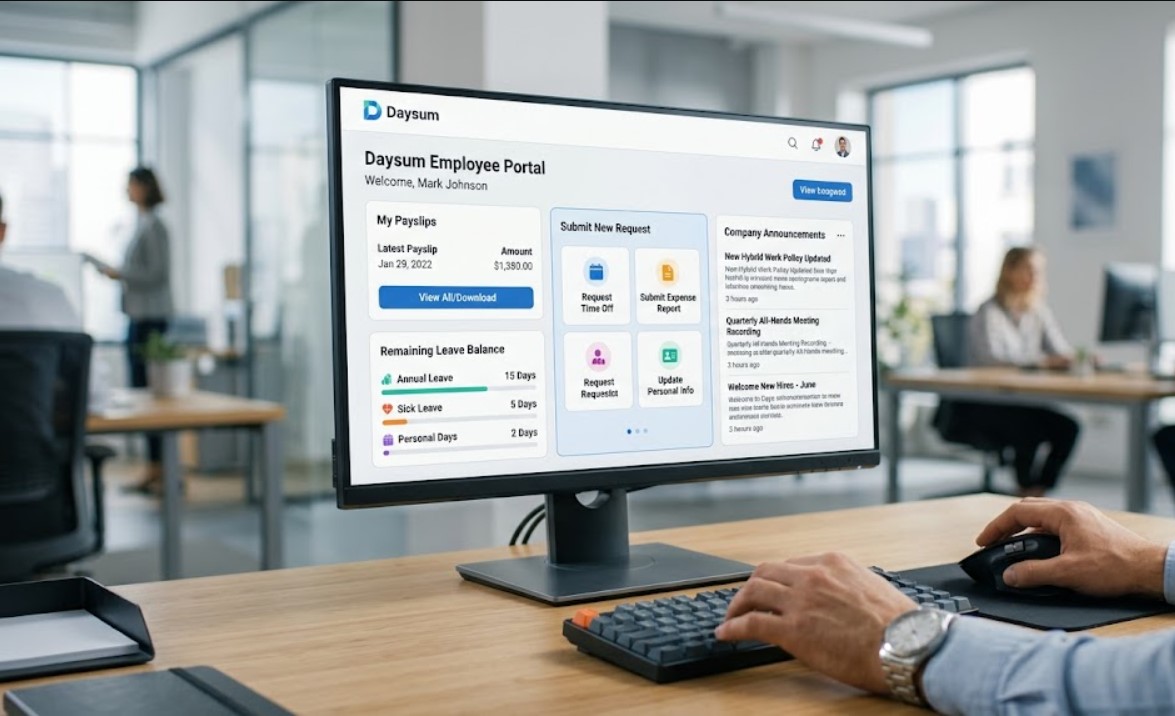
An Employee portal is more than just a digital request form; it is a comprehensive, mobile-responsive hub that places the power of HR management directly in the hands of the employee. Integrated deeply within an ERP environment like Odoo, it ensures that every request is automatically routed to the right stakeholder, validated against company policy, and synchronized with core systems like payroll and scheduling.
By leveraging Smartphones and web interfaces, employees can now submit their requests anytime, anywhere. Whether they are at home or on the office floor, they can interact with the system without needing to walk into an HR office or pick up the phone. This shift from “pulling” information from HR to “self-service” is the core of administrative efficiency.
Key Capabilities of the Portal
- Leaves and Vacations: Employees view their remaining quotas, select dates on a calendar, and submit requests that are validated by the system against leave policies.
- Financial Advances and Expenses: Staff can upload receipts for business expenses or request salary advances directly, with the workflow automatically flagging them for financial approval.
- Document Access: Pay slips, contract copies, and tax documents are accessible at the click of a button, reducing the load on HR to print or email sensitive information.
HR Process Comparison: Manual vs. Automated ESS
| Process | Manual HR Request Management | Automated ESS Portal (Odoo) |
| Submission | Paper forms or ad-hoc emails. | Standardized digital forms via mobile/web. |
| Validation | HR checks balance sheets/policies manually. | System validates eligibility in real-time. |
| Approval | Physical signatures or slow email chains. | Instant, automated routing to managers. |
| Data Entry | HR re-types data into Payroll/Accounting. | Synchronized automatically with Payroll/ERP. |
3. Speeding Up Approvals: The Workflow Automation Engine
One of the most significant advantages of an Odoo-integrated HRMS is the Approvals engine. Manual request processing often dies in the “In-tray” of a manager who is traveling or caught in meetings. An integrated system solves this by implementing structured workflows.
When an employee submits a leave request, the portal immediately triggers a notification to the direct manager. If the manager is unavailable, the system can be configured to escalate the request or allow for secondary delegation. This ensures that the process moves forward without stalling.
Furthermore, the integration of attendance systems ensures that requests are contextual. For example, if an employee requests a day off, the manager can see if there is enough staff scheduled for that day before hitting “approve.” This visibility prevents scheduling conflicts and operational gaps, which is a major pain point in B2B environments where staffing levels are critical.
4. Enhancing Data Accuracy and Reducing HR Admin Time
For a Human resources department, time is their most valuable asset. When an HR professional spends 40% of their day responding to basic inquiries and processing simple leaves, the business suffers. The strategic value of an Employee portal lies in how it redistributes this time.
Automated Payroll Integration
Because the portal is an extension of the ERP, it natively feeds into the payroll module. When an advance is approved, it automatically reflects as a deduction in the next payroll cycle. This eliminates the “re-entry” phase, which is where 90% of payroll errors occur. Data is captured at the source—by the employee—and is verified by the workflow, leaving no room for manual tampering.
Empowerment and Engagement
Beyond efficiency, there is a psychological benefit. Employees feel empowered when they have control over their administrative life. Transparency builds trust. When an employee knows they can get an answer or a document in seconds via their portal, the relationship between the worker and the organization strengthens. HR becomes a partner in the employee experience, rather than an administrative gatekeeper.
As discussed in various Odoo ERP system software implementation projects, the success of such portals often hinges on the quality of the user interface (UI) and the depth of integration with existing business processes.
5. Mobile Accessibility: HR in Your Pocket
In a globalized workforce, mobility is non-negotiable. The modern Employee portal must be mobile-first. By making HR services accessible via Smartphones, companies meet the workforce where they are.
Consider the B2B warehouse or factory floor: workers do not have access to laptops. Providing them with a simple, easy-to-use mobile portal allows them to interact with HR just as effectively as a corporate office worker. They can check their shifts, submit Leaves, or access information on company benefits while on the go. For enterprises operating in these specialized sectors, scaling operations requires aligning workforce efficiency with advanced stock control;Optimizing your precious metals inventory becomes seamless when you leverage Benefits Of Using Gold And Jewelry Management Software.
This accessibility also improves the reach of HR policies. Updates to safety protocols or company announcements can be pushed to the mobile portal, ensuring that everyone receives the same information simultaneously, which is critical for compliance and maintaining high corporate standards.
The Strategic Impact of ESS Portals
| Perspective | Traditional HR Role | HR Role with ESS Portal |
| Task Focus | Administrative data entry and filing. | Strategic planning and employee development. |
| Request Speed | Days (due to manual routing). | Minutes (due to automated routing). |
| Accuracy | Prone to human data entry errors. | High (direct user input, auto-validated). |
| Employee Value | Low; often feels disconnected. | High; feels empowered and trusted. |
6. Implementing ESS: A Path to Strategic HR
The implementation of an ESS portal is a critical step in the digital transformation of a company. It is not just about installing software; it is about changing how the organization communicates.
To successfully implement an ESS portal in an Odoo environment:
- Map your workflows: Clearly define who approves what, and under what conditions.
- Define user permissions: Ensure that only the right people see the right data.
- Train the workforce: Change management is key. Show employees how to use the portal to their advantage (e.g., getting quicker answers, faster approvals).
- Monitor usage: Use the analytics provided by the portal to see which processes still cause friction and optimize them accordingly.
By following these steps, HR teams can transform their administrative burden into a streamlined asset.
Frequently Asked Questions (FAQs)
In manual systems, employee data (such as salary information or personal documents) is often scattered across emails or physical paper, making it highly vulnerable to unauthorized access. An ESS portal within an integrated HRMS ensures that data is stored in a centralized, encrypted, and secure database. Access is controlled via robust Role-Based Access Control (RBAC), ensuring that only the employee and authorized HR personnel can view sensitive information.
Yes. Modern Odoo-based ESS portals are highly flexible. You can set up multi-level approval workflows where a request goes from a team lead to a manager, and if necessary, to an HR director. The system allows for conditional logic—for example, if a vacation request is for less than three days, it may only need a team lead's approval, but anything longer requires departmental head validation.
No, a well-designed portal should be intuitive and mimic the user experience of popular consumer applications. Odoo’s interface is designed with a focus on usability. Most employees can pick up the system with minimal guidance. The benefit of "faster approvals" is an immediate incentive for employees to adopt the system, as they quickly see their requests processed faster than the old manual methods.
The ESS portal is not an isolated module; it is part of an integrated HRMS ecosystem. When an employee submits an expense claim or a leave request through the portal and it receives final approval, the system automatically tags that transaction for the payroll period. This eliminates the need for HR to manually reconcile requests at the end of the month, as the data is already computed, verified, and ready for payroll processing.