For jewelry retailers managing high-value assets, knowing exactly what is in the display case, what is in the vault, and what has been sold is not just an operational requirement; it is the foundation of business security. Historically, jewelers have relied on manual counting to reconcile physical stock with accounting records. However, as stores scale and transaction volumes increase, these archaic methods become unsustainable.
Modern Saudi retail environments demand technological precision. Implementing an RFID Jewelry Inventory system, particularly one integrated directly into a specialized platform like Daysum, fundamentally restructures how a store handles its assets. By combining radio frequency identification with advanced software, store owners can achieve absolute stock visibility, eliminating discrepancies and protecting their capital. This guide explores the mechanics of this technology, the financial impact of adopting it, and how it directly addresses the vulnerabilities of manual operations.
The Financial Drain of Manual Audit Pains
Before understanding the solution, store owners must quantify the exact cost of the problem. A traditional gold shop audit is a grueling process that damages both employee morale and the store’s bottom line.
Time and Labor Exhaustion
A typical jewelry boutique may hold anywhere from 2,000 to 10,000 individual pieces. Conducting a manual stock audit requires staff to physically touch every single item, read the tiny tag, and check it off a printed ledger or scan it individually with a basic barcode scanner.
- Store Closures: To prevent inventory movement during the count, stores are often forced to conduct audits after hours, paying overtime rates, or closing the store entirely for a day, resulting in lost sales.
- The “Double-Check” Requirement: Because manual counting is inherently flawed by human fatigue, any discrepancy found at the end of the audit requires the staff to start over and recount the entire section to find the missing item.
- Operational Blind Spots: Because manual audits are so painful and expensive, store managers perform them rarely—perhaps once a quarter or twice a year. This creates massive blind spots; if a piece goes missing in January, management might not discover the loss until the June audit.
Limitations of the Standard Barcode Jewelry System
While a standard barcode jewelry system is a step up from pen and paper, it still requires line-of-sight. The employee must pick up the ring, find the tag, aim the barcode scanner, and pull the trigger. If a display tray holds 100 rings, the employee must perform this action 100 times. It is slow, tedious, and still prone to omission if two tags are stuck together.
Revolutionizing how retailers manage high-value assets requires adopting an advanced RFID Jewelry Inventory Tracking system to replace outdated manual counting methods. This innovative technology enables instant stock audits by scanning hundreds of tagged items in seconds, drastically reducing discrepancies and saving countless administrative hours. By seamlessly integrating these instant scans into a comprehensive ERP platform, business owners can maintain absolute control over their inventory and secure their profit margins.
How RFID Works in Precious Metals Retail
Radio Frequency Identification (RFID) solves the line-of-sight limitation. It allows a user to scan hundreds of items simultaneously from a distance. For a system managed by Daysum ERP, this technology transforms days of work into seconds.
The Technical Mechanics
An RFID system consists of three primary components working in unison:
- The RFID Tag: Each piece of jewelry is fitted with a specialized tag containing a microchip and a tiny antenna. This microchip stores a unique identification number tied directly to the item’s profile in the Daysum database.
- The RFID Reader: A handheld or fixed device that emits radio waves. When the tag is within range of these waves, the tag’s antenna powers the microchip, which then broadcasts its unique ID back to the reader.
- The Software Engine: The reader transmits the collected IDs to the central Daysum ERP. The software instantly compares the physical tags detected against the expected inventory list in the database.
Executing a Minute-Long Audit
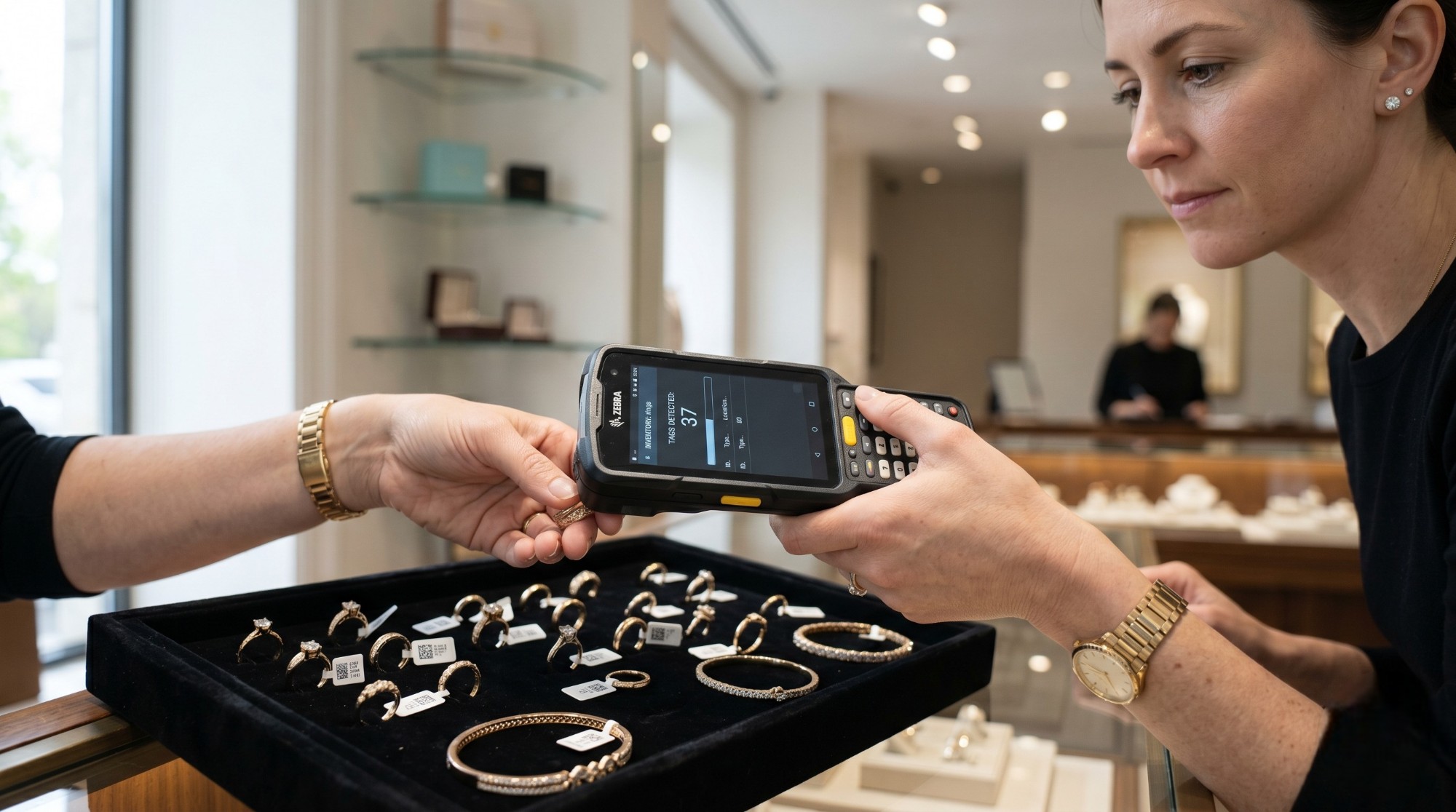
With an RFID Jewelry Inventory setup, the audit process changes drastically. A manager simply opens the audit module on their tablet, picks up the handheld RFID reader, and slowly waves it over the display cases.
The reader captures up to 500 tags per second. As the manager walks the floor, the screen turns green for verified items. If the database expects 450 items in a specific showcase and the reader only detects 449, the system instantly flags the discrepancy, isolating the missing piece by its exact SKU, description, and last known location. An entire store can be audited with 100% accuracy in under ten minutes, allowing management to perform daily audits without disrupting retail operations. RFID tagging turns a full jewelry inventory count from a full-day showroom closure into a walkthrough that takes minutes. Ask Daysum how RFID integrates with your existing display cases.
Smart Barcode Design and Tagging Strategy
Implementing RFID does not mean abandoning visual identification. The most secure methodology uses a hybrid approach, combining the radio chip with a smart barcode design.
Dual-Technology Tags
Jewelry tags are notoriously small because they must not obscure the beauty of the piece. A high-quality RFID tag manufactured for precious metals incorporates both technologies:
- The RFID Inlay: Hidden inside the plastic or paper layer of the tag.
- The Printed Surface: Displays the human-readable text (Weight, Carat, Price) and a scannable 2D barcode (QR code or DataMatrix).
Why the Barcode Remains Necessary
Even with RFID handling the bulk stock audit, the physical barcode serves critical functions at the point of sale.
- Precision at Checkout: When a customer buys a single ring, the cashier uses a standard barcode scanner to process that specific transaction. This prevents the system from accidentally scanning a neighboring ring via RFID during the checkout process.
- Customer Transparency: The printed barcode and pricing provide the buyer with visual confirmation of the item’s specifications.
- Backup Protocol: If the RFID microchip is physically crushed or damaged by a careless customer, the printed barcode ensures the item can still be identified and sold without issuing a completely new tag.
Daysum provides specialized label printing software that encodes the RFID chip and prints the visual barcode simultaneously in one seamless step during inventory intake.
Anti-Theft Benefits and Financial Security
The primary ROI of an RFID system lies in theft prevention and extreme accountability. High-value retail environments face threats from both external shoplifters and internal shrinkage.
Internal Accountability and “Blind” Audits
When employees know the store is audited daily, internal theft drops to near zero. A robust ERP like Daysum allows management to enforce “blind audits.”
In a blind audit, the employee scanning the floor with the RFID reader is not shown the expected database quantity. They merely scan the cases and submit the read data to the server. The server then calculates the variance and reports it directly to upper management. This prevents staff from manually adjusting numbers to hide missing stock.
Real-Time Movement Tracking
Fixed RFID readers can be installed at critical chokepoints in the store, such as the doorway between the stockroom and the showroom. If a piece of jewelry passes through this doorway, the system logs the exact timestamp. If an item goes missing, management can pull the audit log and pinpoint exactly when it left the vault, narrowing down the security camera footage required to investigate the incident.
Table: Comparing Inventory Security Methods
|
Security Aspect |
Standard Manual/Barcode System |
Integrated RFID Jewelry System |
|
Audit Frequency |
Monthly or Annually (due to high labor cost). |
Daily or per-shift (takes under 10 minutes). |
|
Theft Detection Time |
Weeks or months after the incident. |
Same-day detection. |
|
Staff Accountability |
Low; easy to blame paperwork errors. |
High; precise digital logs track all movement. |
|
Search Functionality |
Requires opening every box and tray manually. |
“Geiger counter” mode locates hidden items via radio signal. |
Transforming Saudi Jewelry Operations
For Saudi jewelers operating under strict ZATCA regulations and managing millions of riyals in inventory, guessing is not a viable business strategy. Transitioning from manual checks to an automated RFID workflow powered by Daysum ensures that every gram of gold and every carat of diamond is accounted for. The technology recovers lost administrative hours, prevents financial shrinkage, and allows staff to focus purely on customer service and sales generation. Optimizing your precious metals inventory becomes seamless when you leverage The Secret Behind Jewelry Stores Profit Increase.
Frequently Asked Questions (FAQ)
Standard RFID tags suffer from interference when placed directly on metal. However, specialized jewelry RFID tags are engineered with an insulating layer or a specific antenna design (called a "flag tag") that projects the antenna away from the metal surface, ensuring a perfect read rate even in densely packed trays of gold rings.
Handheld RFID readers feature a "Geiger counter" or "Find" mode. You select the missing SKU in the Daysum mobile app and begin walking. As you get closer to the hidden tag (perhaps it slipped behind a drawer or under a counter), the scanner beeps faster and louder, guiding you directly to the physical location of the misplaced item.
Yes. Implementing this system requires a one-time project to replace your old barcode tags with the new dual-technology RFID tags. While this requires an initial labor investment, the subsequent daily time savings cover the cost of the project within the first few months of operation.
RFID tags do cost more than blank paper labels because they contain a microchip and antenna. However, the cost per tag is negligible when compared to the value of the precious metals they protect and the thousands of dollars saved in labor costs during stocktakes.
No. The RFID tag only stores a randomized SKU number, not customer data. Furthermore, standard retail practice involves removing the tag and placing the jewelry in a presentation box at the point of sale. The tag is then discarded or destroyed by the cashier.
The handheld RFID reader can store the scanned data locally in its internal memory. Once the local network connection to your Daysum server is restored, the scanner automatically syncs the audit data, ensuring you can complete your daily checks regardless of temporary internet outages.