In the rapidly evolving retail landscape of 2026, selecting the right technology to run your precious metals and gemstone business is one of the most consequential decisions you will ever make as an enterprise leader. The days of managing a luxury boutique or a high-volume wholesale operation on fragmented spreadsheets, generic accounting tools, or outdated legacy programs are entirely over. Upgrading your technological infrastructure is no longer a luxury; it is a fundamental prerequisite for survival, growth, and strict government compliance. However, navigating the software market can be overwhelmingly complex, and the defining moment of your purchasing journey always boils down to one critical event: the Jewelry Software Demo.
A software demonstration should never be treated as a passive, cinematic presentation where a salesperson simply clicks through a slideshow of attractive screens. It must be a rigorous, hands-on stress test of the platform’s capabilities against your most complex, real-world operational challenges. Whether you are conducting a high-speed Silver POS trial or a meticulous Diamond ERP review, knowing exactly what to ask for, what to test, and what to scrutinize is the only way to separate marketing promises from functional reality.
In this comprehensive, deep-dive guide, we will arm you with the ultimate framework for evaluating your next tech partner. We will explore exactly why demos matter, outline the precise diamond tracking queries you must raise, explain how to conduct a brutal speed test for silver retail, and detail the exact reporting features that will transform your business. By utilizing the provided Checklist and posing the right Critical questions, you will guarantee that your investment drives unprecedented profitability and absolute operational control.
1. Why Demos Matter: Moving Beyond the Marketing Hype
When a software vendor presents their product on a website, they highlight the absolute best-case scenarios. The dashboards look flawless, the colors are vibrant, and the workflows seem completely effortless. However, your retail environment is not a best-case scenario. Your showroom is chaotic, your inventory is incredibly complex, and your cashiers operate under immense pressure during peak holiday seasons. The primary purpose of a demo is to drag the software out of its pristine marketing environment and drop it into the messy reality of your daily operations.
Scrutinizing the UI/UX (User Interface and User Experience)
The single biggest barrier to successful software adoption in any retail environment is employee resistance. If the system is difficult to learn, visually cluttered, or requires ten clicks to perform a simple task, your staff will hate using it, leading to a massive spike in human error.
During the demo, you must ruthlessly evaluate the UI/UX. Ask the presenter to hand over the mouse (or grant you remote control access if the demo is virtual). Try to navigate the system yourself. Is it intuitive? Does the layout make logical sense to someone who understands jewelry, rather than someone who just understands coding? A premium jewelry ERP software will feature a touch-friendly, modern interface that a new cashier can master in a matter of hours, drastically reducing your onboarding and training costs.
Testing the Depth of Integrations
A standalone system is a dead system. Your jewelry business requires a symphony of interconnected hardware and software to function properly. During the demo, demand to see live Integrations in action.
- Ask to see how the software directly interfaces with digital weighing scales. Does the weight populate on the screen instantly, or does the cashier have to type it in manually?
- Demand a demonstration of how the system communicates with your local tax authority (such as ZATCA in Saudi Arabia). Does it generate the required cryptographic XML files and Phase 2 QR codes natively, or does it rely on unstable third-party plugins?
- Check the payment terminal integrations to ensure that credit card transactions push the exact monetary value directly to the card reader, eliminating manual entry mistakes.
“A software demo is not a presentation; it is an interrogation. If the system cannot handle your hardest operational questions in a controlled environment, it will absolutely collapse on your busiest retail day.”
2. Diamond Tracking Queries: The Ultimate Diamond ERP Review
Gold is sold primarily by its weight and the daily spot market price. Diamonds, however, are a completely different retail entity. Every single diamond is a unique asset with distinct characteristics, varying market values, and specific international certifications. Conducting a thorough Diamond ERP review during your demonstration is absolutely critical if you deal in high jewelry or bridal sets.
Demanding Proof of Unique Serialization
During the demo, do not let the salesperson simply show you a generic “Diamond Ring” inventory item. You must ask them to demonstrate how the system handles unique serialization and the 4Cs (Cut, Color, Clarity, Carat).
Give the demonstrator a hypothetical scenario: “I have two identical 18k white gold settings, but one holds a 1.0-carat VVS1 diamond, and the other holds a 1.0-carat VS2 diamond. Show me how your system differentiates them, tracks their specific procurement costs, and prevents my cashier from selling the VVS1 at the VS2 price.”
The system must be capable of generating a unique serial number or barcode for every individual stone or finished piece. Furthermore, sophisticated inventory management solutions should allow you to digitally attach international grading certificates (like GIA, HRD, or IGI) directly to the item’s profile, allowing the sales consultant to pull up the certificate on a tablet to show the customer during the sales pitch.
Critical Questions for Diamond Management
To ensure the software is truly built for high-end jewelers, present these Critical questions to the vendor during the demo:
- Memo and Consignment Tracking: “Show me exactly how I receive diamonds on consignment from a wholesale dealer. How does the system track my financial liability to the dealer if the stone is sold, versus if it is returned?”
- Custom Bespoke Orders: “If a customer wants to design a custom ring, show me how I can digitally ‘reserve’ a specific loose diamond from my vault, link it to the customer’s 3D CAD design, and remove it from my available retail stock.”
- Stone Upgrades: “If a customer returns a 0.5-carat diamond ring they bought last year to upgrade to a 1.0-carat ring, how does the system calculate the trade-in value, handle the return of the old stone into inventory, and issue the new invoice seamlessly?”
Diamond Software Capability Checklist
| Feature Requirement | What to Ask the Vendor to Demonstrate | Why It Is Crucial for Your Business |
| Digital Certificate Linking | “Show me how to attach and view a GIA PDF on the POS screen.” | Builds immediate consumer trust and justifies premium pricing. |
| Component Level Tracking | “Separate the cost of the center stone from the gold setting.” | Ensures accurate gross margin calculations and Zakat/Tax valuations. |
| Consignment Management | “Process a sale for a stone I do not own yet (Memo stone).” | Automates vendor payouts and prevents paying for unsold inventory. |
| Bespoke Reservation | “Allocate a specific loose diamond to a custom work order.” | Prevents the catastrophic error of double-selling a promised stone. |
When you sit down for any ERP demo, ask the vendor to show — not describe — how a GIA certificate attaches to a diamond item and displays on the POS screen during a sale. Request that exact demo from Daysum at no cost.
3. Silver POS Speed Test: Handling High-Volume Retail
While diamond sales are characterized by low transaction volume and extremely high value, silver retail is the exact opposite. Silver jewelry and accessories represent a high-volume, fast-paced retail environment. Whether it is a holiday rush, Mother’s Day, or the wedding season, a silver shop might process hundreds of transactions in a single evening. Therefore, scheduling a rigorous Silver POS trial within your demo is non-negotiable.
The Simulated Rush Hour Stress Test
During the Jewelry Software Demo, you must simulate a chaotic retail scenario. Tell the vendor: “It is the night before Eid. I have ten customers in line. I need to see how fast your system can clear a queue.”
Ask the vendor to perform a rapid-fire checkout process using a barcode scanner. You are looking for absolute fluidity. The point of sale system must scan the item, instantly calculate the VAT, accept a split payment (e.g., half cash, half credit card), and generate the e-invoice in less than 10 seconds. If the system lags, freezes, or requires the cashier to click through multiple unnecessary confirmation screens, it will create massive bottlenecks in your store, leading to abandoned purchases and furious customers.
Evaluating Frictionless Returns and Exchanges
Silver items are frequently purchased as gifts, which guarantees a high volume of returns and size exchanges in the days following a major holiday. In legacy software, processing a return is an administrative nightmare that holds up the checkout line.
Challenge the demonstrator with this scenario: “A customer wants to return a silver bracelet they bought yesterday, but they want to exchange it for a more expensive silver necklace. Walk me through this.”
The ideal software should allow the cashier to scan the original receipt, instantly pull up the transaction, hit a single “Return” button to put the bracelet back into inventory, automatically generate the legally required Credit Note, and apply the credited amount directly to the new necklace on a single, unified screen.
4. Reporting Features: Demanding Data-Driven Business Intelligence
A modern jewelry business cannot be steered by intuition; it must be navigated by hard data. The final and arguably most important phase of your Jewelry Software Demo should be entirely dedicated to analytics, dashboards, and Management reports.
Moving Beyond Basic Sales Totals
If the vendor shows you a report that simply states, “You sold 100,000 SAR today,” tell them that is not enough. You need granular, actionable business intelligence. You need a system that acts as a Chief Financial Officer.
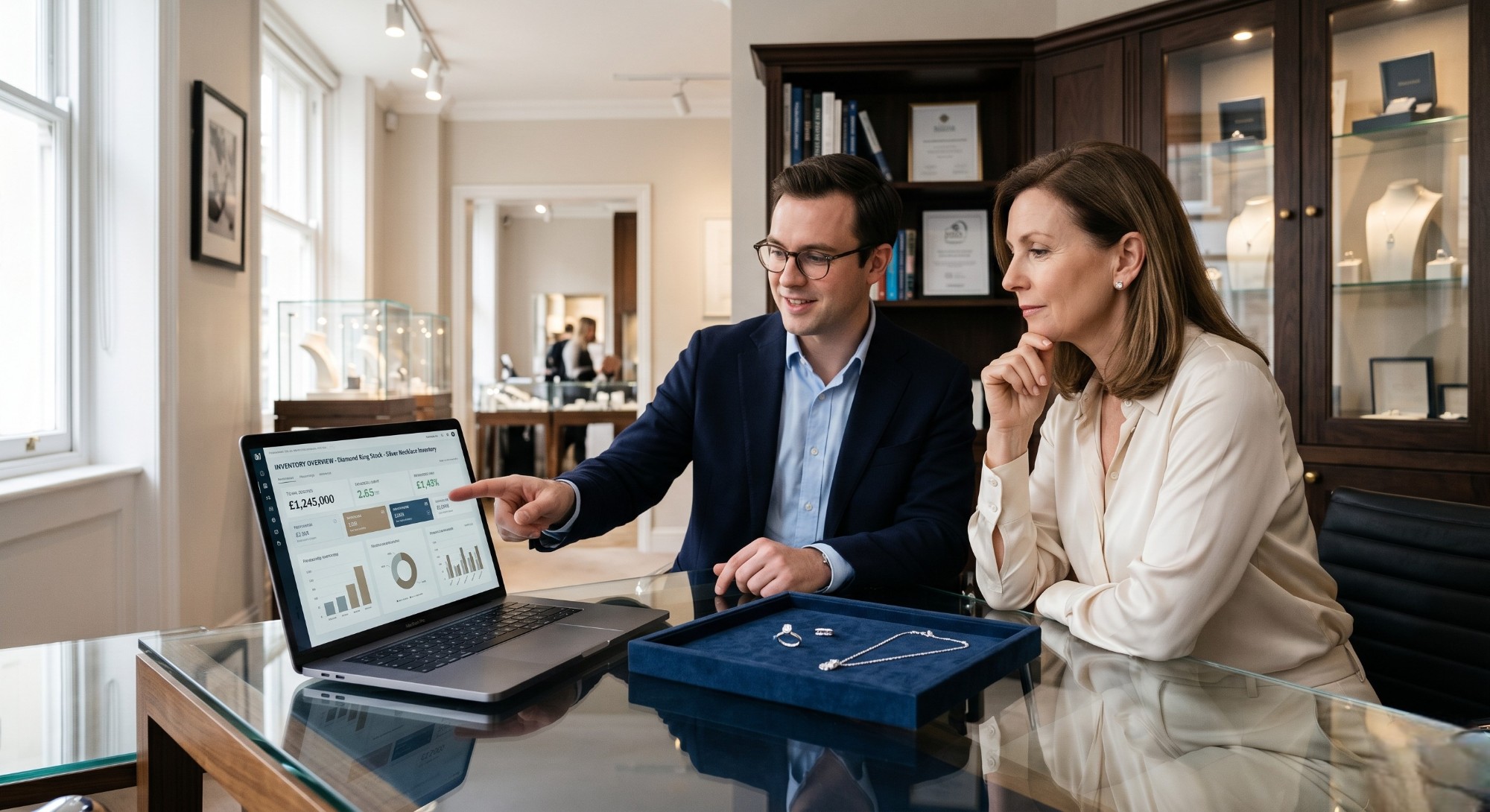
Ask the demonstrator to show you how the integrated accounting ERP software handles multi-dimensional profitability analysis.
- Gross Margin Return on Investment (GMROI): “Show me a report that identifies which specific vendor’s jewelry yields the highest profit margin relative to how fast it sells.”
- Dead Stock Identification: “Generate a heat-map report showing me every piece of inventory that has not moved in over 365 days, so I can plan a targeted liquidation sale or a meltdown.”
- Salesperson Performance: “Show me a breakdown of my staff, not just by total sales volume, but by who has the highest Average Transaction Value (ATV) and who consistently up-sells the most profitable items.”
The Importance of Automated Tax and Financial Reporting
In highly regulated markets, generating accurate tax reports manually is a dangerous game. Ask the vendor to demonstrate their end-of-month financial closing procedures. The system must be capable of generating flawless VAT return reports that perfectly match the electronic invoices submitted to the government. Furthermore, for jewelry retailers in the Middle East, the system must provide instant inventory valuation reports based on the live market price of gold, allowing your accounting team to calculate Zakat obligations accurately without shutting down the store for a week-long manual audit. Implementing the right billing strategy is much easier when you read about How E Invoicing Helps Ensure Compliance With ZATCA Regulations.
The Ultimate Demo Evaluation Checklist
| Demo Phase | Evaluation Criteria | Pass / Fail Indicator |
| General UI/UX | Is the interface modern, intuitive, and touch-friendly? | Pass: Can be learned in hours. Fail: Looks like a 1990s spreadsheet. |
| POS Speed | Can it process a complex sale with split payments in under 15 seconds? | Pass: Instant processing. Fail: Lagging screens and spinning wheels. |
| Inventory Depth | Does it handle 4C tracking, unique serials, and live gold weights? | Pass: Total granularity. Fail: Treats a diamond like a generic t-shirt. |
| ZATCA Compliance | Is Phase 2 e-invoicing native, silent, and instantaneous? | Pass: Native XML/QR generation. Fail: Relies on clunky external bridges. |
| Analytics & BI | Can it generate real-time profitability and dead-stock reports? | Pass: Dynamic, visual dashboards. Fail: Basic, static Excel exports only. |
Conclusion: Taking Command of Your Digital Future
Selecting the software that will run the entirety of your precious metals enterprise is a monumental task. If you approach the Jewelry Software Demo passively, you risk shackling your business to an outdated, restrictive platform that will stifle your growth and expose you to severe regulatory risks. However, by taking command of the demonstration, demanding rigorous stress tests, and asking uncompromising questions, you transform the procurement process into a massive strategic advantage.
Remember, you are not just buying a cash register; you are investing in the central nervous system of your entire business. By utilizing the comprehensive Checklist provided, ensuring flawless Integrations, conducting a brutal Silver POS trial, and executing a deep Diamond ERP review, you will easily identify the software capable of scaling your vision. Demand excellence, scrutinize the Management reports, and partner with a technology provider like Daysum that is truly capable of driving your digital transformation in retail forward into 2026 and beyond.
Frequently Asked Questions (FAQs)
Yes, whenever possible, this is highly recommended. Sending the vendor a small sample of your actual inventory data (e.g., an Excel sheet with a few diamond certificates, gold weights, and making charges) forces them to configure the demo to your specific reality. If they can easily ingest your messy real-world data and show you how it looks inside their system, it proves the software’s flexibility and data migration capabilities.
Do not take their verbal word for it. Ask the demonstrator to process a live (or sandbox) sale and generate the receipt on the screen. Take out your smartphone, open the official government ZATCA application, and scan the QR code displayed on their software. If the app successfully reads the cryptographic data and validates the seller’s VAT number, timestamp, and totals, you have definitive proof that their integration is legitimate and compliant.
The critical question is: "Where is your support team physically located, and what are your guaranteed Service Level Agreement (SLA) response times during my peak retail hours?" You must ensure that you will not be routed to a foreign call center that operates in a different time zone. You need local experts who understand the jewelry industry and can resolve emergency POS issues instantly, especially during critical evening shifts or holiday weekends.
This is a vital workflow to test during your demo. Ask the vendor to show you the "Trade-In" or "Gold Exchange" module. The system must allow the cashier to intake the customer's old gold, evaluate it based on its karat purity, convert it to a 24k equivalent, value it at the current buying rate, and seamlessly deduct that value from the price of the new jewelry being purchased, all while keeping the accounting ledgers perfectly balanced.
In 2026, yes, cloud-based architecture is essential. On-premise servers are expensive to maintain, vulnerable to physical damage or theft, and highly restrictive. A true cloud-based ERP allows you to monitor your global sales from your smartphone, ensures enterprise-grade cybersecurity encryption, and guarantees that your system automatically receives all necessary governmental tax updates and feature enhancements without requiring manual, disruptive installations.