In the highly specialized sector of wholesale gold and jewelry manufacturing (B2B), gold is never viewed merely as a product sitting on a shelf. Instead, it is treated as a highly liquid, high-value commercial asset and a critical component of a corporation’s working capital. Whether you are managing a massive production facility, a network of wholesale distribution centers, or multi-branch jewelry showrooms across the Middle East, the absolute precision of your inventory is non-negotiable. A discrepancy of even a few grams can translate into massive financial losses, severely impacting the company’s balance sheet and operational integrity.
For decades, the nightmare of “inventory shortages” has plagued Chief Financial Officers (CFOs) and operations managers. Relying on manual ledgers, disconnected spreadsheets, and human memory leaves an unacceptable margin for error. In today’s fast-paced corporate environment, adopting comprehensive Gold management software integrated with smart barcode technology is no longer a luxury—it is a fundamental necessity for survival and growth. In this extensive guide, we will explore how smart barcode systems revolutionize the tracking of commercial gold assets, enforce absolute control over corporate inventory, and permanently eliminate the risks of shortages and operational discrepancies.
1. The High Stakes of B2B Jewelry Inventory Management
Managing inventory in the gold wholesale and manufacturing sectors is fundamentally different from any other retail or commercial industry. Gold is a highly volatile commercial asset whose value fluctuates continuously based on global market screens. Furthermore, the B2B supply chain involves complex transformations: from raw gold bullion to meticulously crafted jewelry, which is then distributed in massive batches to secondary wholesalers or retail chains.
Relying on manual data entry for Jewelry inventory introduces a cascade of operational vulnerabilities that threaten the stability of the enterprise:
- Weight Recording Errors: In the wholesale gold trade, transactions are calculated down to the milligram. A single typographical error when manually recording the Gold weight during a transfer can instantly create a phantom shortage or a false surplus, completely distorting the financial valuation of the company’s assets.
- Sluggish Operational Cycles: Receiving and dispatching large commercial quantities (often measured in kilograms) to B2B clients takes hours of sorting, weighing, and manual matching. This sluggishness delays invoicing and ties up valuable capital.
- Paralyzing Audit Processes: Traditional auditing requires shutting down warehouses or showrooms for days to physically count items. For a wholesale business, pausing operations means missing out on critical commercial opportunities.
- Severe Security Loopholes: Without precise, item-level tracking, companies cannot pinpoint exactly where or when an asset went missing. This lack of visibility makes it nearly impossible to hold specific departments or personnel accountable, leaving the door wide open for internal shrinkage.
To overcome these deeply rooted challenges, leading enterprises are abandoning spreadsheets in favor of robust, industry-specific digital platforms. For a deeper understanding of how to select the right platform for your corporate needs, explore our comprehensive guide to choosing the best gold management software.
2. The Mechanics of Smart Gold Barcode Printing
The definitive solution to tightening control over high-value assets lies in the automation of identification and tracking. This meticulous process begins the moment a manufacturing facility receives raw materials or a wholesale distributor accepts a new batch of manufactured goods. The system immediately generates a unique identifier (Unique ID) for every single item or homogenous batch.
The physical execution of Gold barcode printing is a highly specialized technical process. Because jewelry pieces are inherently small and delicate, businesses utilize specialized thermal transfer printers. These printers produce incredibly small, highly durable tags made from specialized synthetic materials. These tags are designed to withstand extreme conditions, including exposure to the harsh ultrasonic cleaning chemicals and polishing compounds routinely used in the gold trade, ensuring the barcode remains perfectly legible throughout the item’s entire lifecycle.
What Data Does a B2B Smart Barcode Hold?
In a sophisticated B2B ecosystem, a barcode is not merely a random string of numbers. It acts as an encrypted micro-database that communicates directly with the central Gold management software. When scanned, the system instantly retrieves:
- The Unique Serial Number: This prevents any possibility of item duplication or the fraudulent swapping of a high-value piece for a lower-value lookalike.
- The Exact Theoretical Weight: Recorded in grams and milligrams based on the final manufacturing quality control check.
- The Karat/Purity: Essential for segregating assets in financial ledgers and calculating exact material value.
- Making Charges (Labor Costs): Crucial for B2B invoicing, as wholesale transactions separate the cost of the raw gold from the manufacturing labor for accurate tax application.
- Vendor and Batch Origins: Vital for tracking production quality, managing bulk B2B returns, and analyzing supplier performance.
Since accurate barcode data forms the foundation of compliant corporate accounting, bridging the gap between inventory and invoicing is critical. Implementing the right billing strategy is much easier when you read about Difference Between E Invoices And Traditional Invoices.
Traditional Inventory Management vs. Smart Barcode Systems
Traditional Inventory Management vs. Smart Barcode Systems
| Operational Metric | Traditional Management (Spreadsheets/Manual) | Smart Barcode System (Digital ERP) | Direct Impact on B2B Capital |
| Speed of Auditing | Takes days; requires complete warehouse shutdown. | Completed in minutes using wireless handheld scanners. | Ensures continuous commercial operations and steady cash flow. |
| Data Accuracy | Highly prone to human error (up to 5% variance). | 100% accuracy; perfect match between physical and digital records. | Protects corporate assets from critical financial misvaluation. |
| Tracing Shortages | Nearly impossible; discrepancies are found as a bulk loss at month-end. | Instant identification of the exact missing piece, time, and responsible employee. | Enforces strict accountability and immediately halts internal shrinkage. |
| Balance Updates | Delayed manual entries cause severe operational bottlenecks. | Real-time, instant updates the second a tag is scanned during transfer. | Optimizes the working capital cycle and prevents stock stagnation. |
3. Seamless Integration with POS and Gold Scales
The true genius of an advanced enterprise system does not stop at printing durable labels; it lies in the system’s ability to create a secure, closed-loop workflow by integrating physical hardware with cloud-based software.
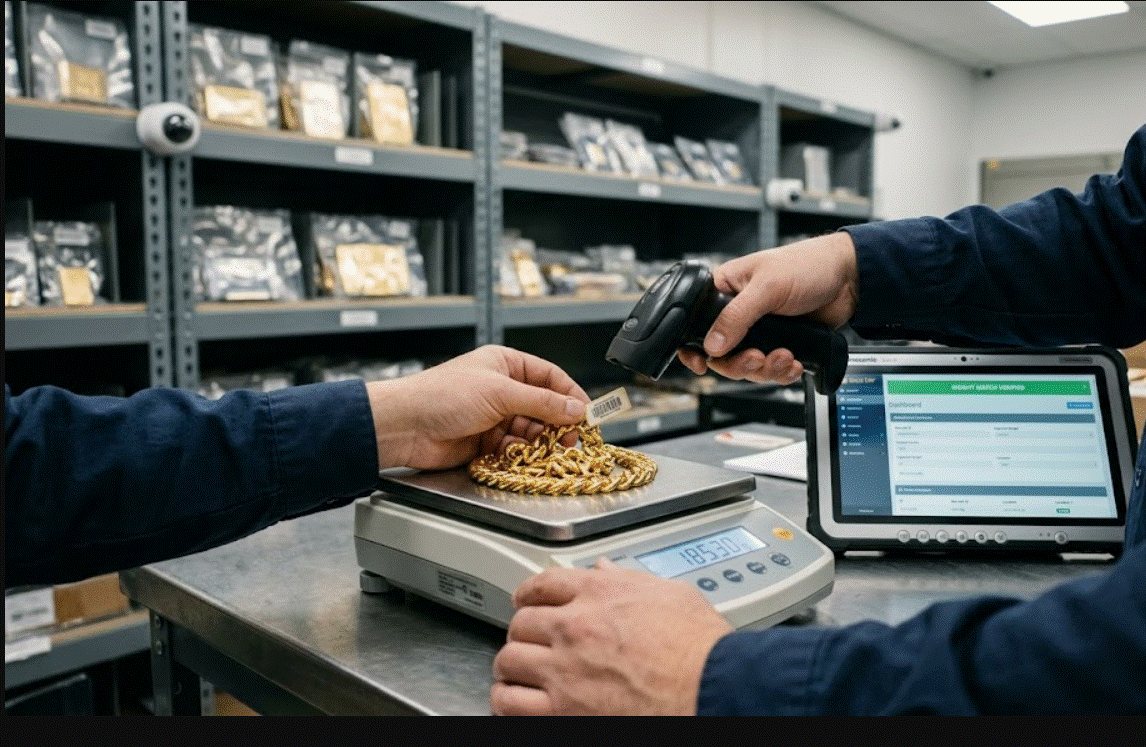
In a B2B wholesale environment, where gold is transferred in massive quantities, the Gold scale is the ultimate arbiter of truth. A professional Gold management software creates a direct, unalterable communication line between the highly sensitive electronic gold scale and the POS (Point of Sale) or warehouse management terminal via COM or USB ports.
The Automated Hardware Workflow:
- The warehouse manager or wholesale sales representative scans the barcode tag on the jewelry piece or gold batch.
- The software instantly recognizes the item and retrieves its “theoretical weight” stored securely in the central database.
- The employee places the physical item on the integrated Gold scale.
- The system reads the “actual live weight” directly from the scale and automatically compares it to the theoretical weight from the barcode.
- The Security Checkpoint: If the weights match perfectly, the system approves the transfer or sale. If there is any discrepancy—even a fraction of a milligram caused by excessive polishing or potential tampering—the system immediately blocks the transaction. It will require high-level managerial override to proceed.
This impenetrable workflow ensures that keyboard data entry errors are completely eradicated, closing the largest loophole that leads to financial discrepancies. To discover how these workflows optimize massive distribution networks, read our insights on best practices in gold inventory management for retailers and wholesalers.
4. Ironclad Traceability and Theft Prevention
High-value corporate assets demand proactive, aggressive security strategies. Relying solely on security cameras in a manufacturing plant or a wholesale distribution center is an outdated, reactive approach. True security requires an invisible, digital fortress.
By implementing smart barcodes, Inventory tracking transforms from a mundane administrative task into a formidable security apparatus dedicated to absolute Theft prevention:
- Item-Level Traceability: Top management can trace the exact journey of any gold asset. From its creation on the factory floor, to its transit in an armored vehicle, to its placement in a wholesale branch vault, and finally to its bulk sale to a B2B client. Every movement is logged with a timestamp and a user ID.
- Dynamic Cycle Counting: Instead of waiting for a grueling annual audit, the barcode system empowers managers to conduct random, rapid cycle counts of specific high-value sections (e.g., the 21-karat wholesale sets) in minutes. This continuous auditing detects anomalies immediately, severely narrowing the window of opportunity for internal embezzlement.
- Securing Internal Transit: When transferring kilos of gold between corporate branches, the system generates a digital transit barcode document. The receiving branch cannot add the assets to their vault until every single piece is scanned and verified against the transit document. Any unscanned item remains the legal responsibility of the transit custodian.
For a comprehensive look at how modern cloud infrastructure secures your assets against both physical and digital threats, review our detailed analysis on how to prevent jewelry theft with an ERP system.
The Financial and Operational ROI of Barcoded Inventory
| Strategic Benefit | Software Mechanism Achieving the Benefit | Impact on the Corporate Balance Sheet |
| Minimizing Shrinkage | Mandatory synchronization between the barcode scanner and the Gold scale for every movement. | Protects fixed and current assets, directly increasing net profit margins. |
| Accurate Financial Valuation | Linking each barcode to exact manufacturing labor costs and live global gold prices. | Generates pristine, audit-ready financial statements free of valuation distortions. |
| Accelerating Capital Turnover | Automating stock counts and speeding up the reception of massive B2B wholesale shipments. | Increases corporate liquidity by drastically reducing the time assets sit idle. |
| External Audit Compliance | Providing an immutable, timestamped Audit Trail for every transaction on the system. | Effortlessly passes stringent external financial audits and governmental tax inspections. |
5. Scaling B2B Operations with Centralized Control
As a corporation expands its footprint—opening new manufacturing facilities or international wholesale branches—the complexity of managing Jewelry inventory grows exponentially. The greatest challenge for the executive board is unifying data from dozens of geographical locations into one coherent, real-time dashboard.
Advanced Gold management software powered by barcode and RFID (Radio Frequency Identification) technologies allows for mass scanning of assets. A single warehouse auditor using a wireless handheld scanner can walk through a wholesale vault, capturing hundreds of barcodes in seconds. The system instantly cross-references these scans with the centralized cloud database. Any discrepancies—whether a missing piece or an unregistered surplus—flash red on the Chief Operating Officer’s screen at the headquarters, enabling instant, decisive corrective action.
To achieve this level of centralized mastery, corporations must rely on a highly flexible, robust platform like Odoo Community. Generic ERP systems fail because they treat gold like standard retail merchandise. Through expert implementation by a verified integrator like Daysum, Odoo Community is deeply localized to handle the unique financial, weight-based, and multi-currency demands of the B2B gold sector. To see how this digital transformation elevates entire organizations, read about how gold inventory systems transform jewelry stores in KSA.
Conclusion
In the high-stakes arena of wholesale gold distribution and manufacturing, where a minor error is measured in thousands of dollars, relying on human memory or manual ledgers is a reckless gamble with corporate capital. Transitioning to a sophisticated Gold management software driven by smart barcode technology is the ultimate defense mechanism for your commercial assets. By physically integrating barcode scanners with the Gold scale, enforcing real-time Inventory tracking, and deploying aggressive Theft prevention protocols, B2B enterprises guarantee absolute precision in their asset ledgers. This digital transformation permanently eradicates the nightmare of inventory shortages, streamlines massive wholesale operations, and provides the transparent, secure foundation necessary for aggressive corporate expansion.
Frequently Asked Questions (FAQs)
In a B2B setting, gold is treated as a highly liquid corporate asset and raw material, not just a consumer product. Inventory management requires separating the pure gold weight from the manufacturing labor (making charges) for accurate wholesale invoicing and tax compliance. Furthermore, the total inventory valuation must be dynamically updated daily based on global market fluctuations to ensure accurate corporate financial reporting.
Yes. Gold barcode printing utilizes specialized thermal transfer technology to create tags from durable synthetic polymers. These specific tags are engineered to resist tearing, fading, and degradation when exposed to the intense heat, ultrasonic cleaners, and abrasive polishing chemicals routinely used in the gold supply chain, ensuring the barcode remains scannable for the lifetime of the product.
This is the core security feature of an integrated system. When the barcode scanner and the Gold scale are linked to the software, scanning the barcode pulls the "theoretical weight" from the database, while the scale provides the "live actual weight." The software logic strictly dictates that if there is any mismatch between these two values, the transaction at the POS or transfer terminal is instantly blocked, preventing any weight-swapping fraud.
A smart barcode system creates an immutable "Audit Trail" within the ERP. Every single interaction with an asset—whether it’s a barcode generation, a warehouse transfer, or a B2B wholesale invoice—is permanently logged with the exact time, location, and the specific user's ID. This level of granular, unalterable data provides external auditors and tax authorities with complete confidence in the integrity of the corporation's asset valuation and inventory reports.