In the complex, fast-paced ecosystem of modern Business-to-Business (B2B) commerce, the financial ledger is the ultimate source of truth. Every transaction, whether it involves the procurement of raw materials, the distribution of manufactured goods, or the rendering of professional corporate services, culminates in a single, critical document: the invoice. Historically, managing these documents involved overflowing filing cabinets, fragile hard drives, and fragmented local servers. However, as the volume of trade expands, the traditional methods of Saving invoices have evolved from a mere administrative annoyance into a severe corporate liability.
Imagine this scenario: A regulatory authority announces an unexpected, comprehensive Tax audit encompassing the last three fiscal years of your operations. Your finance team scrambles, digging through physical archives and searching local desktop folders, only to discover that critical invoices are missing, damaged by hardware failure, or accidentally deleted. This is the nightmare of lost invoices—a situation that leads not only to immense operational panic but also to crippling financial penalties and severe reputational damage.
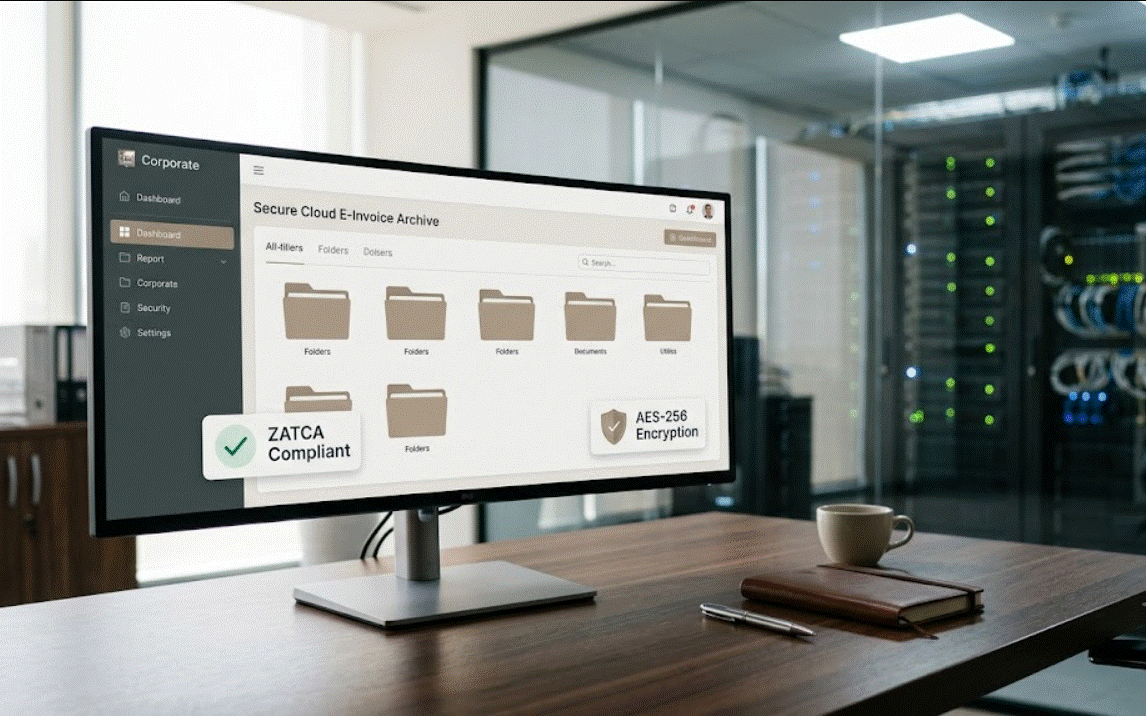
The definitive solution to this modern corporate vulnerability is robust E-invoice archiving. By transitioning your financial records to a highly secure, centralized digital infrastructure, you transform a fragile paper trail into an indestructible digital fortress. In this extensive guide, we will explore the transformative power of Cloud e-invoicing, delve into the rigorous data security measures that protect your ledgers, examine how these systems guarantee seamless compliance with authorities like ZATCA, and demonstrate why migrating to the Cloud is the most critical investment for your company’s financial safety.
1. The Perils of Traditional Invoice Storage: A Recipe for Disaster
For decades, enterprises relied on physical paper storage or basic local servers for Saving invoices. In a contemporary B2B environment, where thousands of transactions are processed weekly, these antiquated methods present unacceptable risks to business continuity.
The Vulnerability of Physical and Local Storage
Paper invoices are inherently fragile. They can be destroyed by fire, water damage, or simply fade over time (especially thermal paper receipts). But even businesses that digitize their invoices by saving PDFs to a local computer’s hard drive are living on borrowed time. Local hardware is susceptible to sudden crashes, voltage spikes, and catastrophic hard drive failures. If a local server crashes without a rigorous, off-site backup protocol, years of financial history can vanish in an instant.
The Cybersecurity Threat
Beyond physical damage, local servers are prime targets for malicious cyber-attacks. Ransomware attacks, which encrypt a company’s local files and demand massive payments for their release, have devastated countless businesses. When your financial ledgers are held hostage, your ability to collect receivables, pay vendors, and prove tax compliance is completely paralyzed.
To understand the critical differences between relying on vulnerable local networks versus robust modern infrastructures, it is highly recommended to review the detailed comparison of desktop applications vs cloud-based solutions. This comparison highlights why local storage is no longer viable for enterprise-level financial security.
2. What is Cloud E-Invoice Archiving?
E-invoice archiving is not merely scanning a piece of paper and saving it as an image file. In the era of digital transformation, it refers to the systematic, automated, and secure storage of structured electronic invoice data (such as XML or JSON files, alongside human-readable PDFs) in a centralized, remote server environment known as the Cloud.
The Paradigm Shift to Cloud E-Invoicing
When a business adopts Cloud e-invoicing, the entire lifecycle of the invoice becomes automated. The moment a transaction is finalized—whether through an integrated ERP system or a Point of Sale (POS) terminal—the invoice is instantly transmitted to the cloud archive. This environment is hosted on enterprise-grade servers managed by top-tier data centers that offer 99.99% uptime.
By archiving invoices in the Cloud, businesses achieve geographical independence. A Chief Financial Officer (CFO) traveling internationally can access the exact same real-time financial ledger as the accounting team working at the corporate headquarters in Riyadh or Dubai. The data is continuously synchronized, automatically backed up across multiple distinct geographic locations, and shielded by layers of advanced cybersecurity protocols.
Traditional Storage vs. Cloud E-Invoice Archiving
| Evaluation Metric | Traditional Storage (Paper / Local Servers) | Secure Cloud E-invoice archiving | Strategic Value for B2B Enterprises |
| Disaster Recovery | High risk of permanent data loss due to hardware failure, fire, or theft. | Automated, redundant backups across multiple global data centers. | Guarantees business continuity; financial records survive any physical disaster. |
| Data Security | Vulnerable to local ransomware, unauthorized physical access, and theft. | Protected by military-grade Encryption, firewalls, and continuous monitoring. | Shields highly sensitive corporate financial data from cybercriminals and internal leaks. |
| Accessibility | Requires physical presence at the office or complex, slow VPN connections. | Instant access from any device, anywhere in the world via secure web portals. | Empowers remote executive decision-making and seamless global financial management. |
| Storage Costs | High physical real estate costs, server maintenance, and IT staff salaries. | Scalable, pay-as-you-go subscription models with zero hardware maintenance. | Drastically reduces IT overhead, converting heavy capital expenditures into predictable operating expenses. |
3. ZATCA Compliance and the Legal Imperative of Digital Archiving
In the Middle East, particularly within the Kingdom of Saudi Arabia, digital archiving is no longer a best practice; it is a strict, unavoidable legal mandate. The Zakat, Tax and Customs Authority (ZATCA) has implemented one of the most rigorous and technologically advanced electronic invoicing frameworks in the world.
The Mandate for Immutable Records
Under the ZATCA guidelines (Phase 1 and Phase 2 Integration), businesses are legally required to generate, transmit, and archive their electronic invoices in a highly specific format. More importantly, the law mandates that these electronic records must be retained safely for several years (typically six years or more, depending on specific commercial regulations).
The archived invoice cannot be altered, tampered with, or deleted. It must contain its original Cryptographic Stamp, the generated Universally Unique Identifier (UUID), and the specific QR code. If a company fails to produce these exact, unaltered digital files during a governmental inspection, they face compounding financial penalties that can devastate their profit margins.
By utilizing a certified cloud archiving solution, companies ensure that their Saving invoices protocols are natively compliant with these regulations. The system acts as a digital vault, freezing the invoice in its legally approved state the millisecond it is generated. To grasp the full scope of these legal requirements and how to prepare your enterprise, you must explore everything related to e-invoicing in Saudi Arabia.
4. Surviving the Tax Audit: The Power of Instant Data Retrieval
The phrase “Tax audit” is enough to strike fear into the hearts of even the most seasoned accounting professionals. During an audit, governmental inspectors demand absolute transparency, requiring the company to substantiate specific VAT claims, verify massive B2B transactions, and prove the legitimacy of input and output taxes spanning several years.
The Agony of Manual Audits
In a non-cloud environment, a Tax audit paralyzes the finance department. Accountants must manually sift through thousands of physical folders or poorly organized local hard drives to find specific documents from years past. If an inspector requests invoice number “INV-2023-08945,” finding it could take hours or days. This delay not only frustrates the auditors, leading to deeper, more aggressive scrutiny, but it also halts the company’s daily financial operations.
Instant Data Retrieval: The Cloud Advantage
With secure Cloud e-invoicing and archiving, a Tax audit transforms from a crisis into a calm, routine procedure. Advanced archiving platforms are equipped with powerful, multifaceted search engines. The concept of Data retrieval becomes instantaneous.
If an auditor requests a specific batch of invoices, the CFO simply inputs parameters into the cloud dashboard. They can filter by:
- Specific date ranges (e.g., Q1 2024).
- The exact B2B client’s VAT registration number.
- The unique invoice UUID or sequential document number.
- Specific product categories or total transaction amounts.
Within three seconds, the system retrieves the exact, unalterable digital files, complete with all cryptographic stamps. This flawless, immediate Data retrieval projects an image of absolute corporate professionalism and compliance, often leading to faster, smoother, and penalty-free audit resolutions. For insights into how this precision builds trust with both governments and stakeholders, read about enhancing financial transparency and credibility.
5. Advanced Encryption and Zero-Trust Data Security
For B2B enterprises, financial data is highly confidential. Invoices contain exact pricing strategies, raw material costs, client lists, and discount matrices. If this data falls into the hands of competitors or malicious actors, the commercial damage is catastrophic. Therefore, the primary hesitation executives have regarding the Cloud is a question of security. How can you be sure your data is safe when it is not stored in your own building?
The answer lies in the deployment of state-of-the-art Encryption and Zero-Trust security architectures provided by elite cloud archiving platforms.
Military-Grade Encryption Protocols
When you utilize a premium E-invoice archiving system, your data is never stored in plain text. It is protected by AES-256 (Advanced Encryption Standard), the same cryptographic algorithm utilized by global financial institutions and military organizations.
- Encryption at Rest: When your invoices are sitting in the cloud servers, they are encrypted. Even if a hacker managed to breach the physical data center and steal the server’s hard drives, the files would be completely indecipherable without the unique decryption keys.
- Encryption in Transit: When an invoice travels from your company’s ERP system over the internet to the cloud archive, it is protected by TLS/SSL (Transport Layer Security) tunnels. This prevents cybercriminals from intercepting or “sniffing” the data as it moves across the web.
Granular Access Controls and Immutable Logs
Security is not just about keeping external hackers out; it is also about preventing internal data breaches. A secure cloud archive employs Role-Based Access Control (RBAC). This means that a junior accountant might only have permission to view invoices they created, while the CFO has access to the entire archive. Furthermore, every single action taken within the archive—every login, every search, every document downloaded—is recorded in an immutable audit log. You always know exactly who accessed what data and when.
To delve deeper into how top-tier providers guarantee the sanctity of your financial data, we strongly encourage reviewing the specific protocols surrounding e-invoicing security and privacy.
Core Data Security Features and Their B2B Value
| Cloud Security Feature | Technical Mechanism | Strategic Reassurance for CFOs & Business Owners |
| End-to-End Encryption | AES-256 encryption at rest and TLS/SSL encryption in transit. | Absolute assurance that financial ledgers cannot be read, stolen, or weaponized by competitors or hackers. |
| Role-Based Access Control (RBAC) | Restricting data visibility based strictly on an employee’s verified job title and clearance level. | Prevents internal data leaks, ensuring that sensitive B2B pricing matrices remain strictly confidential to top management. |
| Immutable Audit Trails | A tamper-proof background log that records the timestamp and IP address of every user action. | Provides total accountability and proves to Tax audit inspectors that the records have never been maliciously altered. |
| Geographic Redundancy | Simultaneously copying data to multiple physically separated Tier-3 or Tier-4 data centers. | Guarantees that even if a catastrophic event destroys one data center, your financial history remains 100% intact and instantly available. |
6. The Synergy of ERP Integration: Why Standalone Archiving Isn’t Enough
While having a secure cloud archive is crucial, the method by which invoices reach that archive determines your operational efficiency. If your accounting team has to manually upload PDFs into a separate cloud folder at the end of each day, you are still suffering from administrative friction and the potential for human error.
The ultimate corporate solution is seamless integration. When your E-invoice archiving is natively built into your centralized Enterprise Resource Planning (ERP) software (such as Odoo Community implemented by Daysum), the entire process becomes invisible and automatic.
As soon as a sales representative confirms a B2B order, or a cashier closes a transaction at the POS, the ERP automatically generates the compliant tax invoice, routes it through the ZATCA portal for clearance, and instantly deposits the final, stamped digital document into the secure cloud archive. There is zero manual handling. This integration ensures that your archive is always perfectly synchronized with your live accounting ledgers, eliminating discrepancies and allowing your finance team to focus purely on strategic financial analysis and corporate growth, rather than tedious document management.For retail businesses dealing with high-value goods, connecting these secure financial workflows with specialized endpoints is essential; Optimizing your precious metals inventory becomes seamless when you leverage Best Silver Shop POS System.
Conclusion
The era of paper filing cabinets and vulnerable local servers is definitively over. In today’s heavily regulated and highly digitized business environment, the loss of financial documents is a catastrophic failure that no enterprise can afford. Embracing Cloud e-invoicing and migrating to a secure E-invoice archiving system is the ultimate strategic maneuver to protect your business. By harnessing the power of the Cloud and advanced Encryption, you guarantee the absolute security and privacy of your sensitive B2B trade data. Furthermore, you ensure total compliance with stringent government mandates like ZATCA, and transform the previously terrifying prospect of a Tax audit into a swift, stress-free process thanks to instantaneous Data retrieval. Investing in an integrated, cloud-based archiving ecosystem is not just about Saving invoices—it is about securing your company’s legacy, protecting its capital, and ensuring its unhindered growth in the digital age.
Frequently Asked Questions (FAQs)
Yes, absolutely. In fact, tax authorities like ZATCA in Saudi Arabia mandate electronic archiving over physical paper. As long as the Cloud e-invoicing solution retains the invoice in its original, tamper-proof electronic format (usually XML/JSON with the embedded cryptographic stamps and QR codes), it is fully recognized and preferred during a Tax audit due to its unalterable nature and ease of verification.
The Cloud is exponentially more secure than local office servers. Enterprise cloud providers invest billions in cybersecurity, employing teams of top-tier security experts, utilizing military-grade AES-256 Encryption, and housing servers in heavily guarded, climate-controlled facilities. A local office server is highly vulnerable to physical theft, fires, power surges, and sophisticated ransomware attacks that local IT teams simply do not have the resources to repel.
While an internet connection is required to access cloud archives, your data is never lost during an outage. Furthermore, advanced ERP systems with offline capabilities will continue to generate and locally cache invoices during an outage. The millisecond your internet connection is restored, the system automatically pushes the cached invoices to the secure cloud archive, ensuring zero data loss and uninterrupted compliance.
Time is money, especially in the finance department. When an auditor or an internal financial controller requests a specific set of invoices from three years ago, manual retrieval can consume days of billable accounting hours, delaying other critical financial tasks. Instant Data retrieval via cloud search filters turns a multi-day administrative chore into a 5-second task. Furthermore, responding instantly to a Tax audit prevents the costly fines associated with delayed submissions or lost documentation.